Why the Future of Work Is Remote

Far Coder Team
Mon May 18 2026
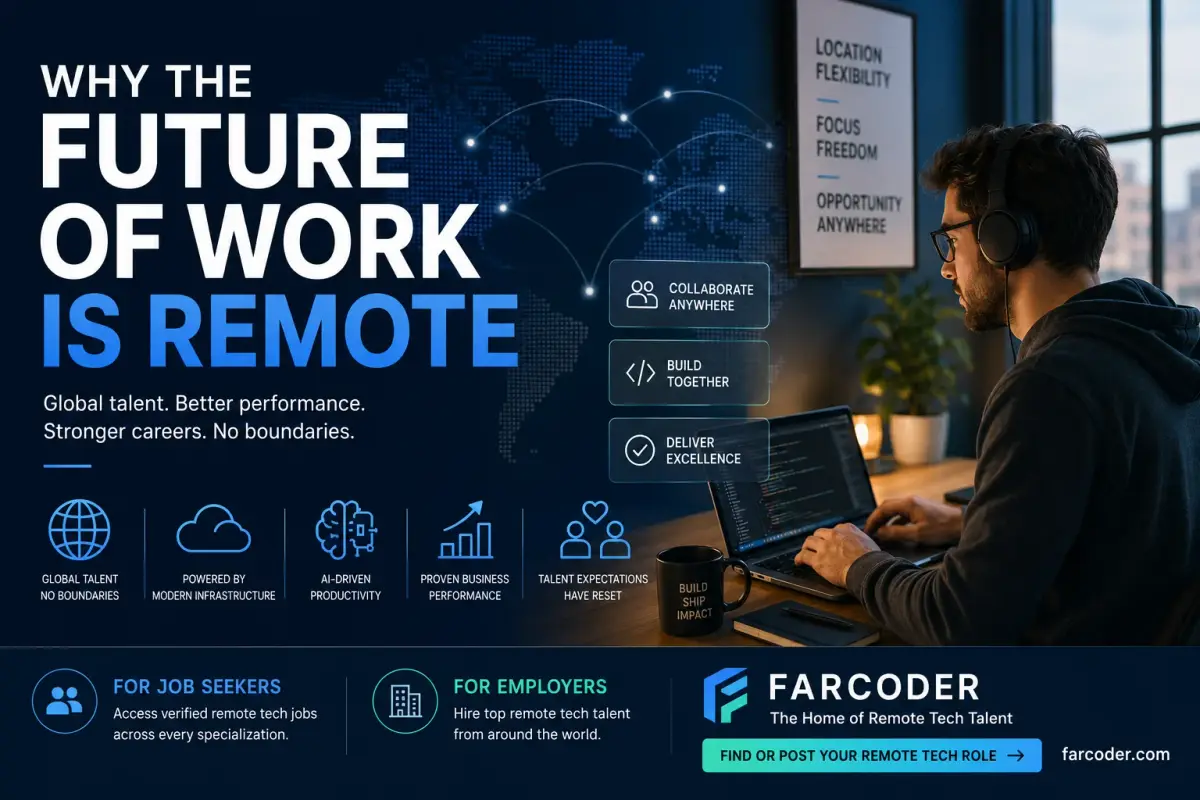
Remote work is no longer an emergency measure or a temporary perk, it is the structural reality of how the global technology industry hires, builds products, and operates teams in 2026. The question is no longer whether remote work will last. It has lasted. The question now is which professionals and employers are building the skills, systems, and strategies to lead in a remote-first world, and which are still waiting for an office to return that will not come back. This guide covers why the future of work is remote, what forces are making that shift permanent, what it means for tech professionals at every career stage, and what employers need to do to compete for the best distributed talent.
The future of work is remote because the combination of global communication infrastructure, distributed collaboration tools, AI-assisted productivity, a permanently shifted talent expectation, and demonstrated business performance has made remote work structurally superior to office-based work for the majority of knowledge work, and the technology industry has led and will continue to lead that shift.
Remote work is not a trend created by a pandemic. It is the endpoint of a trajectory that began when broadband internet made distributed collaboration technically feasible, accelerated when cloud computing made it operationally reliable, and was compressed from a twenty-year transition into a five-year reality by the events of 2020 through 2022. What the pandemic did was not create remote work, it validated it at scale, forced millions of organisations to prove it worked, and permanently reset employee expectations about where and how professional work happens.
The technology industry was remote-first before the pandemic normalised it for the broader economy. GitHub, Automattic, Basecamp, HashiCorp, and hundreds of other tech companies had built fully distributed workforces years before 2020. They did not pivot to remote work under pressure, they demonstrated for a decade what distributed-first companies could build. The rest of the industry took note, and the talent market responded accordingly.
The Forces Making Remote Work Permanent
Infrastructure Has Caught Up With Ambition
The technical infrastructure required to make remote work as productive as, and in many cases more productive than, office work is now fully mature, globally available, and continuously improving.
Ten years ago, remote work was limited by video call reliability, file-sharing latency, and the absence of real-time collaborative tools. Those limitations no longer exist at any meaningful scale. Fibre internet reaches the majority of knowledge workers in developed markets. Video conferencing is stable, high-definition, and nearly frictionless. Cloud-based development environments, collaborative code editors, async video tools, and AI-assisted productivity software have eliminated the last technical objections to distributed work.
The infrastructure argument against remote work, that teams cannot collaborate effectively without physical proximity, has been empirically disproven at scale. Teams at Shopify, GitLab, Stripe, Cloudflare, and thousands of other distributed tech companies ship products, manage incidents, conduct design reviews, and make architectural decisions entirely without sharing a building. The tools that enable this are not experimental. They are the standard operating environment of the global tech industry.
Talent Has Permanently Reset Its Expectations
The single most powerful force sustaining remote work as the future is that the global talent pool, particularly in technology, has reset its career expectations around location flexibility, and those expectations will not reverse.
Surveys of software developers, designers, DevOps engineers, and cybersecurity professionals consistently show that location flexibility ranks among the top three considerations in evaluating new job opportunities, behind compensation and role scope, and ahead of company prestige and benefits packages. Candidates who experienced remote work and performed well in it have no rational incentive to accept less flexibility in future roles.
This is not a generational preference that will shift as the workforce ages. It is a rational response to demonstrated evidence: remote workers report higher job satisfaction, better work-life integration, lower commute-driven stress, and in many cases higher productivity in their own evaluation of their output. The talent market has run the experiment and returned a verdict.
Employers who require full-time office attendance for tech roles are now competing for a significantly smaller candidate pool than employers who offer remote or remote-flexible work. That competitive disadvantage compounds over time as the strongest candidates are hired by remote-first employers first, leaving a thinner applicant pool for office-mandatory positions.
Business Performance Has Validated the Model
Remote-first tech companies have demonstrated that distributed work does not reduce business performance, and in key metrics including talent acquisition, retention, and operational cost, it outperforms co-located models.
GitLab, the world's largest all-remote company, has published its operational data transparently for years. Its engineering teams ship code, manage incidents, conduct performance reviews, and onboard new employees entirely without a central office. GitLab's growth, retention metrics, and product velocity are documented and competitive with any co-located company at equivalent scale.
The cost case is equally clear. Office space in the major tech hubs, San Francisco, London, New York, Toronto, Amsterdam, costs employers tens of thousands of dollars per employee per year. Remote-first companies redirect that capital into compensation, tooling, and productivity infrastructure that directly benefits their distributed workforce. The employers who compete most aggressively on compensation for remote tech talent are frequently the ones who have eliminated or dramatically reduced their physical office footprint.
Retention is the third performance dimension. Remote workers report significantly higher job satisfaction and lower intent to leave than office-based counterparts in comparable roles. For tech employers, where the cost of replacing a senior engineer or DevOps professional can reach 150 to 200 percent of annual salary including recruiter fees, onboarding, and productivity ramp time, retention improvement at even modest scale represents material financial performance.
AI Is Accelerating the Remote Shift, Not Reversing It
AI tools are making remote teams more productive, not less, and the integration of AI into distributed workflows is one of the primary reasons remote-first companies are extending their performance advantage over co-located competitors.
The concern that AI would centralise work back into offices, where teams could gather around shared AI infrastructure, has not materialised. AI productivity tools are cloud-native by design. GitHub Copilot, Cursor, Claude, ChatGPT, Notion AI, and the growing ecosystem of AI-assisted development, design, and operations tools are as accessible from a home office in Karachi as from a corporate campus in Seattle. If anything, AI tools amplify the remote work advantage by reducing the coordination overhead that was previously one of the genuine challenges of distributed teams.
AI-assisted code review, async summarisation of meeting transcripts, intelligent task prioritisation, and automated documentation generation all reduce the friction of distributed collaboration. Remote teams that integrate AI tools effectively operate with the coordination efficiency of co-located teams and the talent access advantage of globally distributed hiring. That combination is competitively significant, and it is widening the performance gap between remote-native companies and those still managing the overhead of physical offices.
What the Future of Remote Work Looks Like for Tech Professionals
The Roles Leading the Remote Revolution
Remote work in tech is not uniformly distributed. Some roles have been remote-native for years. Others are completing their transition now. Understanding where your specialisation sits in this landscape helps you position your career in the right direction.
Software development: frontend, backend, and full stack, is the most comprehensively remote-converted tech discipline. The overwhelming majority of developer job postings globally now include remote as either a requirement or a preference. The shift is structural and complete for most of the market.
DevOps and cloud engineering is one of the most naturally remote-compatible disciplines in tech. Infrastructure management, CI/CD pipeline operation, and cloud architecture work are inherently digital, requiring access to systems, not buildings. Remote DevOps professionals are among the most actively hired profiles in the distributed tech job market.
Browse verified remote DevOps jobs → farcoder.com/remote-devops-jobs
Cybersecurity is completing its remote transition faster than most predicted, driven by the documented reality that cyber threats are global and do not require defenders to be in one location. SOC analysts, incident responders, and penetration testers increasingly work in fully distributed teams, managing remote access to client environments through secure tooling.
Browse verified remote cybersecurity jobs → farcoder.com/remote-cybersecurity-jobs
Product design has transitioned to remote-compatible workflows through the adoption of collaborative design tools. Figma's real-time collaboration capability alone eliminated the strongest operational argument for co-located design teams. Design reviews, user research sessions, and stakeholder presentations all operate effectively in distributed environments for teams that have built the right async communication norms.
Browse verified remote design jobs → farcoder.com/remote-design-jobs
Skills That Define the Remote Tech Professional of 2026
The future of remote work rewards a specific profile. Technical skills remain essential, but the professionals who advance fastest in remote-first environments combine technical depth with a second layer of capabilities that distributed work demands.
Async communication fluency is the primary differentiator. Remote teams run on written communication, and the quality of your async output, your pull request descriptions, your technical decision records, your incident post-mortems, your project updates, is a visible, recorded signal of your value that co-located workers never produce in the same form. Invest in your writing.
Self-directed performance management separates remote professionals who advance from those who stagnate. Without the ambient accountability of a shared office, the professionals who set explicit goals, track their own output, communicate progress proactively, and iterate on their productivity systems are the ones who build strong reputations in distributed teams.
AI tool integration is the fastest-emerging expectation across all remote tech roles. Remote employers in 2026 increasingly expect candidates to use AI tools effectively, not as a replacement for technical skill, but as a productivity multiplier that raises the output standard for all technical work.
Time zone agility is the professional skill that unlocks global remote opportunity. Tech professionals who can work effectively across time zone differences, through strong async communication, deliberate overlap scheduling, and documentation practices that eliminate synchronous dependencies, have access to the full global remote job market, not just the listings within their local business hours.
For Employers: How to Lead in a Remote-First Talent Market
Employers who will win the competition for the best remote tech talent in 2026 and beyond are those who treat distributed work as a core organisational competency, not a policy concession, and build the hiring, onboarding, management, and culture practices that make distributed teams perform at their highest.
The talent market has already separated into two tiers. Remote-native companies, those that built distributed-first from the start or made the structural transition completely, hire from a global talent pool with no geographic constraint and offer compensation and flexibility that office-mandatory employers cannot match without eliminating their office. The second tier, companies that offer remote as an exception or as temporary flexibility, competes in a progressively smaller candidate pool as the strongest tech professionals take remote-native offers.
Closing that gap requires structural decisions, not policy statements. Remote-first employers document their processes. They run async by default and synchronously by exception. They onboard new employees with structured 90-day programmes that build relationships and knowledge transfer without requiring physical presence. They evaluate performance on output and communication quality, not hours logged or desk occupancy.
The Stanford Institute for Economic Policy Research has documented the productivity and retention effects of remote work across large-scale studies, a foundational reference for employers building the business case for permanent distributed operations.
FarCoder connects remote employers with verified tech professionals across every specialisation, developers, designers, DevOps engineers, cybersecurity analysts, data professionals, and mobile developers, actively building remote careers in a distributed-first market.
Post your remote tech role on FarCoder and reach the global remote tech talent pool → farcoder.com
For Job Seekers: How to Build a Remote Career That Lasts
The future of work being remote is the best career news for tech professionals in a generation. Geography is no longer a ceiling. A developer in Karachi, a designer in Lagos, a DevOps engineer in Buenos Aires, and a cybersecurity analyst in Warsaw all access the same global job market as their counterparts in San Francisco or London, if they have the skills, the communication quality, and the remote work infrastructure to compete.
The remote career is not built by accident. It is built by developing technical depth in a specialisation that remote employers need, investing in the async communication skills that distributed teams run on, building a visible professional presence through public work, and applying deliberately through platforms that connect verified remote roles with qualified candidates.
FarCoder lists verified remote positions across every tech specialisation, with salary ranges included, work type verified, and employers who have committed to distributed hiring.
Frequently Asked Questions (FAQ)
Is remote work actually the future, or will offices come back?
+−
Offices will continue to exist, but mandatory full-time office attendance for knowledge work particularly tech roles, is not returning as the dominant model. The talent market has made its preference clear, distributed work has demonstrated its performance, and the infrastructure supporting remote collaboration continues to improve. For the tech industry specifically, the transition to remote-first is structural and complete for the majority of the market.
Which remote tech roles have the strongest long-term outlook?
+−
DevOps and cloud engineering, cybersecurity, full stack development with AI integration experience, and product design with collaborative tool proficiency all have strong long-term remote outlooks. These roles combine technical depth with the kind of async-compatible work that distributed teams handle most effectively. Browse all categories on FarCoder to see current remote listings across every tech specialisation.
How do I transition from an office job to a remote tech career?
+−
Build your remote work infrastructure first, a dedicated workspace, reliable internet, and professional audio and video capability. Develop the async communication skills remote employers evaluate in interviews. Tailor your resume to demonstrate self-management and remote readiness alongside your technical skills. Apply through platforms like FarCoder that list verified remote roles specifically, rather than general job boards where remote listings are mixed with hybrid and office positions.
Do remote tech jobs pay less than office jobs?
+−
No. Remote tech salaries are competitive with and frequently exceed equivalent co-located roles, particularly at remote-native companies that have redirected office cost savings into compensation. The highest-paying remote tech roles, senior DevOps, cybersecurity engineering, AI/ML engineering, and senior full stack development, pay salaries that compete with any major tech hub globally.
As an employer, how do I build a remote-first culture that retains tech talent?
+−
Document your processes so distributed teams have shared context without requiring synchronous meetings. Invest in async communication tooling and norms. Build a structured remote onboarding programme that creates relationships and knowledge transfer in the first 90 days. Evaluate performance on output quality and communication rather than availability signals. Post your remote roles on FarCoder to reach tech professionals who are actively building distributed careers and understand what remote-first culture demands.
How do I find remote tech jobs that are genuinely remote and not hybrid in disguise?
+−
Use platforms built specifically for verified remote roles. FarCoder lists only remote positions, with work type clearly defined in every listing. Filter by your tech specialisation, preferred location, and salary range to find roles that match your profile at farcoder.com.
About the Author

Muhammad Mansoor Ishaq
**Muhammad Mansoor Ishaq** is the Co-Founder of FarCoder and an experienced web developer specializing in WordPress, Shopify, Wix, and Squarespace. In addition to his technical expertise, he is a regular contributor to FarCoder’s blog, where he writes about remote work, software development careers, web development, freelancing, digital transformation, workplace productivity, hiring trends, and the future of distributed teams. Drawing from both hands-on industry experience and ongoing research, Muhammad creates practical, insightful content that helps job seekers, developers, and employers succeed in an increasingly remote-first world. His work focuses on bridging the gap between technology, talent, and modern work opportunities across global markets.
Connect on LinkedIn