What Remote-First Companies Actually Screen for When Hiring Senior Leaders

Far Coder Team
Tue Apr 28 2026
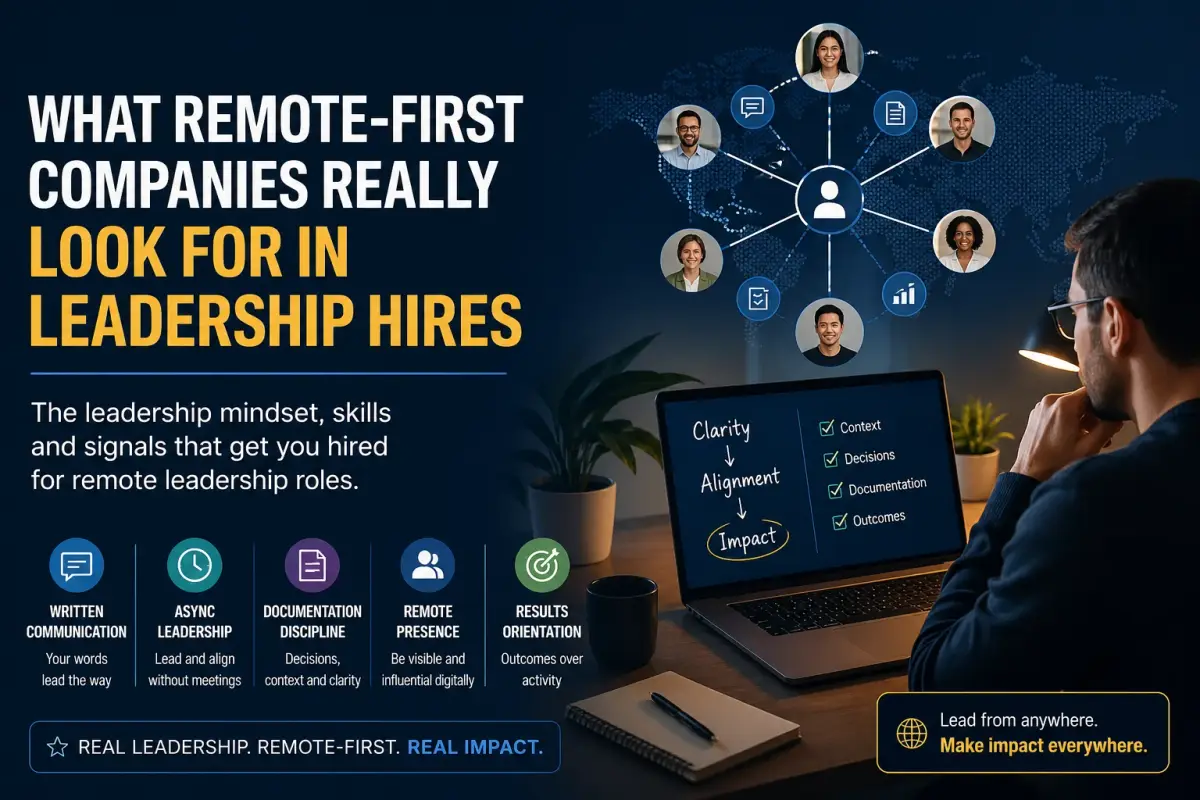
Most senior professionals fail to land remote leadership roles not because of weak experience, but because they approach them with an office-first mindset. Remote-first companies look for leaders who can communicate clearly in writing, lead asynchronously, document decisions properly, maintain strong digital presence, and deliver measurable results. The hiring process itself is designed to test these skills, so candidates who adapt to this model have a clear advantage.
Most senior professionals who pursue remote leadership jobs prepare the same way they prepared for every previous role: polished resume, rehearsed accomplishments, strong answers to standard leadership questions.
They do not get the offer.
Not because their credentials are weak. Not because their track record is unconvincing. They lose to candidates with comparable experience who understood something they did not — remote-first companies screen for an entirely different leadership profile than traditional organizations, and that profile is not obvious to professionals whose entire career has unfolded inside an office.
This is what that profile actually looks like, why it matters, and what candidates pursuing leadership jobs remotely need to demonstrate at every stage of the process.
What the Remote First Model Does to Leadership
Before examining what remote-first companies screen for, it helps to understand what the remote-first model does to leadership itself, because the change is more fundamental than most office-based leaders expect.
In a traditional office environment, leadership has a physical dimension. Presence signals commitment. Visibility creates influence. Hallway conversations shape decisions that never appear in any formal record. A leader who walks the floor, reads the room in real time, and maintains high social capital within the building exercises authority through proximity, a form of influence that requires no documentation and leaves no written trail.
None of that works in a distributed environment. In a remote-first organization, influence is entirely determined by the quality of written communication, the clarity of documented decisions, the frameworks a leader establishes, and the degree to which their teams can operate effectively without synchronous access to them. A leader who depends on physical presence to exercise authority becomes invisible in a remote-first structure, not because they lack capability, but because they are using the wrong instruments entirely.
This is not a minor stylistic adjustment. It is a structurally different model of how authority, accountability, and influence work in practice. Remote-first hiring teams screen for genuine internalisation of this model, not surface-level familiarity with remote tools. They have seen enough candidates who claim remote experience while displaying every signal of office-centric leadership to have developed sharp instincts for distinguishing between the two.
Written Communication Is Screened Before the First Interview
The first evaluation in a remote-first leadership hiring process is not a phone call or a video interview. It is how the candidate writes.
Every written touchpoint in the process, the application email, the cover letter, any follow-up communication, is read for signal. Remote-first hiring teams ask themselves a specific question when they read a candidate's written output: could this person lead effectively in an environment where writing is the primary leadership instrument?
In a remote-first organisation, a senior leader's written output does the work that physical presence does in an office. Strategy documents, decision memos, performance feedback, team updates, and cross-functional alignment all travel through writing. A leader who writes vaguely, assumes shared context that distributed readers do not have, or produces communications that require follow-up calls to clarify generates friction at every level of the organisation they lead.
The candidates who advance in remote leadership job processes write with a specific quality: they anticipate the questions their writing will generate and answer them preemptively. They establish context explicitly rather than assuming it. They communicate decisions with enough clarity that recipients can act without a synchronous conversation to fill the gaps. This is a learnable skill, but it is also a highly visible one, and remote-first hiring teams assess it from the first email a candidate sends.
Professionals actively pursuing leadership jobs remote should treat every written communication in the hiring process as a demonstration of the capability the role demands. Not performatively long, concise writing that respects the reader's time is itself a signal of async communication maturity. But precise, complete, and structured enough that the recipient has everything they need to respond or act without coming back for clarification.
Async Leadership Is Tested Through Specific Examples
The second major screen in remote-first leadership hiring is whether a candidate has genuinely led asynchronously, and can demonstrate it through specific, textured examples rather than general assertions about communication style.
Async leadership is not simply preferring written updates to meetings. It is a comprehensive shift in how a leader creates alignment, maintains accountability, develops team members, and moves decisions forward without the synchronous touchpoints that office leadership depends on.
Remote-first companies ask candidates to describe how they have managed teams across time zones. They probe for specific examples of how the candidate has addressed performance issues without private office conversations, maintained team cohesion without spontaneous social interaction, and kept distributed teammates informed without defaulting to synchronous status meetings.
Candidates who answer with frameworks, "I believe in clear communication and regular check-ins", reveal that they have not actually led in a remote-first environment at meaningful depth. Candidates who answer with specific examples, the documentation systems they built, the async rituals they established, the ways they identified disconnection before it became disengagement, demonstrate the genuine capability that remote-first companies are hiring for.
Senior professionals who have developed this async leadership depth and are ready to apply it in their next role will find that the market for remote leadership jobs rewards it directly. The roles available to genuinely async-capable leaders on dedicated remote platforms like FarCoder, which lists verified remote leadership and senior technical positions across technology, cybersecurity, engineering management, and product, are materially different in scope and compensation from the hybrid or nominally flexible roles that appear on general job boards.
Documentation Is a Leadership Responsibility, Not an Administrative One
In a remote-first organisation, documentation is not overhead that senior leaders delegate. It is how leadership functions at scale across a distributed team.
Senior leaders in remote-first companies are evaluated on whether they treat documentation as a core leadership output, not as something their teams should produce while they focus on higher-order concerns. The organisations that operate most effectively in the remote first model are those where decisions are written down with their reasoning preserved, institutional knowledge is accessible rather than residing in any single person's head, and new team members can onboard effectively without requiring synchronous time from senior leaders.
Remote-first hiring teams screen for this orientation explicitly. They ask candidates how they handle decisions made during synchronous conversations. They probe for whether candidates document not just what was decided but why, the context, the alternatives considered, the conditions under which the decision should be revisited. They assess whether candidates understand that an undocumented decision is effectively invisible to every team member who was not present in the conversation where it was made.
Candidates who advance furthest in leadership hiring processes at remote-first companies describe specific documentation systems they have built, decision logs, team playbooks, onboarding documentation, architectural decision records, and the impact those materials had on team autonomy and organizational resilience. Generic answers about keeping records do not pass this screen. Concrete examples of documentation that genuinely changed how a team operated do.
Remote Presence Replaces Physical Visibility
Office leadership carries a visibility dimension, being seen in the right meetings, engaging in the right hallway conversations, and occupying the spaces where informal influence operates. Remote-first organizations have developed an equivalent concept that strong distributed leaders understand well: remote presence.
Remote presence is the degree to which a leader is consistently visible, engaged, and influential within the digital spaces where the organization operates, without requiring constant synchronous availability. A senior leader with strong remote presence participates meaningfully in written discussions. They produce updates that keep teams and peers informed without meetings to convey the same information. Their decisions and reasoning are documented in shared spaces where the organization can reference them independently. Their thinking is accessible even when they are offline.
Remote-first companies screen for remote presence awareness in leadership hiring because leaders who do not understand this concept consistently underperform in distributed environments, not from lack of effort, but from applying the wrong currency of influence. A senior leader who is technically excellent but digitally invisible produces an organization that lacks direction because the leader's thinking never makes it into the documented, accessible form that distributed teams need to act on it.
Candidates demonstrate remote presence during the hiring process itself, through the quality of their written communications, their conduct in any async exercises the process includes, and the care they take to make their thinking accessible to a distributed hiring team evaluating them across time zones without the benefit of reading a room.
Results Orientation Is Non-Negotiable
Remote-first companies have learned to be suspicious of leadership authority built on the appearance of effort, visible long hours, constant availability, and participation in every meeting. In a distributed environment, none of these signals are visible. Results are the only currency of leadership credibility.
Senior leaders either delivered the outcomes their role required or they did not — and in a remote-first organisation, the evidence is entirely in what was produced, documented, and measurable rather than in how busy the leader appeared.
Leadership hiring teams at remote-first companies screen for results orientation by asking candidates to describe their most significant accomplishments in ways that separate personal contribution from organisational context. They probe for specific, measurable outcomes — revenue impact, team performance improvements, product delivery milestones, rather than accepting role descriptions dressed as accomplishments.
They also screen against activity-focused leadership language. Candidates who describe their leadership in terms of the meetings they ran and the processes they participated in signal an office-centric model. Candidates who describe outcomes, quantify impact, and speak about their teams' capability and autonomy signal the results orientation that the remote-first model requires at every level of seniority.
The Hiring Process Is the Assessment
Every stage of a remote-first leadership hiring process simultaneously evaluates remote leadership capability. This is not incidental; it is deliberate design.
The take-home strategic exercise tests written communication quality, independent structured thinking, and the ability to produce high-quality work without live feedback. The async video response tests comfort with asynchronous formats and the ability to communicate clearly without the real-time feedback of a face-to-face conversation. The written case study tests documentation quality, reasoning transparency, and the candidate's ability to anticipate the questions their analysis will generate.
Candidates who treat these elements as inconvenient substitutes for real interviews — rushing through them, producing thin responses, or requesting synchronous replacements — signal immediately that they have not genuinely adopted the remote-first model they claim to want to work within. Candidates who engage with each element as an opportunity to demonstrate exactly the capabilities the role demands consistently advance further and receive stronger offers.
The most effective preparation for remote-first leadership hiring is not rehearsing standard leadership interview answers. It is auditing the quality of every written communication, every documented decision, and every async output that represents your professional thinking — and ensuring that quality reflects the senior distributed leader the role requires.
Where Remote Leadership Roles Actually Are
The market for senior leadership positions in remote-first organisations has expanded significantly across technology, cybersecurity, engineering management, product management, and technical programme management. These are not experimental arrangements — they are permanent operating models at well-funded companies that have built the distributed infrastructure senior leaders need to function effectively.
Finding genuine remote leadership positions requires searching on platforms where the remote commitment is verified at the employer level, not platforms where remote is a filter applied to a general job listing database that includes hybrid and nominally flexible roles described with the same language.
Senior professionals who have built the async leadership depth, documentation discipline, and remote presence that this post describes will find that the verified remote leadership positions listed on FarCoder, a global remote-only tech job board built for distributed technology professionals, match both their capabilities and the compensation those capabilities command in the current remote market.
The Candidate Who Gets the Offer Is Not the Most Experienced One
Remote-first companies hiring senior leaders are not simply selecting the candidate with the most impressive title history. They are selecting the candidate who has genuinely operated in a distributed environment and built the specific capabilities that remote leadership demands.
Written communication that creates alignment without synchronous clarification. Async leadership practices developed through real distributed experience, not claimed through familiarity with remote tools. Documentation instincts that build organizational resilience. Remote presence that makes their thinking accessible across time zones. Results orientation that makes their impact measurable rather than merely visible.
These qualities are built through deliberate practice in distributed environments. The candidates who have built them hold a durable advantage in the remote leadership job market, one that experience and credentials alone cannot replicate, and one that remote-first hiring teams have developed sharp instincts for identifying.
Browse remote leadership jobs on FarCoder → farcoder.com/jobs
Frequently Asked Questions (FAQ)
Why do experienced leaders struggle to get remote leadership jobs?+−
Because they rely on office-style leadership like meetings and physical presence, while remote companies value written communication, async work, and documented decision-making.
What is the most important skill for remote leadership roles?+−
Clear and structured written communication, since it replaces most in-person interactions and drives alignment across distributed teams.
How do remote-first companies evaluate candidates?+−
Through async tasks, written exercises, and real examples of past work, focusing on results, documentation habits, and ability to lead without constant meetings.