What Does a Backend Developer Do? Role, Skills and Career Guide

Far Coder Team
Thu Apr 30 2026
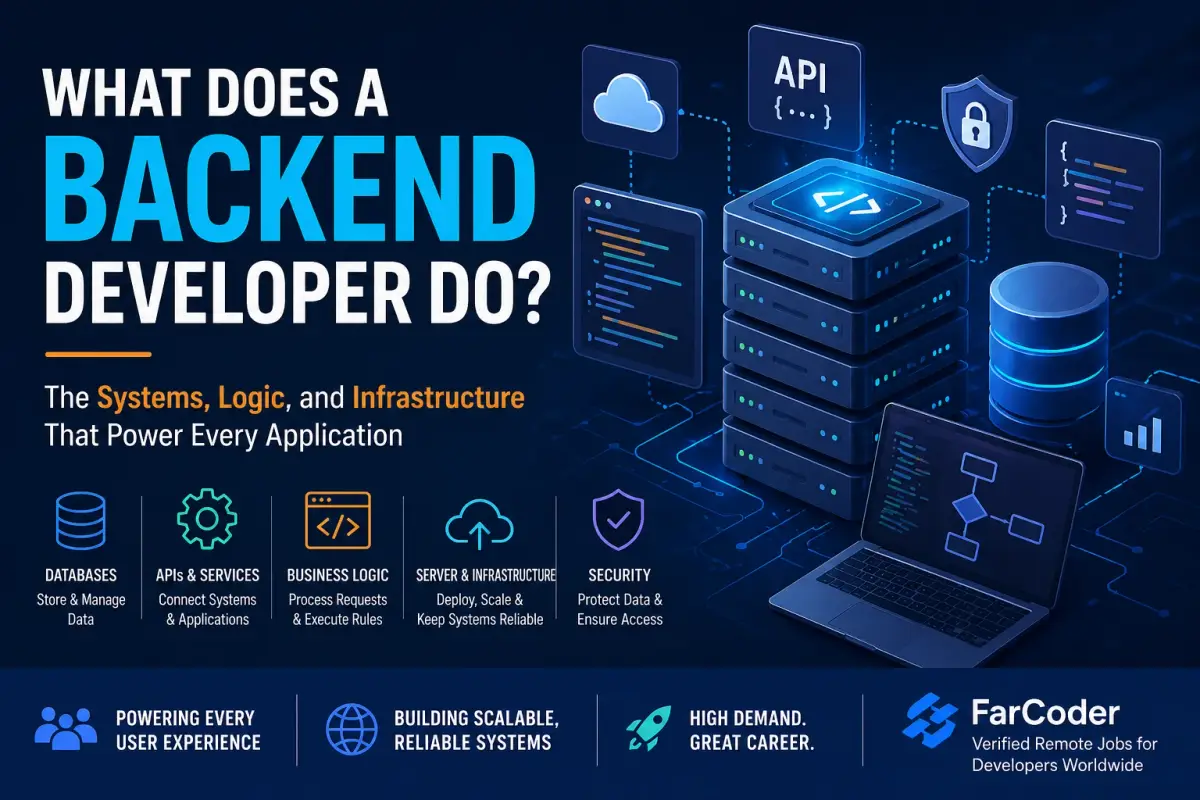
A backend developer builds and maintains the server-side systems that power applications, including databases, APIs, business logic, and infrastructure. They ensure applications run reliably, securely, and efficiently at scale. The role involves designing APIs, managing databases, optimizing performance, and handling production issues. As developers grow, they move from building features to designing systems and architecture. With strong demand and remote-friendly work, backend development offers high salaries and global opportunities, especially for developers skilled in modern stacks and scalable systems.
A backend developer builds and maintains the server-side systems that power everything a user cannot see, the databases that store information, the APIs that move data between systems, the business logic that processes requests, and the server infrastructure that keeps applications running reliably at scale.
When you log in to an application and your account loads instantly, a backend developer built the authentication system that verifies your credentials. When you complete a purchase and receive a confirmation, a backend developer built the order processing logic that made that transaction work. The visible surface of any digital product is only possible because a backend developer built the systems underneath it.
That is the direct answer. The full picture, what the role involves day to day, what skills it demands, how the career path progresses, and what the remote market for backend developers looks like in 2026, is what this guide covers.
Backend Development vs Front-End Development: The Fundamental Distinction
Understanding what a backend developer does starts with understanding where the back end begins and the front end ends, because the distinction is more significant than most people outside the field appreciate.
Front-end developers build everything a user sees and interacts with directly, the layout, the buttons, the animations, the forms. Their work renders in the user's browser and responds to user input in real time. The front end is the interface layer.
Backend developers build everything that makes the interface work, the systems that receive requests from the front end, process them according to business rules, retrieve or store the relevant data, and return a response that the front end can display. The back end is the logic and data layer.
A search bar on a website is a front-end component. The system that receives the search query, queries a database of millions of records, ranks results by relevance, and returns a structured response in milliseconds is backend work. Both layers are essential. Neither functions without the other.
Backend developers also carry responsibilities that have no front-end equivalent, system performance at scale, data integrity across concurrent operations, security architecture for authentication and authorisation, and the reliability engineering that keeps services available when traffic spikes or infrastructure components fail.
What a Backend Developer Does Day to Day
The day-to-day work of a backend developer varies by seniority level, team structure, and the type of product being built, but several core activities appear consistently across roles, companies, and technology stacks.
Designing and building APIs is the work that connects the backend systems to the front-end interfaces and to external services. A backend developer designs the endpoints that the front end calls to retrieve or submit data, implements the business logic that processes those requests, and ensures that the API responds with correct data in the correct format under all expected conditions, including error conditions that the front end needs to handle gracefully.
Database design and management occupies a significant portion of backend development work. Backend developers design schemas that organise data in ways that support both current requirements and anticipated growth. They write queries that retrieve data efficiently, implement indexing strategies that keep response times fast as data volumes grow, and manage migrations that evolve the database structure as the application's requirements change, without disrupting the application or corrupting existing data.
Writing and maintaining server-side business logic is where the application's core rules live. Pricing calculations, access control rules, workflow state machines, notification triggers, data validation, all of this runs in the backend layer. Backend developers implement this logic in ways that are testable, maintainable, and clear enough that future developers can understand and modify it without introducing unintended consequences.
Performance assessment and optimisation are ongoing backend responsibilities. Once an application is in production, backend developers monitor its performance, identifying slow queries, memory leaks, bottlenecks in request processing, and infrastructure constraints that degrade the user experience. They profile the system, identify root causes, and implement optimisations that restore or improve performance without breaking existing functionality.
Troubleshooting and debugging production issues is the highest-pressure element of backend work. When an application experiences errors, downtime, or unexpected behaviour in production, backend developers diagnose the problem under time pressure, reading logs, tracing request flows through distributed systems, isolating the failing component, and implementing a fix that resolves the immediate issue while the full root cause investigation continues.
Code review and mentoring become increasingly prominent as backend developers advance beyond the junior tier. Senior backend developers review pull requests from colleagues, provide feedback that improves both the specific code and the reviewer's broader understanding, and mentor junior developers through the problem-solving approaches and production awareness that only experience can efficiently transfer.
The Backend Developer vs Backend Engineer Distinction
These titles are used interchangeably at many companies and with meaningful distinction at others. Where companies do differentiate, the pattern is consistent: a backend developer focuses on implementation, building specific features, maintaining existing systems, and contributing to the technical decisions that affect their immediate scope of work. A backend engineer carries broader architectural responsibility, designing the systems that developers implement, making technology choices that affect the entire platform, and owning the technical vision for backend infrastructure at an organisational level.
In practice, the most important distinction is the scope of ownership rather than the job title. At earlier career stages, the scope is narrow: a specific service, a specific feature, a specific layer of the stack. As experience accumulates, scope expands, from features to systems, from systems to architecture, from architecture to the technical strategy that shapes how the entire engineering organisation builds.
Remote backend developer roles reflect this progression clearly. Entry-level and junior remote positions scope work tightly and provide structured support. Mid-level positions expect independent feature ownership and active contribution to technical discussions. Senior and staff-level positions carry architectural responsibility and organisation-wide technical influence, and are compensated accordingly in the remote market.
The Technical Skills Backend Developers Need
Backend developer skills fall into three layers that build on each other: the language and framework layer, the data layer, and the systems layer. Employers assess all three — and weakness in any one layer limits career progression regardless of strength in the others.
Programming languages form the foundation of backend technical skill. Python is the most widely adopted backend language across the current remote job market, its clean syntax, extensive standard library, AI and machine learning compatibility, and strong framework ecosystem make it the default choice at product-focused companies and startups. Node.js brings JavaScript to the back end, enabling teams to use a single language across the full stack, a significant operational simplification that many remote-first companies prioritise. Java remains dominant in enterprise environments where performance, type safety, and established ecosystem depth are priorities. Go has grown rapidly in adoption for high-performance services and infrastructure tooling where raw speed and low memory footprint matter. Ruby, PHP, and C# maintain strong presences in specific market segments.
Choosing a primary language is a career decision that deserves deliberate thought rather than defaulting to whatever tutorial appeared first. The remote backend job market concentrates demand in Python and Node.js at the startup and product company segment, where the majority of fully remote positions originate. Developers who invest in Python or Node.js access the widest remote opportunity set. Those targeting enterprise environments find Java and C# more directly applicable.
Frameworks reduce the boilerplate that backend development would otherwise require and provide the structural conventions that make codebases maintainable across teams. Django and FastAPI serve Python developers building web applications and APIs, respectively. Django for full-featured web applications with built-in authentication, ORM, and admin infrastructure; FastAPI for high-performance API development where speed and automatic documentation are priorities. Express.js is a lightweight Node.js framework that gives developers precise control over their application structure. Spring Boot dominates the Java enterprise space. Ruby on Rails remains productive and well-adopted for rapid application development. Framework knowledge is tested directly in most backend technical interviews, and knowing your primary framework deeply is more valuable than shallow familiarity with several.
Databases are where backend developers spend disproportionate time relative to how prominently they appear in job descriptions. Strong database skills are among the clearest differentiators between junior backend developers and mid-level ones, because they require experience with real data at real scale to develop properly. Relational databases, PostgreSQL, and MySQL are foundational. SQL proficiency, schema design, query optimisation, index strategy, and transaction management are skills that every backend employer tests. PostgreSQL is the most widely used relational database in the remote tech market and the safest investment for developers choosing a primary database system. NoSQL databases, MongoDB for document data, Redis for caching and session storage, DynamoDB for serverless and event-driven architectures, add depth that scales with the complexity of the applications backend developers build.
APIs are the communication layer that connects backend systems to everything that depends on them. REST API design, endpoint structure, HTTP verb semantics, status codes, error response format, versioning strategy, and documentation, is a core backend developer skill that remote employers assess in technical interviews and code reviews. GraphQL has grown in adoption particularly at product companies where front-end teams need flexible data fetching and bandwidth efficiency. gRPC is increasingly used for high-performance inter-service communication in microservices architectures. Understanding when to use each API paradigm, and being able to articulate the trade-offs clearly, is the mark of a backend developer who thinks beyond implementation to system design.
Security is a non-negotiable backend responsibility that many developers underinvest in at the early stages of their career. Authentication, implementing secure login flows, session management, and token-based authentication with JWT or OAuth 2.0, is foundational. Authorisation, ensuring that authenticated users can only access the resources their role permits, is where many security vulnerabilities originate in practice. Input validation, SQL injection prevention, rate limiting, secrets management, and HTTPS enforcement are all backend security responsibilities that production applications depend on and that employers test for explicitly.
The Systems Layer: Where Senior Backend Developers Differentiate
Beyond language, framework, database, and API skills lies the systems layer, the architectural and operational knowledge that distinguishes senior backend developers from those who have not yet reached that level.
Scalability is the systems-layer concern that most visibly separates backend developers who have worked at scale from those who have not. Designing systems that handle ten users is fundamentally different from designing systems that handle ten million. Caching strategies, where to cache, what to cache, how to invalidate cached data correctly, dramatically affect the scalability of backend systems. Message queues, RabbitMQ, Apache Kafka, AWS SQS, decouple components of distributed systems and enable async processing that keeps response times fast regardless of the work required to fulfil a request. Understanding these tools conceptually is not sufficient; demonstrating their application in specific design decisions is what remote employers screen for at the senior level.
Microservices architecture has become the dominant pattern for large backend systems at scale. Rather than building a single monolithic application, organisations decompose their back end into independent services that communicate through APIs and message queues. Each service has a focused responsibility, can be deployed independently, and can be scaled according to its specific load characteristics. Backend developers who understand both the benefits of microservices, deployment flexibility, team autonomy, targeted scaling, and their costs, distributed systems complexity, network latency, operational overhead, make better architectural decisions than those who apply the pattern reflexively.
Cloud infrastructure knowledge has moved from specialist skill to general backend expectation. The majority of production backend systems run on AWS, Google Cloud, or Azure, and backend developers who understand the services their applications run on, how to configure them correctly, and how to monitor and debug them in cloud environments are significantly more effective than those who treat cloud infrastructure as someone else's concern.
Backend Developer Salary: What the Remote Market Pays
Backend developer salary in the US market sits at a median of approximately $116,000 per year across all experience levels, a figure that reflects strong demand and a consistent shortage of experienced backend talent relative to the number of open positions.
The remote market adds a dimension that domestic salary figures alone do not capture. Backend developers outside major US tech hubs who secure remote positions with US and European employers access compensation that their local markets cannot approach for equivalent work. A mid-level Python developer in Eastern Europe, Southeast Asia, or Latin America who holds a remote role at a US product company earns at a rate that creates genuine wealth accumulation potential regardless of local cost of living.
The variables that drive backend salary within the remote market follow a consistent pattern. Experience level is the primary driver, junior, mid-level, senior, and staff positions carry meaningfully different compensation tiers that reflect the scope of contribution each level provides. Technology stack matters at the margins, Go and Rust developers command a premium over equivalent experience in more commonly available languages because the talent pool is smaller relative to demand. Specialisation in high-value areas, distributed systems, high-performance API design, cloud architecture, security engineering, produces salary outcomes above the general backend developer market at equivalent experience levels.
How to Become a Backend Developer
The path into backend development does not require a computer science degree, though approximately 71 percent of web developers hold a bachelor's degree, and the computer science fundamentals a degree provides do accelerate progress in the systems-layer skills that senior backend roles demand. Developers who enter without a degree and invest seriously in those fundamentals, data structures, algorithms, computer networking, operating systems — close the gap through deliberate study rather than formal education.
The practical path into backend development follows a consistent sequence regardless of starting point. Programming language fundamentals come first, not framework familiarity, but genuine command of the language itself, its data types, its control flow, its error handling, its standard library, and its runtime behaviour. Frameworks built on a weak language foundation produce fragile applications and fragile understanding that collapses under the pressure of real technical interviews.
Database skills develop alongside language and framework knowledge, first relational databases with SQL, then schema design, then query optimisation and indexing, then NoSQL systems as the application of each becomes clear through project work. API design knowledge grows through building APIs rather than studying them, the concepts solidify when the design decisions have real consequences for the applications that depend on them.
Portfolio projects translate this learning into visible, verifiable evidence of capability. Backend work is invisible by nature, the challenge of making it visible to employers is one of the central difficulties of the backend job search. Strong backend portfolio projects solve this through thorough documentation: README files that explain architectural decisions and their rationale, API documentation that demonstrates design thoughtfulness, test suites that demonstrate production awareness, and deployment configurations that show the project functions in a real environment rather than only on a local machine.
Certifications accelerate credibility in specific areas, particularly cloud platforms, where AWS, Google Cloud, and Azure certifications validate infrastructure knowledge that project portfolios alone cannot demonstrate as efficiently. CompTIA Security+ and related certifications validate security knowledge that backend employers test for but that few junior developers invest in proactively.
Backend Developer Career Path: From Junior to Staff Level
The backend developer career path progresses through distinct stages that each represent a qualitative shift in contribution scope rather than simply an accumulation of years.
Junior backend developers implement well-defined features within established systems, write tests for their implementations, fix bugs identified through testing or production monitoring, and gradually expand their understanding of the broader system architecture through exposure rather than ownership. The priority at this stage is producing reliable, tested code within a defined scope, and demonstrating the learning velocity that earns expanded ownership.
Mid-level backend developers own features end to end, from database schema through API implementation through integration tests through deployment. They make independent technical decisions about implementation approach, communicate those decisions clearly in pull requests and technical documentation, identify performance issues proactively rather than waiting for them to surface in production, and contribute meaningfully to team discussions about architectural direction. Remote mid-level backend developer positions are the most actively hired tier in the distributed job market.
Senior backend developers own systems rather than features, taking responsibility for the architectural decisions that shape how multiple features are built, the performance characteristics of services under production load, the security posture of the systems they maintain, and the technical development of the junior and mid-level developers on their team. Their code review feedback improves the codebase's quality beyond the specific pull requests they review. Their architectural recommendations reduce the cost and risk of future development decisions.
Staff and principal backend engineers carry organisation-wide technical influence, setting the architectural standards that multiple teams build within, leading the technical evaluation of significant infrastructure decisions, and representing engineering concerns in product and business strategy conversations. These roles are rare, well-compensated, and almost exclusively filled through referral networks and specialised platforms rather than general job boards.
Remote Backend Developer Jobs: What the Market Looks Like
Backend development is among the most remote-compatible technical disciplines available. The work is terminal and browser-based. The collaboration is naturally async, pull requests, code review, architectural decision records, and technical documentation all travel through writing. The output is measurable in ways that make performance evaluation straightforward without requiring physical proximity.
The remote backend job market is active across every experience level and technology stack. Python and Node.js developers find the widest range of remote opportunities; these stacks dominate at the product companies and startups that make up the majority of remote-first employers. Go developers find a smaller but consistently well-compensated remote market at performance-focused organisations building infrastructure tooling and high-throughput services. Java and C# developers find remote opportunities concentrated more in enterprise environments, where the hybrid model remains more common than fully distributed teams.
Remote backend developer positions at the mid-level and above consistently exceed the $80K threshold in the global remote market, and senior positions at well-funded companies frequently reach two to three times that figure for developers who have built genuine depth in high-demand specialisations.
Professionals building toward their first remote backend developer role, or experienced backend developers ready to move into the remote market from an office-based position, will find that the verified remote backend developer positions listed on FarCoder, a global remote-only tech job board built by senior developers for developers, represent the range of opportunities, stacks, and experience levels that the current remote backend market actually contains.
Backend Development Is Where the Application's Reliability Lives
Every application that users trust, every system that processes transactions at scale, every service that maintains data integrity across millions of concurrent operations, all of it runs on backend systems built and maintained by developers who understand both the technical depth and the operational discipline the work demands.
The remote job market for backend developers reflects the value of that work directly. Demand is persistent, compensation is strong, and the global remote market gives developers outside major tech hubs access to opportunities and compensation that their local markets cannot replicate.
Whether you are building the skills to enter backend development, positioning yourself to move from an office-based backend role into the remote market, or looking for your next senior position at an organisation that takes distributed work seriously, the verified remote backend developer jobs on FarCoder represent the employers, stacks, and experience levels where the current remote backend opportunity is concentrated.
Browse remote backend developer jobs on FarCoder → farcoder.com/remote-backend-developer-jobs
Frequently Asked Questions (FAQ)
What does a backend developer actually do?+−
They handle everything behind the scenes—servers, databases, APIs, and logic—to make applications function correctly and efficiently.
What skills are required to become a backend developer?+−
Key skills include programming (Python, Node.js, Java), databases (SQL), API design, and system design, along with knowledge of security and scalability.
Are backend developers in demand for remote jobs?+−
Yes, backend development is highly remote-friendly, with strong demand globally and competitive salaries, especially for mid-level and senior developers.