Vue Interview Questions for Remote Tech Jobs

Far Coder Team
Wed Jun 17 2026
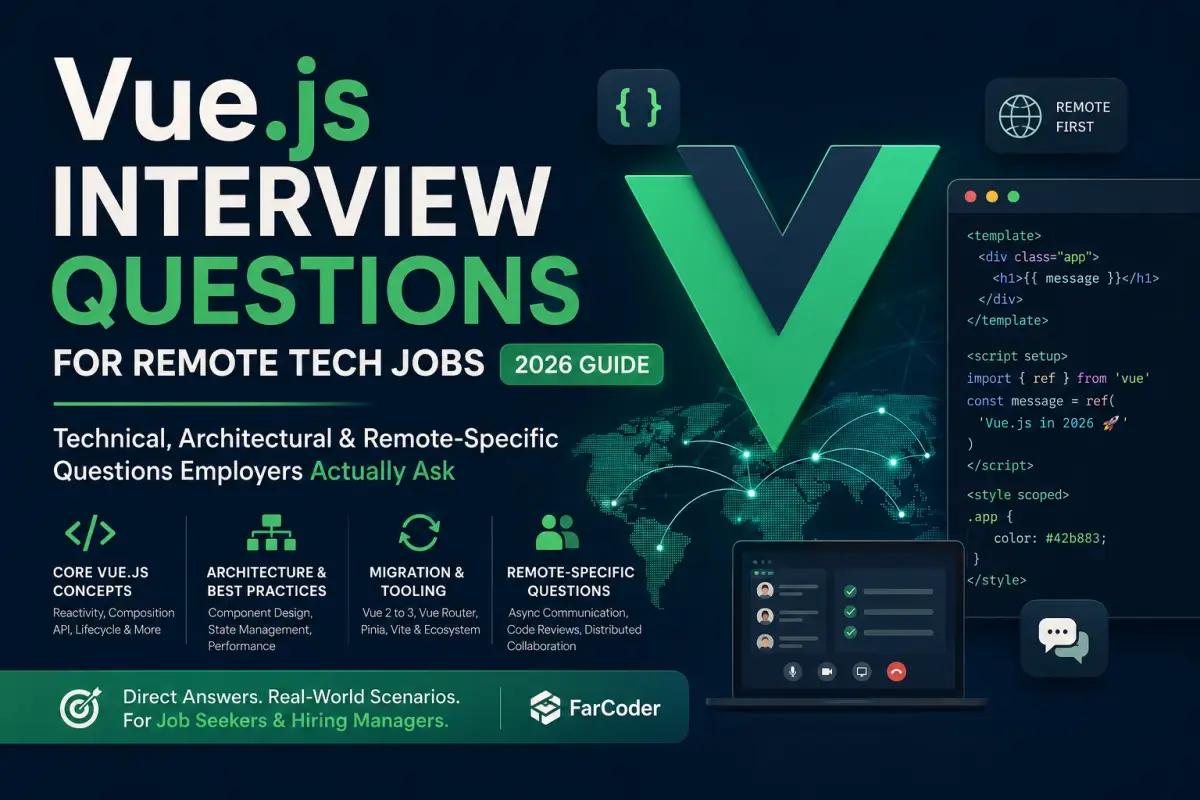
Vue.js remains one of the most widely adopted frontend frameworks for remote teams in 2026, particularly at European and Asia-Pacific employers where Vue adoption significantly exceeds the global average. A Vue interview for a remote role tests more than syntax knowledge, it evaluates your understanding of reactivity internals, your ability to architect components for distributed teams, your migration and tooling experience, and your async communication fluency. This guide covers the Vue.js interview questions remote employers actually ask in 2026, with direct answers for each, plus the remote-specific questions that distinguish a strong remote Vue developer from a candidate who only knows the framework. Whether you are preparing for your next remote frontend role or building a technical assessment for your distributed team, this guide covers both sides.
Why Vue Interviews for Remote Roles Are Different
Remote Vue.js interviews evaluate three layers simultaneously: core framework knowledge, architectural and migration judgment, and remote collaboration fluency, because a candidate who is technically strong but cannot communicate component decisions asynchronously or work effectively across a distributed codebase will create friction that a co-located team would absorb more easily.
Vue's adoption patterns make this especially relevant. Vue is significantly more prevalent at European remote-first companies; Germany, France, and the Netherlands all show Vue adoption well above the global average, which means a meaningful share of remote Vue roles involve distributed teams spanning multiple time zones from the outset. Employers hiring for these roles are evaluating whether a candidate's technical communication holds up in writing, in pull requests, and in async architecture discussions, not just in a live coding session.
Core Vue.js Technical Questions
Question 1: What is the difference between a slot and a scoped slot?
A regular slot is a placeholder in a child component filled with content from the parent, compiled in the parent's scope, meaning the parent cannot access the child's internal data. A scoped slot allows the child component to pass its own data back to the parent, so the parent's slot content can use that child data directly.
This is one of the most consistently asked Vue questions because it tests whether a candidate understands Vue's component communication model at a level beyond basic props and events. A strong answer explains not just the mechanical difference but when each is appropriate, regular slots for simple content injection, scoped slots when the child needs to expose internal state or methods to customise how that content renders, such as a data table component exposing row data to let the parent define custom cell rendering.
What a strong remote candidate adds: An explanation of how they would document a scoped slot's contract for a distributed team — since the implicit interface between parent and child is easy to get wrong without clear documentation, and remote teams cannot resolve ambiguity with a quick desk conversation.
Question 2: How does two-way data binding work with v-model?
The v-model directive creates two-way binding between a form input and a data property by combining a value binding with an input event listener. Under the hood, v-model is syntactic sugar that binds the element's value to the data property and listens for input events to update that property when the user types.
Strong candidates explain that the V-model on custom components requires the component to emit an update event and accept a corresponding prop. In Vue 3, this defaults to modelValue and update:modelValue, replacing the value and input pattern from Vue 2. Candidates who can explain this Vue 2 to Vue 3 distinction demonstrate they have worked across both versions, which is valuable for teams maintaining legacy codebases during migration.
Question 3: Why would you choose Vue.js over other frameworks?
Vue is chosen for its gentle learning curve for developers familiar with HTML, CSS, and JavaScript, its lightweight and performance-optimised runtime, its integrated ecosystem (Vue Router for routing, Vuex or Pinia for state management), and its approachability for teams that need to onboard developers quickly without a steep framework-specific ramp-up.
For remote teams specifically, this last point matters more than it might in a co-located environment. A framework that is approachable for developers at varying skill levels reduces the onboarding burden when a distributed team brings in new contributors who cannot learn through pairing or in-person mentorship as easily. Strong candidates connect Vue's design philosophy to practical team outcomes, not just technical preference.
Question 4: How do you migrate a Vue 2 application to Vue 3?
A Vue 2 to Vue 3 migration uses the official migration build for compatibility during transition, addresses breaking changes systematically (the Composition API, changes to v-model, global API changes), updates dependencies that may not yet support Vue 3, and plans the migration in phases rather than as a single cutover.
This is one of the highest-value questions for senior remote roles because it tests architectural judgment under real business constraints. Strong answers cover the @vue/compat package for incremental migration, migration helper tooling for identifying breaking changes across a codebase, testing strategy to ensure functionality is preserved through each phase, and team training needs, particularly important for distributed teams where not everyone may have equal familiarity with the Composition API.
A senior engineering manager's perspective on this question, frequently cited in 2026 hiring guides, is that the developers who excel are not just coding the migration but thinking about component contracts, state flow, and long-term maintainability, explaining not just how Vue works but why certain patterns emerge and what business problems they solve.
This question is one of the strongest signals available for evaluating senior remote candidates because the answer reveals whether someone thinks in terms of risk mitigation and phased delivery, exactly the documentation-heavy, incrementally-communicated approach that distributed teams need for any significant technical change.
Question 5: How do you handle state management in a large Vue application?
For applications beyond a few components with shared state, Vue applications typically use Pinia (the recommended state management library for Vue 3, replacing Vuex) to centralise state in stores that any component can access, with actions for state mutations and getters for derived state, avoiding prop drilling and ad-hoc event-based communication between distant components.
Strong candidates discuss when centralised state management is actually necessary versus when component-local state or provide/inject is sufficient. Over-engineering state management for simple applications is a common junior mistake. For remote teams, a well-structured store also serves as living documentation of the application's data flow, which is valuable when team members are working asynchronously and cannot walk over to ask, "Where does this data come from?"
Question 6: Explain Vue's reactivity system. How does it detect changes?
Vue 3's reactivity system uses JavaScript Proxies to intercept property access and mutation on reactive objects, automatically tracking which components depend on which reactive properties and re-rendering only the components affected when those properties change, a significant architectural change from Vue 2's Object.defineProperty-based approach, which had known limitations around detecting new property additions and array index changes.
This question separates candidates who have used Vue from those who understand it. A strong answer explains the practical implications: why reactive() and ref() behave differently for primitives versus objects, why reactivity can be "lost" when destructuring reactive objects (and how toRefs() addresses this), and how this understanding prevents subtle bugs that are otherwise difficult to debug, particularly important for remote teams where debugging often happens without a colleague to pair with in real time.
Question 7: How do you optimise performance in a Vue application?
Vue performance optimisation includes using computed properties instead of methods for derived values (to leverage caching), applying v-once for static content that never changes, using v-show versus v-if appropriately based on toggle frequency, implementing virtual scrolling for long lists, lazy-loading routes and components, and using key attributes correctly in v-for to help Vue's diffing algorithm reconcile the DOM efficiently.
For senior remote candidates, the strongest answers go beyond a checklist and discuss how they would identify performance problems in the first place, using Vue DevTools' performance profiling, browser performance tools, and Core Web Vitals metrics, before applying optimisations. This diagnostic-first approach is valuable for remote teams because it produces documented evidence of why a particular optimisation was applied, which matters when the decision needs to be reviewed asynchronously by teammates who were not present for the investigation.
Question 8: How do you implement accessibility in a Vue application?
Vue accessibility implementation covers ARIA semantics for custom components that do not have native accessible equivalents, keyboard navigation support for interactive elements, focus management when content changes dynamically (such as modals and route transitions), and ensuring that Vue's reactivity does not break screen reader announcements when content updates.
Accessibility questions have become standard in Vue interviews in 2026, reflecting both legal compliance requirements at enterprise and government-adjacent employers and growing recognition that accessibility is core engineering quality, not an afterthought. Strong candidates discuss specific patterns, managing focus when a modal opens and closes, using aria-live regions for dynamically updated content, and testing with actual screen readers rather than relying solely on automated audits.
Question 9: How do you handle internationalization (i18n) in Vue?
Vue internationalization typically uses vue-i18n, the standard library for the ecosystem, with strong candidates able to discuss lazy-loading locale bundles to avoid bloating the initial page load, handling pluralization rules that differ across languages, and managing translation keys with extraction tooling rather than hardcoding strings throughout the codebase.
For senior roles, this question extends to right-to-left (RTL) layout support, applications serving Arabic, Hebrew, or Urdu-speaking users require implementing RTL using the dir attribute and CSS logical properties (margin-inline-start rather than margin-left) alongside automated visual regression testing to catch mirrored layout bugs. This question is particularly relevant for remote teams serving global user bases, where the development team itself may be distributed across exactly the regions whose languages the application needs to support.
Question 10: How do you prevent security vulnerabilities in a Vue application?
Vue's template syntax automatically escapes interpolated content, preventing most XSS vulnerabilities by default, but v-html renders raw HTML and is a direct XSS vector if used with unsanitised user input, so candidates should explain when v-html is genuinely necessary and how they sanitise content before using it.
Beyond XSS, strong candidates discuss authentication flow implementation, secure token storage (avoiding localStorage for sensitive tokens in favour of httpOnly cookies where possible), dependency risk management (auditing npm packages for known vulnerabilities), and static analysis enforcement in CI pipelines to catch security issues before code merges. This question matters for remote teams because security review often happens asynchronously through automated tooling and code review rather than in-person pairing — candidates who understand how to build security into the pipeline itself, rather than relying on manual review, fit naturally into distributed team workflows.
Architectural and Practical Assessment Questions
Question 11: Walk through how you would structure a new Vue application from scratch
A well-structured Vue application separates concerns into clear directories, components organised by feature or domain rather than by type, a centralised store for shared state, a composables directory for reusable logic extracted via the Composition API, route-level code splitting, and a clear convention for how API calls are made and errors are handled across the application.
This open-ended question is one of the most revealing in a remote interview because it has no single correct answer; it tests how a candidate thinks about maintainability, onboarding, and team conventions. For remote teams, the strongest answers explicitly address how the structure helps new team members (including remote new hires) understand the codebase without guidance, because in a distributed team, that documentation-through-structure often substitutes for the informal knowledge transfer that happens naturally in offices.
Question 12: How would you debug a Vue component that is not re-rendering when data changes?
Common causes include mutating an array or object in a way that does not trigger Vue's reactivity (such as setting an array index directly instead of using array methods that Vue can detect), losing reactivity when destructuring a reactive object without toRefs(), incorrect key usage in v-for causing Vue to reuse DOM elements incorrectly, or a computed property with a dependency that Vue cannot track.
This practical debugging question reveals depth of understanding that framework familiarity alone does not provide. For remote candidates, strong answers also describe their debugging process, using Vue DevTools to inspect reactive state, adding targeted console logging, and isolating the issue in a minimal reproduction — because remote debugging often happens without a colleague to bounce ideas off in real time, making a structured, methodical debugging approach genuinely more valuable in distributed teams.
Remote-Specific Questions for Vue Developers
Question 13: How do you communicate a component's API to other developers on a distributed team?
Strong remote Vue developers document component props, emitted events, and slots explicitly, through TypeScript interfaces, JSDoc comments, or a component library tool like Storybook, because in a distributed team, another developer cannot ask "how does this component work?" over the desk and needs the answer available in the code itself.
This question directly tests remote collaboration fluency. A candidate who treats documentation as an afterthought will create friction in distributed teams where every undocumented interface becomes a blocking question in an async channel. Candidates who describe documentation as a core part of writing a component, not a separate task, are signalling exactly the habits that make remote Vue teams function smoothly.
Question 14: How do you handle code review for Vue components when your reviewer is in a different time zone?
Strong remote candidates write pull request descriptions that explain what changed, why it changed, what alternatives were considered, and how to test the change, reducing the back-and-forth that would otherwise require synchronous discussion across time zones, and they record short video walkthroughs (using tools like Loom) for changes that are difficult to explain in text alone, such as visual or interaction changes.
This question separates developers who have worked on distributed teams from those who have only worked with co-located reviewers who could be asked questions in real time. For Vue specifically, visual and interaction changes are common; a candidate who proactively addresses how they communicate these without relying on a live screen share demonstrates genuine remote experience.
Question 15: Tell me about a time you had to make an architectural decision without immediate access to a senior reviewer
Strong answers describe a structured decision-making process, researching the options, documenting the trade-offs considered, making a reversible decision where possible, and communicating the decision and reasoning clearly so a senior reviewer could evaluate it asynchronously and provide feedback without needing a live discussion to understand the context.
This behavioural question, framed using the STAR method (Situation, Task, Action, Result), tests whether a candidate can operate with the autonomy that remote teams require while still maintaining the transparency that allows distributed oversight. A candidate who describes making decisions in isolation without any communication trail is a risk in a remote team; a candidate who describes documenting their reasoning for asynchronous review demonstrates exactly the balance remote teams need.
How to Prepare for a Remote Vue.js Interview
Preparation for a remote Vue interview should cover four areas, core framework and reactivity internals, migration and tooling experience (particularly Vue 2 to Vue 3), a practical portfolio piece that demonstrates component architecture decisions, and explicit examples of how you have communicated technical decisions asynchronously in past remote or distributed work.
Practice explaining your reasoning out loud, not just producing correct code. Remote interviews increasingly include a written component, a take-home assignment building a small application with real-world requirements such as API integration, state management, routing, and form handling, evaluated on code organisation, component design, error handling, and adherence to Vue's style guide, in addition to or instead of live coding.
Review your GitHub profile and any public Vue projects before your interview. Remote hiring managers frequently review a candidate's public code before or during the interview process — a portfolio with clear, well-documented Vue components is one of the strongest signals of genuine remote readiness available to a candidate.
Use FarCoder's free AI Resume Matcher to check your resume against the specific Vue role you are applying for → farcoder.com/tools/resume-analyzer
For Employers: Building a Vue Interview Process for Remote Candidates
An effective remote Vue interview process combines targeted technical questions on reactivity and architecture, a practical take-home or pair-programming assessment that reveals real working habits, and explicit evaluation of async communication quality, because the candidates who perform best in remote Vue roles are not always the ones who answer trivia questions fastest, but those who demonstrate the documentation, communication, and structured thinking that distributed teams depend on.
Beyond the technical questions in this guide, structure your assessment around a 2 to 3 hour take-home assignment building a small application with realistic requirements, API integration, state management, routing, and form handling. Evaluate code organisation, component design, error handling, and adherence to Vue's style guide. During any pair programming session, observe how candidates use Vue DevTools to debug, how they structure components before coding, and their testing approach.
For remote-specific evaluation, ask candidates to write a pull request description for a hypothetical change, or to explain how they would document a component for a teammate they will never meet in person. The quality of that written communication is one of the strongest predictors of how that candidate will perform on your distributed team.
Toptal's Vue.js technical screening questions and the official Vue.js style guide are two widely referenced resources for structuring technical assessments that reflect genuine framework depth rather than surface familiarity.
View Vue Jobs at FarCoder:
Main Vue Remote Developer Jobs
Junior Vue Remote Developer Jobs
Frequently Asked Questions (FAQ)
Is Vue.js still in demand for remote jobs in 2026?
+−
Yes. Vue remains one of the most widely adopted frontend frameworks globally, with particularly strong demand at European remote-first employers where Vue adoption significantly exceeds the global average. Vue developers with Nuxt.js experience are especially sought after for roles at companies serving European and Asia-Pacific markets.
What is the difference between Vuex and Pinia?
+−
Pinia is the officially recommended state management library for Vue 3, replacing Vuex. Pinia offers a simpler API without mutations (using actions directly), better TypeScript support out of the box, and a more modular store structure. Candidates working on newer Vue 3 projects should be familiar with Pinia; those working on legacy Vue 2 codebases should understand Vuex and the migration path between the two.
How technical are remote Vue.js interviews compared to in-person ones?
+−
Remote Vue interviews are typically equally or more technical, often supplemented with take-home assignments that replace some live coding components. The technical depth is the same or greater, but remote interviews place additional weight on written communication, pull request descriptions, documentation, and async explanation of technical decisions, which in-person interviews may not explicitly test.
Do I need Nuxt.js experience for remote Vue jobs?
+−
Not always, but it is increasingly valuable. Nuxt.js (Vue's server-side rendering and full-stack framework) is commonly required for roles that involve SEO-critical applications, server-side rendering, or full-stack Vue development. Developers who combine Vue with Nuxt.js are positioned for a broader range of remote roles, particularly at companies building content-heavy or e-commerce applications.
What should I include in my portfolio for a remote Vue.js interview?
+−
Include two to three projects that demonstrate component architecture decisions, state management implementation, and clear documentation. A project that shows a Vue 2 to Vue 3 migration, or one that demonstrates accessibility and internationalization implementation, stands out because these are areas senior remote interviews specifically probe. Ensure your GitHub README explains the project clearly, remote hiring managers often review this before any interview happens.
How do I demonstrate remote readiness, specifically in a Vue interview, beyond technical skill?
+−
Describe how you document component APIs for teammates who cannot ask you questions in real time, how you write pull request descriptions that anticipate async review, and how you have made technical decisions that needed to be communicated clearly to a distributed team. These examples demonstrate the communication fluency that remote employers evaluate alongside technical Vue knowledge.
About the Author

Muhammad Mansoor Ishaq
**Muhammad Mansoor Ishaq** is the Co-Founder of FarCoder and an experienced web developer specializing in WordPress, Shopify, Wix, and Squarespace. In addition to his technical expertise, he is a regular contributor to FarCoder’s blog, where he writes about remote work, software development careers, web development, freelancing, digital transformation, workplace productivity, hiring trends, and the future of distributed teams. Drawing from both hands-on industry experience and ongoing research, Muhammad creates practical, insightful content that helps job seekers, developers, and employers succeed in an increasingly remote-first world. His work focuses on bridging the gap between technology, talent, and modern work opportunities across global markets.
Connect on LinkedIn