Team Building Tips for Remote Workers: 15 Strategies That Actually Work

Far Coder Team
Thu Jul 02 2026
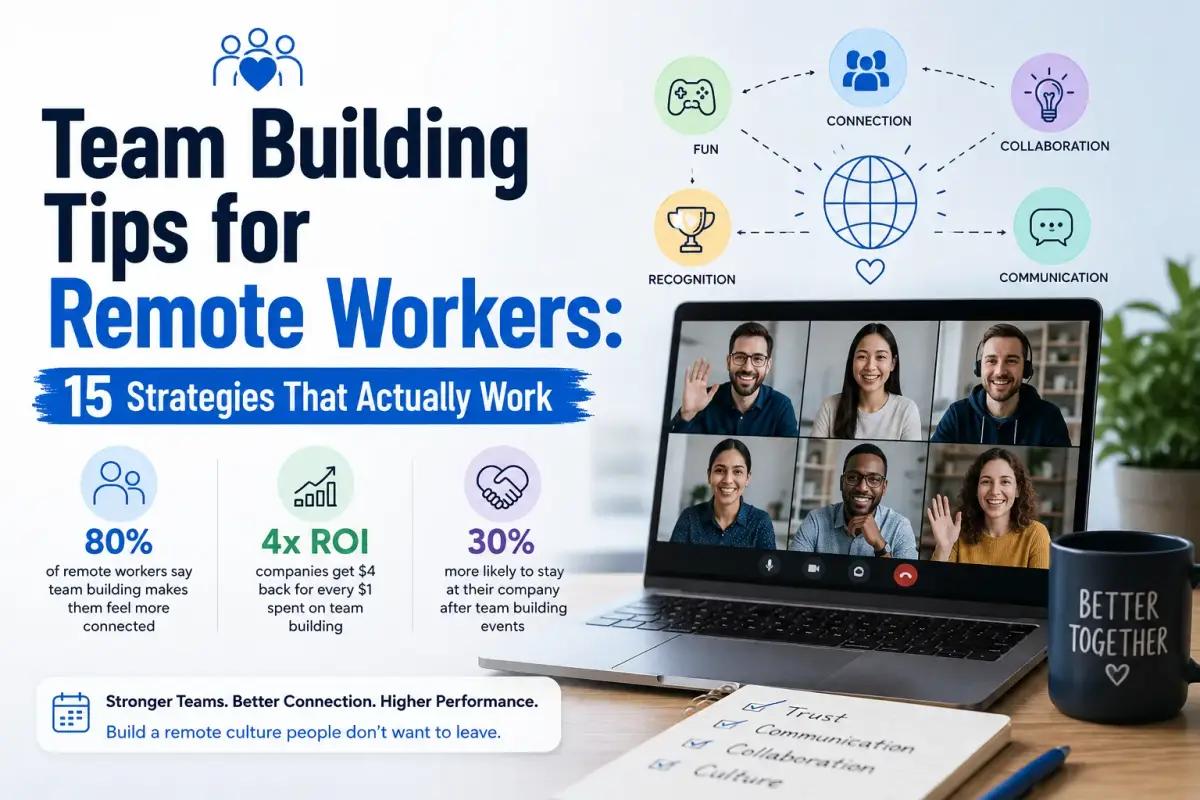
Remote team building is one of the most underfunded and underexecuted priorities in distributed tech organizations, and the data shows exactly what that neglect costs. 65 percent of remote employees feel that their manager has not made an effort in team building since going remote, yet 80 percent of remote workers say that team building activities make them feel more connected to their company. The gap between what employees need and what employers deliver is one of the clearest drivers of preventable attrition in remote tech teams. This guide covers 15 proven team-building strategies specifically designed for distributed tech professionals, what works, what does not, how to execute without wasting everyone's time, and what the research says about the return on investment of getting this right.
Why Remote Team Building Is Not Optional
Remote team building directly determines whether distributed tech teams retain their best people, perform at their potential, and maintain the trust and communication quality that makes distributed collaboration work, and the research in 2026 is unambiguous about the cost of neglecting it.
Only 32 percent of US employees are engaged at work, among the lowest levels ever recorded. Yet companies investing in team building see four dollars returned for every one dollar spent, and organizations with comprehensive engagement programmes report an 87 percent reduction in turnover.
Remote workers who have had a team-building event in the last six months are 30 percent more likely to stay at their company. For a distributed tech team where replacing a senior engineer costs 1.5 to 2 times their annual salary, that retention improvement represents a measurable financial return that dwarfs the cost of any team-building programme.
71 percent of remote employees say they feel more independent working alone, but 81 percent want more connection with their team. This is the central tension of remote work that team building directly addresses: professionals value the autonomy of distributed work and simultaneously experience the isolation it produces. Both things are true, and team building is the primary organizational tool for maintaining the connection without removing the autonomy.
Virtual team building events cost 75 percent less than in-person alternatives while delivering up to 12 percent higher ROI. The resource argument against remote team building does not survive contact with the data.
Tip 1: Run a Structured Weekly Async Check-In
A structured async check-in, a weekly post in a dedicated channel where each team member shares what they are working on, what is going well, and what is blocking them, builds team visibility, normalizes vulnerability, and creates a consistent social rhythm that replaces the informal hallway conversations distributed teams lose.
The format matters. A check-in that is too formal becomes a status report nobody reads. A check-in with too little structure produces nothing useful. The sweet spot is three questions answered in writing by each team member at the start of each week: what are you focused on this week, what did you learn or accomplish last week, and what is one non-work thing you are looking forward to.
The third question is not decoration. It is the mechanism that builds the personal knowledge that makes team relationships more than transactional. Remote teams whose members know each other as people, not just as contributors to a codebase, communicate with more trust, interpret ambiguous messages more charitably, and recover from conflict faster.
Implementation: Create a dedicated channel (not the general work channel), set a consistent time, and make participation visible. Managers should model the behaviour first and consistently. 65 percent of remote employees feel their manager has not made an effort in team building, which means manager participation is the primary signal that these rituals are genuinely valued.
Tip 2: Create a Dedicated Non-Work Channel and Actually Use It
A non-work channel, for sharing photos, recommendations, interests, or random observations, gives remote team members a low-stakes space to interact as people rather than as project contributors, building the background familiarity that co-located teams develop through incidental shared space.
The channel only works if leadership uses it. Teams take cues from their managers about what is appropriate and what signals belonging. A non-work channel where only junior team members post gradually becomes a space where senior engineers do not engage, sending an unintentional message about who the culture includes.
Themes help sustain participation beyond the initial enthusiasm. A weekly photo prompt (share something from your commute-free morning), a shared playlist the team contributes to, or a rotating question of the week generates ongoing low-effort participation that builds familiarity over time without requiring anyone to commit significant attention.
Tip 3: Establish a Virtual Coffee Pairing Programme
A virtual coffee pairing programme, where team members are randomly matched with a colleague for a 20 to 30 minute informal video call each week or fortnight, systematically builds cross-team relationships that would happen incidentally in an office but never happen without deliberate facilitation in a remote environment.
Remote employees who feel supported by their team are 47 percent more likely to report high levels of wellbeing. Virtual coffee pairings are one of the most direct investments in that support infrastructure because they create one-on-one relationships across the distributed team that async channels alone never produce.
Tools like Donut (a Slack integration) automate the pairing and scheduling, removing the coordination friction that makes voluntary one-on-one programmes fade after the first few weeks. The automation matters, remote team building rituals that require ongoing manual organisation consistently die when the organiser gets busy or moves on.
Budget 30 minutes per person per fortnight for virtual coffee pairings and treat it as working time, not personal time. The relationship investment it produces pays back in collaboration quality, communication trust, and retention at a multiple that justifies the cost.
Tip 4: Design Onboarding That Introduces People, Not Just Processes
Remote onboarding that focuses exclusively on systems access, documentation, and process orientation produces new hires who know how to use the tools but do not know their teammates, which means they take longer to ask for help, longer to give feedback honestly, and longer to become fully productive contributors to the team.
The first two weeks of a remote onboarding should include scheduled introductions to at least five to eight teammates, not to discuss work, but to build the personal baseline that makes future work conversations more natural. A 20-minute introductory call with a direct teammate, a coffee chat with someone from a cross-functional team, and a casual group call with the immediate team as a whole produce a foundation that purely process-oriented onboarding never creates.
75 percent of remote workers say their companies help them connect with colleagues at work, which means a quarter of remote employers who do not facilitate these connections are producing more isolated, slower-ramping, and faster-churning new hires than their competitors.
Assign a dedicated onboarding buddy, a peer-level team member with no direct reporting relationship, whose specific responsibility is helping the new hire feel connected, not just informed. Buddies answer the questions new hires are too embarrassed to ask a manager, and their effectiveness at building belonging is consistently higher than formal onboarding programmes alone.
Tip 5: Celebrate Wins Publicly and Specifically
Public, specific recognition of team member contributions, in team channels, in all-hands updates, or in direct messages copied to relevant stakeholders, builds the visible appreciation culture that remote teams need to replace the informal praise and acknowledgment that happens naturally in office environments.
Recognition can lift team morale by 60 percent. 37 percent of employees say they would stay at a company longer if they received more recognition from their leader. For remote tech teams where the cost of turnover is high and the competitive pressure on talent is constant, the return on retention from systematic recognition is one of the most accessible wins available to any manager.
The quality of recognition matters as much as its frequency. Generic "great job" messages carry almost no motivational weight. Specific recognition, describing what the person did, why it mattered, and what outcome it produced, signals that the manager actually understood the contribution and valued it precisely, not just as a ritual.
Peer-to-peer recognition programmes are 35 percent more likely to have a positive impact on financial results than manager-only recognition. Building a culture where teammates recognize each other, not just waiting for a manager to do it, multiplies the recognition frequency without adding to any one person's workload.
Tip 6: Run Virtual Team Events That Respect Time Zones
Virtual team events work when they are genuinely fun, short, and scheduled with awareness of every participant's time zone, and fail when they are long, mandatory in spirit, scheduled across inconvenient hours, or so clearly budget-minimising that they communicate low investment in the team.
75 percent of candidates expect regular team building and virtual social events when evaluating remote employers. This is now a hiring expectation, not just a retention tool.
Activities that consistently work for distributed tech teams include online trivia with teams mixed across departments, virtual escape rooms (multiple platforms offer team versions for six to twelve people), collaborative cooking or cocktail-making with ingredients shipped in advance, online game sessions (skribbl.io, Jackbox Games, Among Us), and async team challenges where participation happens over several days rather than requiring everyone to be online simultaneously.
The async format deserves specific mention. A photo challenge where team members share something from their week, a team playlist built over 48 hours, or a collaborative prediction game about a company milestone all produce social connection without the timezone constraint of a single synchronous event, and they achieve better participation from globally distributed teams precisely because they accommodate different schedules.
Tip 7: Make One-on-Ones Genuinely Human
Remote one-on-one meetings that are entirely task and project focused miss their most important function, building the manager-employee relationship that determines whether a remote team member feels supported, understood, and genuinely part of the team rather than a contractor fulfilling a specification.
The first five minutes of every one-on-one should be genuinely personal, not as small talk before the real agenda, but as the recognition that the remote employee is a full person whose life context affects their work, their wellbeing, and their long-term commitment to the team. Managers who ask about and remember personal context, a project a team member mentioned working on outside work, a challenge they discussed in a previous call, build trust that task-focused management never produces.
Remote employees are 33 percent more likely than average to recommend their managers, which reflects that distributed management done well produces stronger relationships than co-located management by default, the deliberateness required to manage remotely well produces outcomes that incidental in-person management frequently misses.
Increase one-on-one frequency for new remote hires, weekly for the first 90 days is the standard at well-run remote-first companies, stepping down to fortnightly once the team member is fully ramped. The investment in the relationship during that early period pays back in faster productivity, stronger retention, and more honest communication throughout the employment.
Tip 8: Build Documentation as a Team Culture Practice
Teams that document their work, their decisions, their processes, and their norms collectively, rather than leaving documentation to a designated individual, build a shared knowledge infrastructure that reduces isolation, reduces single points of failure, and gives every remote team member the context they need to contribute fully without being physically present.
Documentation is team building in remote environments because it is the primary mechanism through which distributed team members understand each other's context, reasoning, and working patterns. A well-documented architecture decision record is a window into how a senior engineer thinks. A well-written retrospective is a shared record of what the team learned together. A well-maintained onboarding wiki is a gift to every future team member that also reflects a team's investment in each other.
Build documentation into team rituals, a brief documentation slot in sprint retrospectives, a rotating responsibility for summarising key decisions, and a norm of linking to relevant documentation in every async discussion, so that it becomes a shared practice rather than a task that falls to whoever feels guilty enough to do it.
Tip 9: Create Cross-Functional Collaboration Opportunities
Remote tech professionals who interact only with their immediate team develop narrower professional relationships and a weaker sense of organizational belonging than those who have visibility into and relationships across different functions. Engineering, design, product, security, and cross-functional collaboration is the primary mechanisms for building that broader connection.
For distributed teams specifically, cross-functional connection does not happen through physical proximity the way it does in offices; there is no shared kitchen, no all-hands hallway conversation, no accidental overlap that creates familiarity. It must be engineered deliberately through cross-functional projects, open technical reviews that invite input from adjacent teams, and communication channels that span team boundaries.
Remote DevOps engineers who engage with security team peers on infrastructure security reviews, frontend developers who participate in design system reviews with the design team, and backend engineers who join product discovery calls with the product team all build the cross-functional relationships that make distributed organizations more than collections of isolated teams.
Tip 10: Invest in Annual or Bi-Annual In-Person Retreats
A single annual or bi-annual in-person gathering, even two to three days, produces a relationship depth that months of excellent async collaboration cannot replicate, and the investment pays back in communication quality, trust, and collaboration effectiveness for the rest of the year.
Virtual team building events cost 75 percent less than in-person alternatives, which means that the savings from distributed operations more than fund an annual in-person retreat without net cost to the organisation. The framing matters: the retreat is funded by the office cost savings of remote-first operations, not an additional expense.
Retreat design matters as much as frequency. The most effective remote team retreats prioritise unstructured social time alongside strategic planning, activities that allow relationships to deepen informally, not just an off-site with the same meeting structure as every other week. Meals together, physical activities, and genuinely playful social time produce the emotional connection that makes the following year of distributed collaboration warmer and more trusting.
For globally distributed teams where the flight costs of bringing everyone to one location are significant, regional gatherings, smaller teams in closer geographies, can be a practical complement to the full-team annual retreat, maintaining relationship investment without requiring intercontinental travel for every team building event.
Tip 11: Establish Clear Team Norms and Review Them Together
Remote teams that have written, shared, and collectively agreed-upon norms for communication, availability, decision-making, and feedback operate with significantly less friction and misunderstanding than those where these expectations are assumed rather than documented, because assumed norms in distributed teams produce exactly the misalignments that generate conflict and erode trust over time.
A team norms document covers practical expectations, response time windows for different message types, how meetings are scheduled across time zones, how decisions are documented, how feedback is given and received, and what happens when a team member is unavailable, but the process of creating it together is at least as valuable as the document itself.
A facilitated team norms session, run async over a shared document or synchronously in a focused 90-minute call, produces both a practical reference and a shared ownership of the team's operating agreements. Teams that create their norms together feel more accountable to them than teams where norms are handed down by management.
Review and update the norms document annually, or whenever the team significantly changes. A team that revisits its operating agreements regularly is signalling that the culture is a living thing the team owns, not a set of rules imposed from above.
Tip 12: Encourage and Fund Professional Development Together
Remote teams that learn together, through shared courses, book clubs, conference attendance (virtual or in-person), or internal knowledge-sharing sessions, build both team cohesion and the professional development that directly contributes to retention.
75 percent of employees say they are more likely to stay at a company that invests in their professional development. For remote tech teams where skill development cannot happen through proximity, watching a senior engineer debug, pairing on a difficult problem, or absorbing knowledge through shared workspace, deliberate structured learning investment is both a team building tool and a technical performance tool simultaneously.
Internal knowledge-sharing sessions, where a team member presents something they have learned, a problem they solved, or a technology they explored, are one of the highest-value and lowest-cost team building investments available for distributed tech teams. They produce visible professional contribution, technical knowledge transfer, and a regular rhythm of team interaction that serves social as well as educational purposes.
Tip 13: Use Recognition Tools That Make Appreciation Visible
Recognition tools, platforms or integrations that make peer appreciation visible across the team, amplify the effect of individual recognition acts by making them public, searchable, and cumulative, building a visible record of team contribution that purely private praise never creates.
Tools like Bonusly, Kudos, and Slack-native recognition bots allow team members to recognise each other with small monetary rewards or public acknowledgments that are visible to the entire team. The visibility is the mechanism, seeing a colleague receive recognition reinforces that the behaviour is valued, and receiving recognition publicly communicates to the entire team that this person's contribution matters.
Peer-to-peer recognition programmes are 35 percent more likely to have a positive impact on financial results than manager-only recognition. The key word is peer-to-peer, distributed recognition authority across the team multiplies the frequency and authenticity of acknowledgment in ways that centralised, top-down recognition cannot match.
Tip 14: Create Space for Psychological Safety
Remote teams cannot function at their best without psychological safety, the shared belief that team members can speak up, raise concerns, ask questions, and admit mistakes without fear of punishment or embarrassment, and building this safety requires more deliberate effort in distributed environments where the social cues that signal safety in person are absent.
Miscommunication in remote teams is approximately 40 percent more common than in office environments due to the absence of non-verbal cues and the compressed context of written communication. In environments with low psychological safety, that higher miscommunication rate produces blame, defensiveness, and silence, exactly the opposite of what distributed teams need.
Managers build psychological safety in remote teams through consistent, predictable behaviour: responding to mistakes with curiosity rather than blame, asking for input before making decisions, sharing their own uncertainties and errors publicly, and following through on commitments consistently so that team members learn through experience that speaking up is safe. A manager who reacts to problems as learning opportunities communicates safety more powerfully than any culture document.
Tip 15: Measure Team Health and Act on What You Find
Remote teams that regularly survey their members on connection, belonging, communication quality, and engagement, and that visibly act on the findings, demonstrate that team health is a genuine priority rather than a stated value that never influences decisions.
According to Gallup's 2024 study, 29 percent of fully remote workers are engaged, surpassing the 20 percent engagement rate of their on-site counterparts, which means remote work itself is not the enemy of engagement. Disengagement in remote teams is almost always produced by specific, fixable conditions: poor communication norms, isolation, lack of recognition, or unclear expectations. Measuring team health surfaces which of these conditions exist in your specific team.
A simple monthly pulse survey, four to six questions covering communication quality, sense of belonging, clarity of expectations, and workload manageability, takes two minutes to complete and produces actionable data within the same week. The survey only produces value if the results are shared with the team and specific actions are taken in response. A survey whose findings are never discussed communicates that the questions were not genuinely asking.
Gallup's State of the Global Workplace report and Speakwise's Virtual Team Building Statistics provide the most comprehensive current data on remote team engagement, retention, and the financial return on team building investment.
For Employers: The Business Case for Remote Team Building Investment
Remote team building is not a morale programme; it is a retention and performance investment with a documented financial return of four dollars for every one dollar spent, a 30 percent increase in retention likelihood for teams with regular team building activity, and an 87 percent reduction in turnover at organizations with comprehensive engagement programmes.
Companies with strong remote management practices see 21 percent higher employee engagement, according to Accenture's workforce management research. For tech employers competing for senior engineers, DevOps professionals, and cybersecurity specialists, roles with global talent shortages and high replacement costs, a 21 percent engagement improvement translates directly into the retention advantage that reduces the most expensive cost in distributed tech hiring.
51 percent of organizations organize virtual team building activities monthly, which means that monthly team building is now the median expectation, not a differentiator. Companies below this threshold are operating below the standard that candidates and current employees now expect.
The investment required to close this gap is modest relative to the return. A monthly virtual team event, a weekly async check-in ritual, a peer recognition programme, and an annual in-person retreat can be fully funded by the real estate savings of remote-first operations for most organizations, with significant net financial return from retention improvement alone.
FarCoder connects remote employers with verified tech professionals across every specialization, developers, designers, DevOps engineers, cybersecurity analysts, and more, who are actively evaluating employers on culture and team building investment alongside compensation and role scope.
For Job Seekers: How to Evaluate a Remote Team's Culture Before You Join
The quality of a remote team's culture, its communication norms, its recognition practices, its team building investment, is visible through specific signals in the hiring process, and evaluating these signals before accepting an offer is one of the most important due diligence steps available to remote job seekers.
Ask specific questions in your interviews: How does the team celebrate wins? What does a typical week of team communication look like? Does the team have regular rituals beyond work standup? How does the company handle onboarding for remote employees? What is the last team building event the team did together? Vague or unenthusiastic answers to these questions are as informative as strong ones.
Look at the interview process itself as data. A hiring process that is warm, communicative, and respectful of your time is evidence of a team that values the same things in ongoing employment. A process that is disorganised, uncommunicative, or impersonal predicts the same qualities in the team culture you would be joining.
Use FarCoder's Cover Letter Generator to write tailored applications for remote employers whose culture signals match what you are looking for → farcoder.com/tools/cover-letter-generator
Frequently Asked Questions (FAQ)
Why is team building important for remote workers?
+−
Remote work removes the incidental social contact that office environments provide automatically, creating isolation that progressively erodes engagement, communication quality, and retention if not actively addressed. 80 percent of remote workers say team building activities make them feel more connected to their company, and remote workers who have had a team building event in the last six months are 30 percent more likely to stay. Team building is the primary organizational tool for maintaining the human connection that remote work structurally removes.
What are the most effective virtual team-building activities for tech teams?
+−
The most effective activities for distributed tech teams are those that allow genuine interaction without high time or effort commitment, virtual trivia, online escape rooms, async photo or playlist challenges, and virtual coffee pairings consistently outperform elaborate productions. The key is regularity over spectacle: monthly low-effort events produce more cumulative relationship investment than quarterly high-production events.
How often should remote teams do team-building activities?
+−
51 percent of organizations organize virtual team building activities monthly, making monthly the current median expectation. Weekly async rituals (check-ins, recognition) should run continuously. Monthly virtual events maintain social rhythm. An annual or bi-annual in-person retreat produces relationship depth that virtual events cannot replicate.
How do you build team culture without a physical office?
+−
Remote team culture is built through consistent rituals, transparent communication, systematic recognition, and deliberate investment in personal relationships that async work channels alone do not produce. The most important factor is manager behaviour, managers who participate in team rituals, recognize contributions specifically and publicly, and invest in one-on-one relationships model the culture they want the team to build.
What is the ROI of remote team building?
+−
Companies investing in team building see four dollars returned for every one dollar spent, and organisations with comprehensive engagement programmes report an 87 percent reduction in turnover. For tech employers where replacing a senior engineer costs 1.5 to 2 times annual salary, even modest retention improvements produce returns that far exceed the investment in team building programmes.
How do I find remote employers who invest in team culture?
+−
Ask directly in interviews, specific questions about team rituals, recognition practices, and onboarding structure reveal genuine investment versus stated values. Look at review platforms like Glassdoor for mentions of team culture by current and former employees.
About the Author

Muhammad Mansoor Ishaq
**Muhammad Mansoor Ishaq** is the Co-Founder of FarCoder and an experienced web developer specializing in WordPress, Shopify, Wix, and Squarespace. In addition to his technical expertise, he is a regular contributor to FarCoder’s blog, where he writes about remote work, software development careers, web development, freelancing, digital transformation, workplace productivity, hiring trends, and the future of distributed teams. Drawing from both hands-on industry experience and ongoing research, Muhammad creates practical, insightful content that helps job seekers, developers, and employers succeed in an increasingly remote-first world. His work focuses on bridging the gap between technology, talent, and modern work opportunities across global markets.
Connect on LinkedIn