Small Companies Seeking Remote Workforce: How to Hire, Manage, and Scale Remote Teams

Far Coder Team
Fri May 08 2026
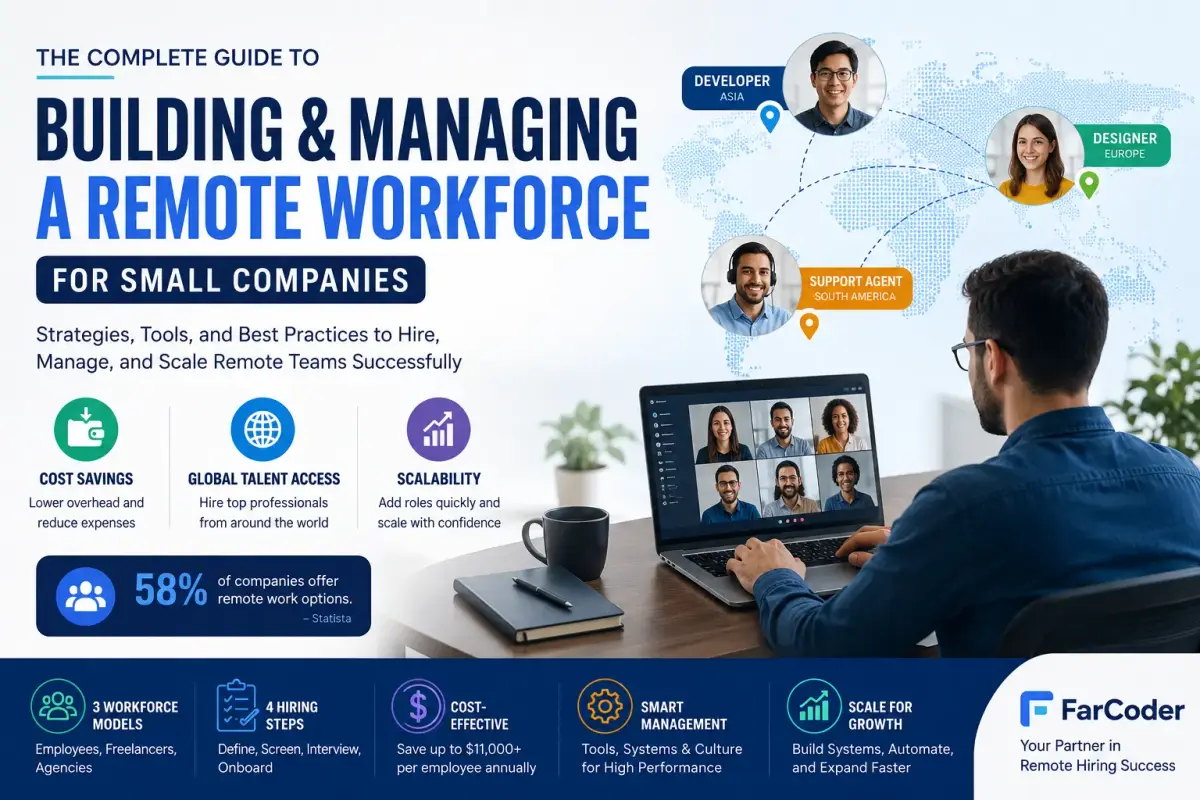
Small companies build remote workforces using remote employees, freelancers, and agencies to reduce costs, access global talent, and scale faster. Successful remote hiring depends on structured recruitment, clear communication, proper management tools, and strong workflows that improve productivity and long-term team growth.
Small companies build remote teams using 3 models: remote employees, freelancers, and agencies.
There are 3 core benefits, including cost savings like reduced office rent and equipment, global talent access like hiring developers from Asia and designers from Europe, and scalability like adding roles quickly. According to Statista, over 58% of companies offer remote work options.
There are 3 hiring sources, including freelance platforms like Upwork and Fiverr, job boards like Indeed and LinkedIn, and platforms like FarCoder for sourcing remote talent efficiently.
There are 4 hiring steps, including defining roles like support and development tasks, screening candidates like tests and portfolios, conducting interviews like video calls and async tasks, and onboarding like contracts and training.
There are 3 cost factors, including salaries like $800–$10,000 monthly by region, operational savings like no office expenses, and hidden costs like tools and compliance.
There are 4 management systems, including communication tools like Slack and Zoom, tracking systems like Trello and Asana, time coordination like async workflows, and culture building like feedback and recognition.
There are 4 risks, including hiring mistakes like unqualified candidates, communication gaps like unclear instructions, process issues like missing SOPs, and engagement problems like low interaction.
There are 3 growth stages, including scaling teams like hiring more roles, transitioning from freelancers to full-time staff, and building systems like automation and workflows.
FarCoder supports remote hiring by connecting small companies with qualified remote workers and structured hiring workflows.
Understanding Remote Workforce for Small Companies
A remote workforce for small companies means hiring distributed talent across 3 models: remote employees, freelancers, and agencies.
There are 3 workforce types, including remote employees like full-time developers and support agents, freelancers like graphic designers and copywriters, and agencies like marketing firms and software teams. Each model supports different tasks.
There are 2 key differences, including control level like managing employees directly and flexibility like hiring freelancers or agencies for short-term work.
Small companies adopt remote hiring due to 3 benefits, including cost savings like office rent and equipment, global talent access like hiring developers from Asia and designers from Europe, and scalability like adding roles quickly.
According to Statista, over 28% of employees worked remotely worldwide in 2023.
Why Small Companies Hire Remote Workers
Small companies hire remote workers for 4 reasons: cost savings, global talent access, flexibility, and scalable hiring.
There are 3 cost advantages, including lower salaries like hiring developers from Asia and designers from Eastern Europe, reduced overhead like office rent and utilities, and lower equipment costs like laptops and software tools.
There are 2 talent benefits, including access to global professionals like developers, marketers, and support agents, and faster hiring like sourcing candidates from multiple regions.
There are 3 flexibility benefits, including scaling teams like adding freelancers for projects, reducing risk like short-term contracts, and continuous work cycles like teams across time zones.
According to Statista, over 58% of companies offer remote work options, showing widespread adoption.
Where to Find Remote Workers
There are 3 main places to find remote workers: freelance platforms, job boards, and agencies.
There are 3 hiring sources, including freelance platforms like Upwork and Fiverr, job boards like Indeed and LinkedIn, and agencies like marketing firms and development companies.
There are 3 pros and cons, including freelance platforms offering fast hiring but variable quality, job boards providing stable hires but slower screening, and agencies delivering managed services but higher costs.
Choosing the right source depends on 3 factors, including project type like short-term tasks and long-term roles, budget like hourly and fixed pricing, and control level like direct management or outsourcing.
According to Statista, over 70 million people work as freelancers globally, increasing talent availability.
How to Hire Remote Workers Step by Step
Hiring remote workers involves 4 steps: defining roles, screening candidates, conducting interviews, and onboarding employees.
Define Roles and Requirements
Define roles using 3 elements: responsibilities, required skills, and expected outcomes.
Responsibilities include tasks like managing emails and handling support tickets. Skills include communication and tool usage. Outcomes include deadlines, task completion, and performance targets.
Screen and Test Candidates
Screen candidates using 3 methods: resume review, skill tests, and portfolio evaluation.
Resumes show experience like past roles and tools used. Tests include coding tasks and writing samples. Portfolios include GitHub projects and design work.
Conduct Interviews Remotely
Conduct interviews using 2 formats: video interviews and async assessments.
Video calls include Zoom and Google Meet sessions. Async tests include written responses and task-based scenarios.
Hire and Onboard Remote Employees
Hire and onboard using 3 steps: offer, setup, and training.
Setup includes contracts like NDAs and payment systems like invoices and payroll tools. Training includes onboarding sessions and workflow guides.
Cost of Hiring a Remote Workforce
The cost of hiring a remote workforce includes 3 components: salaries, operational expenses, and hidden costs across regions.
There are 3 salary ranges by country, including developers in the United States earning $6,000–$10,000 monthly, developers in Eastern Europe earning $2,000–$5,000, and developers in Asia earning $800–$3,000. These differences reduce costs.
There are 2 cost comparisons, including remote employees costing 30–60% less than local hires due to savings like office rent and utilities, and freelancers costing variable rates like hourly and project-based pricing.
There are 3 hidden costs, including tools like Slack and Zoom, onboarding like training and documentation, and compliance like contracts and payroll systems.
According to Global Workplace Analytics, companies save over $11,000 per employee annually.
How to Manage Remote Teams Effectively
Managing remote teams effectively requires 4 systems: communication, performance tracking, time zone coordination, and team culture.
Communication and Collaboration
Effective communication uses 3 tools: messaging, meetings, and documentation.
Messaging includes Slack and Microsoft Teams. Meetings include Zoom calls and Google Meet sessions. Documentation includes Notion pages and Google Docs. These ensure clarity.
Tracking Productivity and Performance
Performance tracking uses 3 methods: task systems, KPIs, and reporting.
Task tools include Trello and Asana. KPIs include task completion rate and deadlines met. Reporting includes weekly updates and summaries.
Managing Time Zones
Time zone management uses 2 strategies: overlap hours and async workflows.
Overlap hours include shared windows like 2–4 hours daily. Async work includes written updates and recorded messages.
Building a Strong Remote Team Culture
Team culture builds through 3 actions: interaction, recognition, and shared goals.
Interaction includes team chats and meetings. Recognition includes feedback and rewards. Goals include milestones and targets.
Best Tools for Remote Workforce Management
There are 4 essential tools for remote workforce management: communication, project management, time tracking, and HR systems.
Communication tools include Slack and Zoom for messaging and meetings. Project tools include Trello and Asana for task tracking and deadlines. Time tracking tools include Toggl and Hubstaff for measuring work hours. HR tools include Deel and Gusto for payroll and compliance.
According to Statista, over 74% of companies use collaboration tools, improving efficiency.
Common Challenges and Mistakes to Avoid
There are 4 common challenges to avoid in remote teams: hiring mistakes, poor communication, unclear processes, and low engagement.
Hiring mistakes include selecting unqualified candidates like developers without project experience and marketers without campaign results. Poor communication includes unclear messages like vague instructions and delayed responses, and missing tools like Slack and Zoom.
There are 3 process gaps, including lack of task systems like Trello and Asana, missing documentation like SOPs and guides, and unclear responsibilities like undefined roles.
There are 2 engagement risks, including low interaction like limited meetings and weak motivation like lack of feedback and recognition.
According to Gallup, only 23% of employees are engaged, affecting remote team performance.
Legal and Compliance Considerations
Legal and compliance considerations for remote hiring include 3 areas: worker classification, contracts, and payment regulations.
There are 2 hiring models, including contractors like freelancers and consultants, and employees like full-time remote staff. Misclassification creates legal risks across countries like the United States, Germany, and India.
There are 3 legal documents, including contracts like employment agreements and service contracts, NDAs like confidentiality agreements and data protection clauses, and compliance forms like tax declarations and identity verification.
There are 3 payment factors, including payment methods like bank transfers and PayPal, tax obligations like income reporting and withholding taxes, and currency handling like USD and EUR.
According to OECD, over 60% of cross-border services require compliance measures.
Scaling a Remote Workforce for Growth
Scaling a remote workforce involves 3 steps: identifying growth signals, transitioning roles, and building structured systems.
There are 3 expansion signals, including increased workload like more client projects and support tickets, revenue growth like higher monthly income and contracts, and delays like missed deadlines and backlog tasks. These indicate scaling needs.
There are 2 transition stages, including moving from freelancers like designers and writers to full-time staff like developers and managers, and shifting from general roles to specialists like SEO experts and UI designers.
There are 3 system requirements, including workflows like SOPs and pipelines, tools like Slack and Asana, and automation like Zapier and reporting dashboards.
Future of Remote Workforce for Small Companies
The future of remote workforce for small companies is shaped by 3 factors: global talent expansion, AI adoption, and continued remote work growth.
There are 3 hiring trends, including global talent access like developers from Asia and designers from Europe, AI-driven hiring like resume screening and automation tools, and remote-first models like fully distributed teams and hybrid setups.
There are 2 technology impacts, including AI tools like chatbots and automation platforms, and productivity systems like dashboards and analytics tools. These improve efficiency.
There are 2 growth drivers, including cost efficiency like reduced office expenses and talent expansion, like international hiring.
Check Remote jobs: https://farcoder.com/jobs
Frequently Asked Questions (FAQ)
What is the best way for small companies to start building a remote workforce?+−
Small companies should start with clearly defined roles, simple workflows, and affordable communication tools. Many businesses begin by hiring freelancers for short-term tasks before transitioning to full-time remote employees as the company grows.
How much does it cost to hire remote workers?+−
Remote workforce costs vary by role and region. Developers in Asia may cost $800–$3,000 monthly, while developers in the United States may cost $6,000–$10,000 monthly. Companies also save money through reduced office, utility, and equipment expenses.
Which tools are most important for managing remote teams?+−
The most important remote management tools include communication platforms like Slack and Zoom, project management tools like Trello and Asana, time tracking software like Toggl and Hubstaff, and HR systems like Deel and Gusto for payroll and compliance.