Remote Work Experience vs. Traditional Experience: How to Present It on Your CV

Far Coder Team
Mon Jul 06 2026
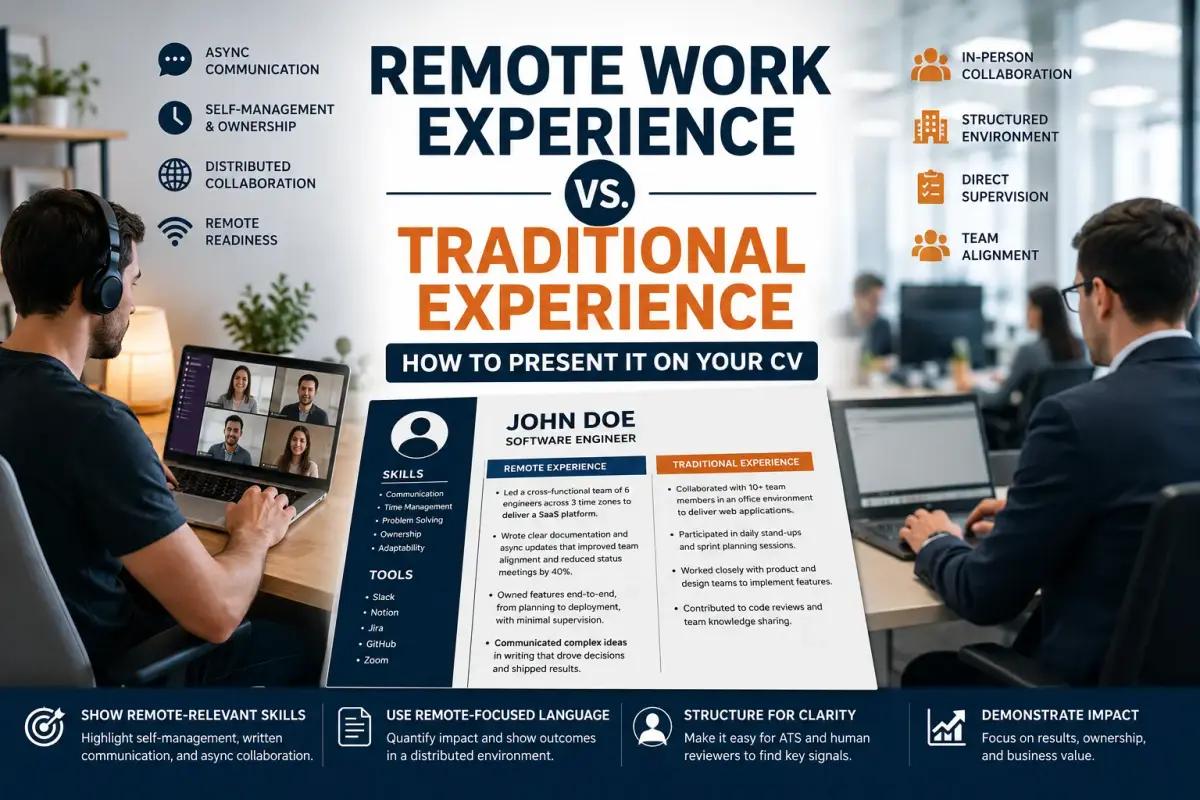
A CV built for office-based hiring and a CV built for remote hiring are not the same document, even when the underlying experience is identical. Remote employers are evaluating a layer of capability that traditional CVs were never designed to communicate: self-management, async communication, and distributed collaboration, and 71 percent of hiring managers now prioritise clear remote-work accomplishments when evaluating candidates. This guide covers exactly how to present remote work experience differently from traditional experience, how to translate office-based experience into remote-relevant signals if you are transitioning, and the specific formatting, language, and structural choices that separate CVs that pass remote screening from those that do not.
Why Remote Experience and Traditional Experience Need Different CV Treatment
Remote employers evaluate a CV for evidence of self-management, written communication quality, and distributed collaboration capability in addition to the technical or professional qualifications a traditional CV is built to demonstrate, which means a CV that simply lists job titles, dates, and duties communicates competence but not remote readiness, and remote readiness is now a primary screening criterion in its own right.
By 2026, companies hiring for remote positions are expected to receive three times more applications compared to on-site roles. This volume means your CV needs to perform well for both automated ATS systems and human reviewers who are actively looking for remote-specific signals, not just generic competence. A CV built for a traditional office role and submitted unchanged to a remote position is competing against a pool of applicants who have deliberately tailored their materials to demonstrate remote capability, and that gap is visible to any experienced remote hiring manager within seconds.
The core difference is this: traditional CVs answer the question "can this person do the job." Remote CVs must answer two questions simultaneously, "can this person do the job" and "can this person do the job without daily supervision, in writing, across time zones, with minimal friction." The second question requires deliberate, specific evidence that a traditional CV format does not naturally surface.
The Five Places Remote Experience Should Appear on Your CV
Remote work experience should not be confined to a single section, it should appear in your professional summary, your job titles and locations, your work history descriptions, your skills section, and optionally in a dedicated remote work section, because hiring managers and ATS systems scan different parts of a CV at different stages of review.
1. Your Professional Summary
Your summary is the first thing both ATS systems and human reviewers process, and it should establish your remote readiness immediately rather than burying it in job descriptions further down the page. Since this section sits at the top of your CV, hiring managers know you can work remotely right away, eliminating the need for them to infer it from scattered details later in the document.
A strong remote-focused summary states your specialisation, your years of remote experience specifically, and one quantified outcome that demonstrates self-directed delivery. For example: "Senior backend engineer with 5 years of fully remote experience leading distributed teams across three time zones, specialising in API architecture and async-first engineering practices."
2. Job Titles and Location Fields
Add "(Remote)" or "(Hybrid – 3 days remote)" directly next to your job title or company location so the format is unambiguous at a glance. For example: "Senior Backend Engineer | TechCorp (Remote) | March 2021 – Present." This single formatting choice means a reviewer scanning quickly does not need to read your full job description to identify your remote experience, it is visible in the header of every role.
For your location field, list your city and country, or simply "Remote," as these are now standard search filters recruiters use in 2026 ATS systems. Omit your full street address; a full home address is unnecessary for remote roles and adds no value to the application.
3. Work History Descriptions
This is where the substance of your remote experience belongs, not as a generic claim that you "worked remotely," but as specific, quantified evidence of what that remote work produced. The strongest descriptions follow an accomplishment formula: action, method, and measurable result.
Compare a traditional bullet point against a remote-specific one for the same underlying work:
Traditional version: "Led a product team and delivered four feature releases."
Remote-specific version: "Led a fully distributed product team of 8 across US, UK, and India time zones, delivering 4 major feature releases in 2025. Established asynchronous communication protocols using Notion and Loom, reducing weekly meeting time by 40 percent."
The second version does everything the first does, plus it demonstrates distributed team leadership, time zone management, and a specific async communication outcome, three signals that directly answer the question a remote hiring manager is actually asking.
4. Your Skills Section
List remote-specific tools and capabilities explicitly rather than assuming a hiring manager will infer them from your job history. Remote tool proficiency appears as a priority signal in 92 percent of remote hiring evaluations, according to recent analysis of remote application outcomes, making explicit tool listing one of the highest-return additions to a remote-focused CV.
Group your skills section into categories that separate technical competencies from remote-readiness competencies: a "Remote Collaboration" or "Async Tools" subsection listing Slack, Notion, Loom, Asana, Linear, Zoom, and GitHub alongside your core technical skills signals deliberate remote positioning rather than incidental tool familiarity.
5. A Dedicated Remote Work Section (Optional but Effective)
For candidates with extensive remote experience across multiple roles, a dedicated section, separate from your standard work history, that summarises your cumulative remote experience can be a powerful addition. This might include total years of remote experience, the range of time zones you have worked across, and your home office setup or certifications relevant to remote work, such as a Certified Remote Work Professional credential where applicable.
This section is not necessary for every candidate, but it is particularly effective for professionals with five or more years of remote experience who want to establish themselves as remote work specialists rather than office workers who happened to work from home occasionally.
How to Present Remote Experience If You Have Extensive Remote History
Candidates with a consistent remote work history should use a reverse-chronological format that highlights career progression within distributed roles, lead every job description with the scale and structure of the remote team they worked within, and quantify async-specific outcomes rather than generic accomplishments that could apply to any work environment.
The strongest signal for experienced remote candidates is specificity about the distributed nature of their teams, not just that the role was remote, but how the team was distributed and what coordination that required. "Managed a $500K product development budget remotely, delivering all initiatives on schedule and 12 percent under budget" demonstrates financial and operational ownership that happened to occur in a remote context, a stronger signal than simply stating you "worked remotely" without connecting it to a concrete outcome.
Use action verbs that imply autonomy and proactive communication: led, established, initiated, coordinated, documented, and delivered, rather than passive verbs like "assisted" or "participated," which undersell the self-direction that remote employers are specifically screening for.
Address time zone coordination explicitly wherever it was a genuine part of your role. "Coordinated sprint planning and code review across a team spanning UTC-8 to UTC+5:30, maintaining a 48-hour maximum turnaround on all pull requests" demonstrates exactly the kind of distributed-team competency that a generic "team player" claim never communicates.
How to Present Traditional Experience If You Are Transitioning Into Remote Work
Candidates without direct remote work history should use a functional or hybrid CV format that foregrounds remote-ready skills rather than burying them in office-based job descriptions, and should translate office accomplishments into the language of self-management, written communication, and independent delivery that remote employers are evaluating for.
If your work history has been consistently office-based, you have more transferable remote-readiness signal than it might initially appear. The task is translation, not invention. Every project you managed independently, every report you wrote that someone else acted on without a meeting, and every instance where you communicated complex information in writing rather than verbally is direct evidence of remote-relevant capability.
A functional or hybrid resume format benefits candidates with limited direct remote experience by emphasising relevant skills at the top of the document, ahead of the detailed chronological work history. This structure allows a hiring manager to see your remote-readiness signals before they reach the office-based job titles that might otherwise create an unconscious bias against your candidacy.
When describing office-based roles, reframe accomplishments toward the underlying remote-relevant capability rather than the physical context in which they occurred. Instead of "Presented quarterly results to leadership in person," write "Synthesised quarterly performance data into a clear written report and delivered findings to leadership, driving a strategic pivot in Q3 priorities", this version demonstrates the synthesis and communication capability without overclaiming remote experience you do not have, while still demonstrating the underlying skill remote employers value.
If you have any remote-adjacent experience, freelance work, contributing to open source projects, managing a side project with collaborators, or even coordinating a community organisation asynchronously, include it explicitly, even if unpaid or informal. These experiences are legitimate evidence of remote capability and should not be omitted simply because they were not part of a formal employment relationship.
The Accomplishment Formula That Works for Both Remote and Traditional Roles
Every bullet point on a remote-focused CV should follow a structure of action, method or tool, and measurable result, because recruiters in 2026 are no longer looking for a list of what you did, they are looking for proof of what you achieved, and this is especially true for remote evaluation where there is no in-person interview impression to compensate for a vague written record.
The formula in practice: start with a strong action verb, describe the specific method or remote tool involved, and close with a quantified outcome. "Reduced average ticket resolution time by 35 percent by implementing an async triage system in Linear, eliminating the need for daily synchronous standups across a globally distributed support team" demonstrates the action (reduced resolution time), the method (async triage system, specific tool named), and the result (35 percent improvement, plus the secondary outcome of eliminating unnecessary synchronous meetings).
This formula works regardless of whether your underlying experience is remote or office-based, the difference for remote-focused CVs is that the method and result should, wherever genuinely true, reference the specific remote or async mechanism that produced the outcome, since that is the layer of evidence remote hiring managers are specifically screening for.
Formatting Choices That Matter for Remote CVs
Remote CVs in 2026 are trending toward simple, single-column, text-based designs to ensure ATS compatibility, since complex multi-column layouts and heavy graphic design elements frequently fail to parse correctly in the automated systems that screen the majority of remote applications before any human review.
Keep your CV to one page for most candidates, extending to two pages only if you have extensive experience directly relevant to the remote role you are targeting. Use clean, professional fonts, Arial, Calibri, or a similar sans-serif, sized between 10 and 12 points, with consistent formatting for headers, dates, and bullet points throughout.
List your contact information clearly at the top, including your city and country (or simply "Remote"), a professional email address, your LinkedIn profile, and a portfolio or GitHub link if relevant to your field. Omit a full street address and, unless explicitly requested or relevant to the hiring market in your specific country, omit a photo.
Use the month and year date format consistently across every role, "January 2022 - Present" rather than mixing formats, since inconsistent date formatting is a small detail that signals carelessness to an ATS parser and a human reviewer alike.
Use FarCoder's free AI Resume Matcher to check that your formatting and language match the specific remote job description you are applying to before submitting → farcoder.com/tools/resume-analyzer
Handling Employment Gaps and Career Changes on a Remote CV
Employment gaps are more accepted in the 2026 job market than in previous years, and the most effective approach is to address a gap proactively and briefly rather than leaving it unexplained, since an unexplained gap invites a hiring manager to guess at the reason, and that guess is rarely as generous as the truth.
A single sentence is sufficient in most cases: a brief note in your CV or cover letter that accounts for the gap without requiring a detailed personal explanation. You do not need to provide extensive personal context, you simply need to account for the time in a way that does not leave the reviewer wondering.
If your gap or transition involved building remote-relevant skills, completing a certification, contributing to open source projects, freelancing, or building a personal project, present this time as active skill development rather than an absence from the workforce. This reframing is particularly valuable for candidates transitioning from traditional to remote work, since the gap period can become evidence of deliberate remote-readiness preparation rather than simply unexplained time.
Remote-Specific Skills to Name Explicitly on Your CV
The specific remote-readiness skills that hiring managers prioritise most consistently in 2026 are remote tool proficiency, written communication clarity, self-management ability, time zone flexibility, and quantifiable remote-specific achievements, and your CV should demonstrate each of these explicitly rather than relying on a hiring manager to infer them.
Remote tool proficiency, cited as a priority in 92 percent of remote hiring evaluations, should be listed specifically by tool name, Slack, Notion, Asana, Linear, Zoom, Loom, GitHub rather than as a generic claim of being "tech-savvy" or "comfortable with collaboration software."
Written communication skills, prioritised in 89 percent of evaluations, are best demonstrated through the quality of your CV itself, clear, concise, well-structured prose is itself evidence of the communication capability remote employers are screening for, in addition to anything you explicitly claim.
Self-management ability, prioritised in 87 percent of evaluations, should be demonstrated through specific examples of meeting deadlines and delivering outcomes without close supervision, ideally with a quantified result attached.
Time zone flexibility, relevant in 78 percent of evaluations, should be addressed directly if your experience includes coordinating across time zones, and should be stated as a preference or capability in your summary if you are open to working across a wide time zone range.
Remote-specific achievements, cited as a factor in 76 percent of evaluations, means your CV must demonstrate these signals through concrete evidence, not just claim them in a skills list. The difference between a CV that lists "strong communicator" as a skill and one that demonstrates communication quality through its own writing and through specific accomplishment evidence is the difference between a CV that gets filtered out and one that gets an interview.
For Employers: What to Look for When Remote and Traditional CVs Cross Your Desk
Remote employers evaluating CVs should weight specific, quantified evidence of self-management and async communication more heavily than generic claims of remote experience, since a candidate with strong traditional experience and clear evidence of transferable remote-readiness skills frequently outperforms a candidate who simply lists "remote" next to several job titles without substantive detail.
Look past the "(Remote)" label itself and assess the substance of the description that follows it. A candidate who writes "Worked remotely for TechCo, 2022–2024" with generic duty descriptions has provided weaker evidence of remote readiness than a candidate transitioning from an office role who writes detailed, quantified evidence of independent project delivery and written communication, even though the second candidate's CV does not use the word "remote" as frequently.
Evaluate the CV itself as a writing sample. Remote roles depend heavily on written communication, and the structure, clarity, and precision of a candidate's CV is a direct, low-cost signal of the communication quality you can expect in pull request descriptions, async updates, and documentation if you hire them.
Indeed's research on remote hiring outcomes and Bridged's 2026 remote resume analysis are two widely referenced resources documenting how application volume and screening criteria have shifted for remote-specific roles.
For Job Seekers: Turning Your CV Into a Remote-Ready Application
Whether your background is entirely remote, entirely office-based, or a mix of both, the principle is the same: remote hiring managers are evaluating evidence, not claims. Every bullet point on your CV is an opportunity to demonstrate the self-management, communication clarity, and distributed collaboration capability that remote roles require, and the candidates who win interviews are the ones who treat that demonstration as deliberately as they treat their technical qualifications.
Frequently Asked Questions (FAQ)
Should I put "Remote" in my job title or just in the location field?
+−
Both, if your CV format allows it cleanly. Adding "(Remote)" directly next to your job title, for example, "Senior Backend Engineer (Remote)", makes it visible to a reviewer scanning quickly, while also listing it in your location field, ensuring it is captured by ATS systems that specifically filter by location or work-type fields.
How do I show remote experience if I have never had an official remote job?
+−
Reframe office-based accomplishments around the underlying remote-relevant capability, independent project delivery, written communication, and self-management, rather than the physical location in which they occurred. Include any remote-adjacent experience explicitly, including freelance work, open source contributions, or informally coordinated projects, even if unpaid or outside a formal employment relationship.
What is the biggest mistake people make when listing remote experience on a CV?
+−
Treating "remote" as a label rather than evidence. Simply writing "Remote" next to a job title without backing it up with specific, quantified accomplishments that demonstrate self-management or async communication provides weak signal. The strongest remote CVs use the accomplishment formula, action, method, measurable result, consistently throughout, with the remote or async element of the method made explicit wherever genuinely true.
Should my CV be one page or two pages for a remote tech role?
+−
Aim for one page for most candidates, extending to two pages only if you have extensive experience directly relevant to the role. Remote hiring managers review high volumes of applications quickly, and a concise, well-structured one-page CV with strong evidence consistently outperforms a longer document with diluted impact.
How do I handle an employment gap on a remote-focused CV?
+−
Address it proactively and briefly rather than leaving it unexplained; a single sentence accounting for the gap is sufficient in most cases. If the gap period involved building remote-relevant skills, such as completing a certification or contributing to open source projects, frame it as active skill development rather than simply unexplained time away from work.
What remote tools should I list on my CV even if I have not worked remotely before?
+−
List any tools you have used in any context, such as Slack, Zoom, Notion, Asana, Trello, GitHub, or similar platforms, since proficiency with these tools is evaluated as a remote-readiness signal regardless of whether your prior roles were formally remote. If you have no direct experience with common remote tools, consider building familiarity through a personal project or freelance work before applying, since tool proficiency is cited as a priority factor in 92 percent of remote hiring evaluations.
How is a CV for a remote job actually screened differently from a traditional CV?
+−
Remote CVs are evaluated against an additional layer of criteria beyond technical or professional competence, specifically, evidence of self-management, written communication quality, and distributed collaboration capability. With remote roles now receiving three times more applications than equivalent on-site roles, both ATS systems and human reviewers are filtering more aggressively for these specific signals, making deliberate remote-focused CV tailoring a competitive necessity rather than an optional enhancement.
About the Author

Muhammad Mansoor Ishaq
**Muhammad Mansoor Ishaq** is the Co-Founder of FarCoder and an experienced web developer specializing in WordPress, Shopify, Wix, and Squarespace. In addition to his technical expertise, he is a regular contributor to FarCoder’s blog, where he writes about remote work, software development careers, web development, freelancing, digital transformation, workplace productivity, hiring trends, and the future of distributed teams. Drawing from both hands-on industry experience and ongoing research, Muhammad creates practical, insightful content that helps job seekers, developers, and employers succeed in an increasingly remote-first world. His work focuses on bridging the gap between technology, talent, and modern work opportunities across global markets.
Connect on LinkedIn