Remote vs Hybrid Work: Which One Is Right for You?

Far Coder Team
Wed Jun 03 2026
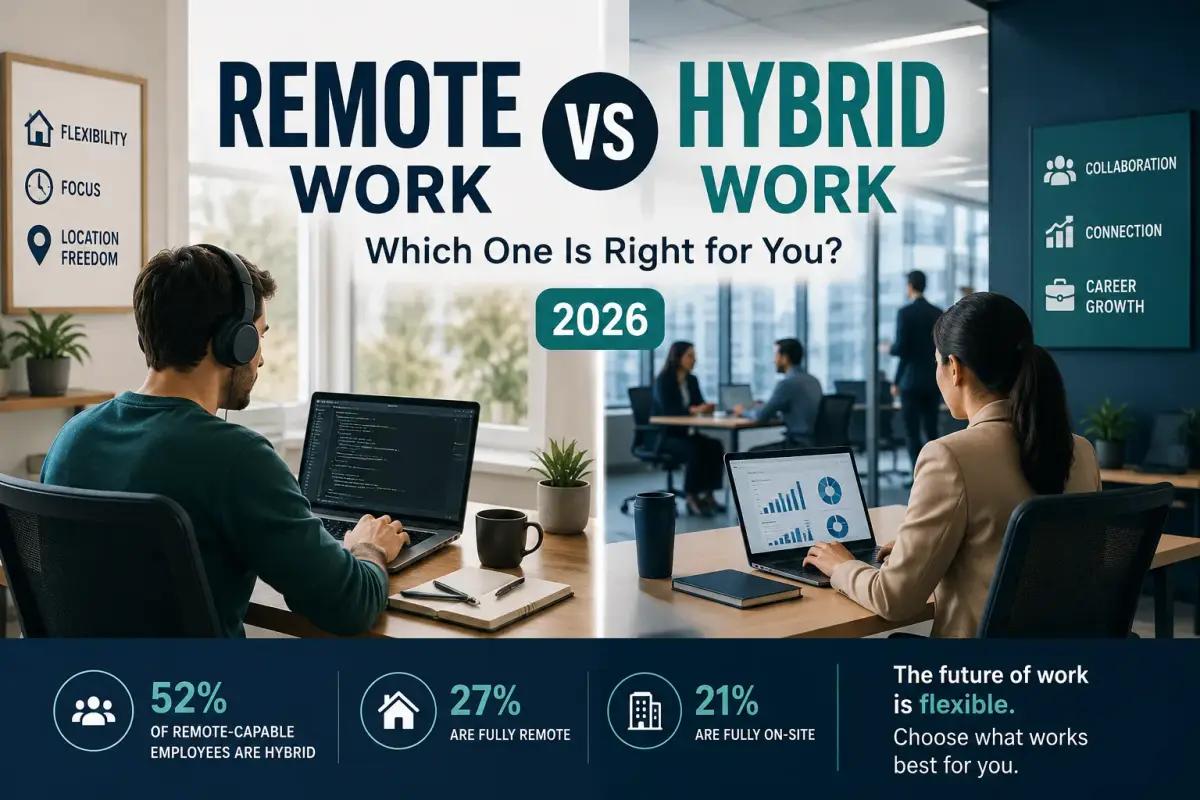
The debate between remote and hybrid work has never been louder, or more data-rich. Return-to-office mandates from Amazon, Google, and Meta dominate headlines, yet over 32.6 million Americans are still working remotely and 52 percent of remote-capable employees operate in hybrid arrangements. For tech professionals choosing their next role, and for employers deciding how to structure their distributed teams, the remote vs hybrid question has real consequences for productivity, salary, career growth, and quality of life. This guide breaks down the real differences between remote and hybrid work in 2026 — with specific data, honest trade-offs, and a clear framework for deciding which model is right for you.
Remote vs Hybrid Work:
Remote work means working entirely outside a physical office, from home, a co-working space, or anywhere with a reliable internet connection, with no expectation of in-person attendance. Hybrid work means splitting time between a remote location and a physical office on a structured or flexible schedule. Neither model is universally superior, the right choice depends on your role, your working style, your career stage, and whether your employer has built the infrastructure to support either model genuinely.
The data in 2026 tells a nuanced story. Among remote-capable U.S. employees, Gallup reports that 52 percent are hybrid, 27 percent are fully remote, and only 21 percent are fully on-site. The five-day-in-office era is statistically over. What is replacing it is not a single dominant model but a spectrum, and where you sit on that spectrum should be a deliberate career decision, not a default acceptance of whatever your next employer offers.
What Is Remote Work?
Remote work is a work arrangement where the employee performs all professional duties outside a central office, typically from a home office or co-working space, using digital tools for communication, collaboration, and project management. There is no required physical attendance at any employer location.
For tech professionals, remote work is the most established and widely available flexible work model. Software development, DevOps, cybersecurity, design, and data analysis are all disciplines where the work is entirely digital, which means location dependency is a policy choice, not a technical requirement. The remote tech job market reflects this: fully remote positions in these disciplines outnumber hybrid listings on tech-specific job boards.
Remote work operates on two communication models: synchronous (real-time video calls, live chat) and asynchronous (written updates, recorded video, documented decisions). The most effective remote teams run async by default and synchronous by exception — scheduling real-time communication only when it adds genuine value over written communication.
What Is Hybrid Work?
Hybrid work is a work arrangement that combines regular remote work with scheduled in-office attendance, typically two to three days per week in the office and the remaining days remote, though the specific structure varies significantly by employer.
Hybrid is currently the most common flexible work model globally. 83 percent of global employees say they prefer a hybrid setup that mixes remote and in-office days. The preference reflects a genuine desire for flexibility without complete disconnection from the social and collaborative context of a shared workspace.
However, hybrid work varies enormously in practice. Structured hybrid programmes, where in-office days are defined, consistent, and designed around specific collaboration needs, function very differently from unstructured hybrid arrangements where "two days in office" is a vague expectation enforced inconsistently. For job seekers evaluating hybrid roles, understanding which type of hybrid is on offer is as important as knowing the split itself.
Remote vs Hybrid: Productivity Comparison
Both remote and hybrid work produce equal or higher productivity than full-time office work — but they produce it differently. Remote work wins on deep work and focused individual output. Hybrid work edges ahead on coordination speed and spontaneous collaboration. The right model for productivity depends on what type of work your role primarily requires.
Remote work delivers almost the same productive hours in less time, 6 hours 55 minutes total, yielding 5 hours 12 minutes productive, versus office work's 7 hours 44 minutes total, yielding 5 hours 17 minutes productive. Office work is longer but less productive, with an additional 49 minutes added to the day, yet a lower active share of approximately 68 percent and 2 hours 27 minutes of overhead and idle time.
A Stanford study published in Nature found that well-organized hybrid teams outperform fully in-office teams by 5 percent, with a 33 percent reduction in employee turnover.
For tech roles specifically, the productivity evidence strongly favours remote work for individual output. 70 percent of remote workers say focused work is easier from home, with fewer interruptions and more control over the work environment, helping employees complete tasks faster. Software development, security analysis, architecture design, and data engineering are all deep work disciplines, they require extended uninterrupted cognitive focus that office environments structurally disrupt through open plan layouts, informal interruptions, and meeting culture.
85 percent of employees report feeling more productive when working remotely or in a hybrid model, and 71 percent of managers said remote or hybrid work makes their teams more productive, with only 11 percent saying it makes them less productive.
The honest trade-off: remote work optimizes for individual output. Hybrid work optimizes for coordination speed and in-person collaboration intensity. For roles that are primarily individual execution, engineering, design, analysis, and remote wins on productivity. For roles that are primarily coordination and relationship management, the hybrid's in-person component adds genuine value.
Remote vs Hybrid: Salary and Compensation
Fully remote roles at remote-first employers typically offer location-agnostic compensation benchmarked to global market rates. Hybrid roles at employers with physical offices sometimes apply geo-banded adjustments, but also sometimes offer premium compensation to attract candidates willing to commute. The relationship between work model and salary is employer-specific, not universal.
Remote-first companies, those that built distributed operations from the ground up, pay location-agnostic salaries because they hire globally and cannot pay differently for equivalent roles based on geography without damaging team cohesion. These employers frequently offer the most competitive compensation in the tech market because they have redirected office cost savings into salary budgets.
Remote-allowed companies, those that offer remote as a policy concession rather than a structural commitment, sometimes apply geo-banded pay adjustments of 10 to 25 percent for workers outside major metropolitan areas. This is the most important compensation distinction for remote job seekers to understand before evaluating any offer.
Hybrid roles at companies requiring partial office attendance sometimes offer salary premiums to compensate for commute requirements, particularly in high cost-of-living markets. However, the net financial benefit of a hybrid premium is frequently offset by commute costs, work wardrobe requirements, and the reduced flexibility that hybrid attendance creates.
For tech job seekers evaluating remote versus hybrid offers, three questions clarify the compensation reality: Is the salary location-agnostic or geo-banded? Does the hybrid arrangement require commuting to a high cost-of-living city that increases your personal expenses? And does the employer's track record suggest the hybrid arrangement is stable or likely to shift toward more in-office requirements over time?
Use FarCoder's free Salary Raise Calculator to compare any remote or hybrid offer against your current compensation in real terms → farcoder.com/salary-raise-calculator
Remote vs Hybrid: Career Growth and Visibility
The concern that remote workers are passed over for promotions due to reduced visibility is legitimate at companies that have not built remote-first promotion criteria, but irrelevant at companies that evaluate performance on output and contribution quality rather than office presence. The model of your employer matters more than the model itself.
The "proximity bias" risk,There managers unconsciously favour employees they see in person when making promotion decisions, is real and documented. It is most acute at companies where hybrid is the dominant model and fully remote employees are a minority. In these environments, remote workers genuinely risk reduced visibility relative to their hybrid colleagues who are present on in-office days.
The solution is not choosing hybrid over remote to protect your career. It is choosing remote-first employers who have structurally removed proximity bias from their promotion criteria by evaluating contribution quality, documented outcomes, and communication effectiveness, the signals that distributed teams can measure regardless of physical presence.
31 percent of fully remote workers feel engaged at work, compared to 23 percent in hybrid roles and 19 percent in fully on-site roles. Engagement is one of the strongest predictors of career advancement, employees who are genuinely engaged produce higher-quality work, take more initiative, and build stronger professional relationships than those who are present but disengaged.
Remote vs Hybrid: Work-Life Balance and Wellbeing
Both remote and hybrid work produce significantly better work-life balance than full-time office work, but fully remote work produces the strongest wellbeing outcomes when the employer has built genuine remote-first culture and the employee has developed effective remote work habits.
In 2025, 79 percent of remote professionals report lower stress levels, and 82 percent say their mental health is better with flexible work.
Approximately 70 minutes per day are saved on commute for remote workers, and this time often converts to real work, personal wellbeing, exercise, and family, which supports better work-life balance and long-term mental health.
The wellbeing advantage of fully remote work comes with one significant risk: isolation. Remote workers who do not proactively build social connection, with teammates, with professional communities, and in their personal lives, report higher rates of loneliness than hybrid workers who maintain regular in-person social contact through office days. This is a solvable problem, not an inherent feature of remote work, but it requires deliberate attention from both employees and employers.
Hybrid work provides a natural social rhythm that partially addresses the isolation risk. Two to three in-office days per week maintain the collegial relationships and informal social contact that office environments provide, while preserving the flexibility and focus benefits of remote days. For professionals who are social by nature and draw energy from in-person interaction, hybrid may genuinely produce better wellbeing outcomes than fully remote work — regardless of what the productivity data shows.
Remote vs Hybrid: The Retention Reality
Both remote and hybrid work dramatically outperform full-time office work on retention, and the threat of eliminating either model is one of the strongest predictors of voluntary employee departure in the current tech market.
46 percent of work-from-home workers say they would likely leave if remote work ended. SurveyMonkey data reveals that if a remote or hybrid position became fully office-based, 29 percent of employees would look to leave their job.
For tech employers, these figures represent a direct financial risk. Replacing a senior engineer costs 1.5 to 2 times their annual salary. A team of 20 senior engineers with an average salary of $160,000 represents $4.8 million to $6.4 million in replacement cost if a return-to-office mandate triggers significant voluntary departures. The retention case for maintaining remote and hybrid arrangements is not a cultural argument, it is a financial one.
The Stanford/Nature study cited earlier found that structured hybrid work produced a 33 percent reduction in employee turnover specifically, one of the strongest retention results documented for any work arrangement change. For employers weighing the benefits of structured hybrid versus full remote, the retention data suggests that both models significantly outperform office-only, and the choice between them is less important than the commitment to maintaining flexibility.
Remote vs Hybrid: Which Is Right for You as a Tech Professional?
Choose fully remote if you have a dedicated workspace, strong self-management habits, a preference for deep individual work, and you are targeting employers who have built remote-first culture and compensation structures. Choose hybrid if you are early in your career, value spontaneous in-person collaboration, draw energy from social environments, or are at a company where in-office visibility genuinely affects promotion decisions.
Work through these questions honestly before making your decision:
Your working style: Do you produce your best work in long, uninterrupted focus blocks, or do you benefit from the ambient energy and spontaneous problem-solving of a shared workspace? Developers, security analysts, and data engineers typically thrive in the former. Sales engineers, project managers, and junior developers learning through observation frequently benefit from the latter.
Your career stage: Early-career tech professionals absorb significant tacit knowledge through proximity, watching senior engineers debug problems, overhearing architectural conversations, observing how senior professionals handle stakeholder relationships. This knowledge transfer is harder to replicate in fully remote environments. Mid and senior professionals with established expertise and strong async communication skills lose less by being remote.
Your home environment: A dedicated, quiet workspace with reliable internet and professional audio and video capability is the minimum infrastructure requirement for effective remote work. If your home environment does not support focused work reliably, hybrid provides a structured office option that remote-only does not.
Your employer's remote-first credibility: The most important variable in the remote vs hybrid decision is not your preference, it is your employer's infrastructure. A fully remote role at a remote-first company with documented async communication norms, structured onboarding, and output-based performance evaluation produces better outcomes than a hybrid role at a company where "hybrid" means three mandatory office days with no async communication structure for the remote days.
Remote vs Hybrid: Which Is Right for You as an Employer?
Choose a fully remote model if you want access to the global tech talent pool, location-agnostic compensation competitiveness, and the strongest productivity outcomes for individual execution roles. Choose structured hybrid if your roles genuinely require high-frequency in-person collaboration, your office is in a talent-dense city where the commute is manageable, and you can commit to a stable, clearly defined hybrid structure rather than an ad-hoc one.
The employer decision has four practical dimensions:
Talent access: Fully remote hiring accesses the global talent pool. Structured hybrid hiring accesses candidates willing to commute to your office location, a fundamentally smaller pool for specialised tech roles. For cybersecurity engineers, senior DevOps professionals, and AI/ML engineers where global shortages are severe, the talent access argument for remote is decisive.
Cost structure: Remote-first employers redirect office cost savings into compensation, tooling, and talent acquisition. Hybrid employers maintain real estate costs while also competing for talent against remote-first employers who pay more. The hybrid cost model requires deliberate justification, what does the office investment produce that remote cannot?
Culture and collaboration: Structured hybrid programmes with defined in-office days built around specific collaboration needs, design sprints, architecture sessions, team onboarding, produce measurably stronger outcomes than unstructured hybrid where in-office days are calendar filler. If you choose hybrid, invest in making the in-office days genuinely worth commuting for.
Stability and trust: 46 percent of remote workers say they would likely leave if remote work ended. Any hybrid policy that is perceived as a transition toward full return-to-office will trigger voluntary departures among your strongest performers — who have the most options. Make your hybrid commitment explicit, stable, and credible before announcing it.
Gallup's State of the Global Workplace report and Stanford economist Nicholas Bloom's ongoing research on hybrid and remote work outcomes are the two most reliable references for employers building the evidence base for their work model decisions in 2026.
Remote vs Hybrid: A Direct Comparison Table
|
Factor |
Fully Remote |
Structured Hybrid |
|
Talent pool |
Global — no geographic limit |
Local or regional — commutable distance |
|
Deep work productivity |
Higher — fewer interruptions |
Moderate — office days fragment focus |
|
Coordination speed |
Slower — async by default |
Faster on office days |
|
Compensation model |
Location-agnostic at remote-first employers |
May include geo-banded adjustments |
|
Commute cost |
Zero |
2–3 days per week |
|
Work-life balance |
Strongest with good habits |
Strong — structured flexibility |
|
Social connection |
Requires deliberate effort |
Built in through office days |
|
Isolation risk |
Higher without deliberate mitigation |
Lower — regular in-person contact |
|
Career visibility risk |
Low at remote-first employers |
Low at hybrid-committed employers |
|
Retention impact |
Very high — 46% would leave if ended |
High — 29% would leave if made fully office |
|
Best for |
Senior tech professionals, deep work roles |
Early-career, high-collaboration roles |
Frequently Asked Questions (FAQ)
Is remote work or hybrid work better for software developers?
+−
Fully remote work produces the strongest productivity outcomes for software developers because coding, architecture design, and debugging are deep work disciplines that benefit from uninterrupted focus blocks. Developers who have built effective remote work environments and async communication habits consistently report higher output and satisfaction in fully remote arrangements.
Do hybrid workers get paid more than remote workers?
+−
Not consistently. Compensation depends primarily on the employer's pay model, whether salaries are location-agnostic or geo-banded, not the specific hybrid versus remote arrangement. Remote-first employers typically pay the most competitive salaries because they hire globally and have redirected office costs into compensation budgets.
Will hybrid work replace fully remote work?
+−
Hybrid is currently the dominant flexible work model by volume, 52 percent of remote-capable employees work hybrid, versus 27 percent fully remote. But fully remote work is not declining; it is stabilizing as the model of choice for remote-first tech companies that have committed structurally to distributed operations. Both models will coexist in the tech industry for the foreseeable future.
How do I know if a hybrid role will shift to more office days over time?
+−
Ask directly in your interview process. Questions that reveal employer intent: "Has the number of required in-office days changed in the past 18 months?", "Is the hybrid policy written into employment contracts or is it informal?", and "What is the company's position on remote work for the next three years?" Vague or evasive answers are warning signals.
Is hybrid work better for early-career tech professionals?
+−
Often yes. Early-career developers, designers, and analysts absorb significant knowledge through proximity, observing senior professionals, participating in informal technical conversations, and learning through the visible context of a team working on shared problems. This tacit knowledge transfer is harder to replicate in fully remote environments. Hybrid provides the mentorship and learning benefits of office proximity while preserving flexibility.
About the Author

Muhammad Mansoor Ishaq
**Muhammad Mansoor Ishaq** is the Co-Founder of FarCoder and an experienced web developer specializing in WordPress, Shopify, Wix, and Squarespace. In addition to his technical expertise, he is a regular contributor to FarCoder’s blog, where he writes about remote work, software development careers, web development, freelancing, digital transformation, workplace productivity, hiring trends, and the future of distributed teams. Drawing from both hands-on industry experience and ongoing research, Muhammad creates practical, insightful content that helps job seekers, developers, and employers succeed in an increasingly remote-first world. His work focuses on bridging the gap between technology, talent, and modern work opportunities across global markets.
Connect on LinkedIn