Top 18 Remote Job Interview Questions and How to Answer Them

Far Coder Team
Fri May 15 2026
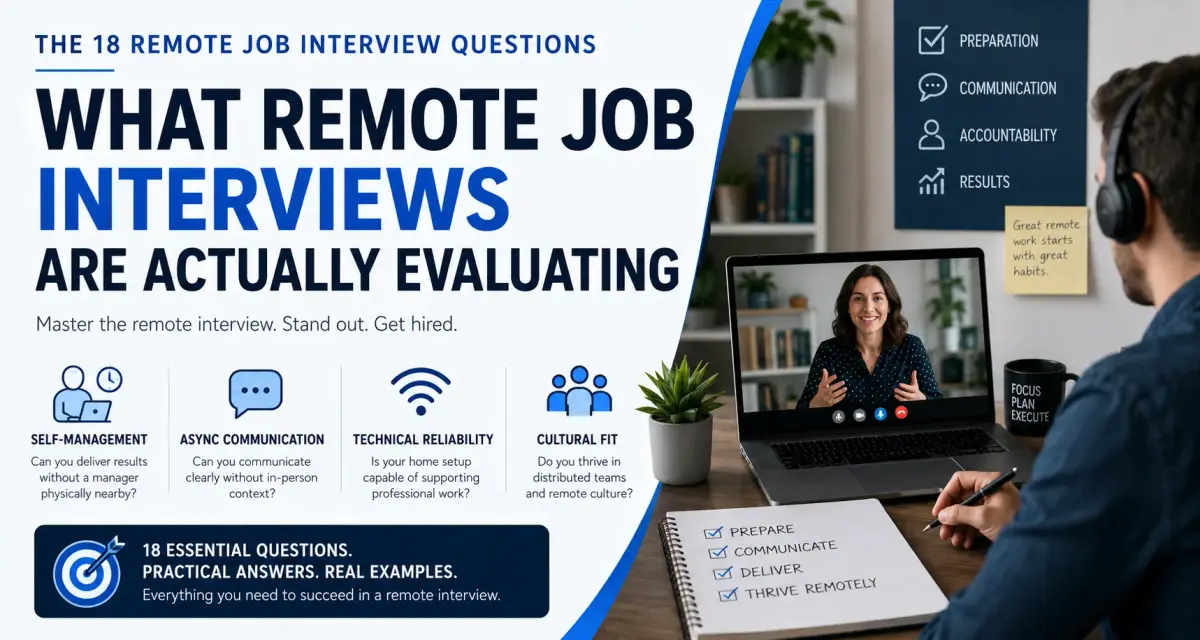
Remote job interviews are not standard interviews conducted over video. They are a different evaluation entirely, one where hiring managers are assessing whether you can communicate clearly without physical presence, manage your own performance without supervision, and integrate into a distributed team without the social infrastructure of an office. This guide covers the 18 most important remote job interview questions you will face in 2026, what each question is actually testing, how to answer each one with confidence, what sample answers look like in practice, which answers immediately disqualify candidates, and what tech-role-specific questions developers, designers, DevOps engineers, and cybersecurity professionals should prepare for separately.
What Remote Job Interviews Are Actually Evaluating
Remote job interviews evaluate four things that standard interviews do not prioritise: self-management capability, async communication quality, technical environment reliability, and cultural fit with distributed teams. Candidates who prepare only for skill-based questions consistently underperform against candidates who understand and prepare for these remote-specific dimensions.
Every question a remote employer asks falls into one of five categories:
-
Communication: Can you write and speak clearly without the context that in-person interaction provides?
-
Self-management: Can you deliver results without a manager physically nearby?
-
Technical reliability: Is your home setup capable of supporting professional remote work?
-
Async competency: Do you understand how distributed teams operate and communicate?
-
Cultural fit: Do you genuinely want remote work, or are you treating it as a temporary convenience?
Understanding which category each question belongs to allows you to tailor your answer to what is actually being evaluated, not just what is being asked.
Before the Interview: What Hiring Managers Screen For Before You Speak
Remote employers are evaluating you before you answer a single question. Your camera framing, audio quality, lighting, and background are all data points that signal whether you have a professional remote work environment and whether you take the role seriously.
Test your setup before every remote interview. Use natural light or a ring light aimed at your face, not behind you. Use a headset or a high-quality microphone rather than laptop audio. Frame the camera at eye level, looking down at a laptop screen is a posture that communicates disinterest regardless of what you are saying. Close every unnecessary application before the call begins.
The interview itself is a simulation of how you will show up on daily video standups, client calls, and team reviews. Hiring managers are noting everything from your on-camera presence to how you manage silence and transitions.
The 18 Most Important Remote Job Interview Questions
Question 1: Can You Tell Me About Yourself?
What it is actually testing: How clearly and concisely you can introduce your background, how well you understand what is relevant to the role, and whether you can communicate without rambling, a critical remote work skill.
How to answer: Use the Present → Past → Future format. Start with your current role or most relevant recent experience, briefly cover the background that led to it, and end with why you are excited about this specific opportunity. Keep it under two minutes.
Sample answer structure: "I am currently a senior backend developer working on payment infrastructure for a fintech platform — fully remote for the past three years. Before that, I built API systems at a SaaS startup where I learned distributed systems and async team collaboration. I am looking to move into a role where I can take on more architectural ownership, which is exactly what drew me to this position."
What disqualifies candidates: Rambling beyond two minutes, failing to connect your background to the role, or beginning with personal history irrelevant to professional performance.
Question 2: Have You Worked Remotely Before?
What it is actually testing: Your familiarity with remote dynamics, the tools, the communication norms, the self-discipline, and the challenges. If you have not worked remotely before, employers are assessing whether you understand what you are signing up for.
How to answer: If you have remote experience, be specific, name the tools, describe how your team operated asynchronously, and give a concrete example of a challenge you navigated in a distributed environment. If you have not worked fully remotely, describe hybrid or async experience you do have and explain the steps you have already taken to prepare.
Sample answer: "I have worked fully remotely for two years. Our team was distributed across four time zones, so we ran almost entirely async, daily written standups in Notion, code reviews via GitHub with detailed written comments, and weekly video syncs. I learned very quickly that the quality of your written communication determines your effectiveness on a distributed team."
What disqualifies candidates: Claiming remote experience vaguely without specifics, or describing remote work as simply "working from home" without demonstrating understanding of distributed team dynamics.
Question 3: How Do You Stay Productive Working From Home?
What it is actually testing: Your self-management system. Remote employers are not asking about your motivation, they are asking whether you have built a reliable structure that produces consistent output without external accountability.
How to answer: Describe your actual system, your workspace, your daily structure, your focus methods, and how you protect deep work time. Be specific. Generic answers about "staying disciplined" carry no weight.
Sample answer: "I start every morning by writing three specific priorities before I open any communication app. I time-block my calendar so deep work, coding, architecture design, happens in my peak hours between 8am and noon. Notifications are off during those blocks. I batch Slack and email into two windows per day, at midday and end of afternoon. It is a system I have iterated over two years and it consistently produces my best output."
What disqualifies candidates: Vague answers about self-discipline, describing motivation as the primary productivity tool, or mentioning that you "work well independently" without explaining the system behind that claim.
Question 4: How Do You Communicate With a Distributed Team?
What it is actually testing: Your async communication fluency, whether you default to meeting requests for every question, or whether you know how to communicate with enough context that teammates can act without follow-up.
How to answer: Explain your communication philosophy, how you match the channel to the type of information, how you write async messages with full context, and how you use video updates for complex information. Name the tools you use and explain why.
Sample answer: "I think about communication in terms of urgency and complexity. For simple questions or updates, I write a Slack message with full context, enough that my teammate can act on it without asking a follow-up. For complex topics like architecture decisions or debugging walkthroughs, I record a short Loom video rather than scheduling a call, so the person can watch it on their own schedule. For anything that genuinely needs real-time discussion, I schedule a call with a clear agenda so the time is used well."
What disqualifies candidates: Describing communication as "I send messages and hop on calls when needed", this signals no async fluency. Employers interpret it as a constant meeting-scheduler in disguise.
Question 5: What Do You Do When You Are Stuck and Cannot Get Immediate Help?
What it is actually testing: Your ability to problem-solve independently and your judgment about when to escalate. Remote teams cannot afford members who block on every uncertainty.
How to answer: Walk through your actual problem-solving sequence, how you approach documentation, how you frame the problem before reaching out, and how you document what you have tried. Demonstrate that you are autonomous but not isolated.
Sample answer: "I give myself a defined time box, usually 30 to 45 minutes, to work through the problem independently. I check documentation, search the codebase, review related issues or pull requests, and try to define the problem precisely in writing. If I am still blocked after that window, I write a clear summary of what I tried, what I found, and what specifically I need help with, then send it async. That way I am not wasting my teammate's time with an underprepared question, and I am often clearer on the problem just from writing it out."
What disqualifies candidates: Saying you "figure things out on your own" with no specifics, this sounds like someone who does not ask for help even when they should. The right answer demonstrates both independence and effective escalation judgment.
Question 6: How Do You Manage Work-Life Boundaries When Working Remotely?
What it is actually testing: Whether you are likely to burn out, which costs employers significantly in rehiring and onboarding, and whether you have the maturity to sustain long-term high performance in a remote environment.
How to answer: Describe your specific boundaries, your end-of-day ritual, how you handle after-hours messages, and your workspace separation. Show that boundary-setting is a professional practice for you, not a sign of low commitment.
Sample answer: "I have a fixed end time that I treat like a commitment. At 6pm I write tomorrow's priority list, close all work applications, and physically leave my workspace. I do not have work Slack on my phone. If something genuinely urgent comes up outside hours, my team knows to call, but I have found that very few things are actually urgent at 8pm that cannot wait until morning. These boundaries are what allow me to perform at a high level consistently over the long term."
What disqualifies candidates: Describing yourself as always available or "happy to work whenever needed", remote employers who understand distributed work know this predicts burnout, not dedication.
Question 7: Describe Your Home Office and Internet Setup
What it is actually testing: Whether you have the technical infrastructure to work professionally from home, reliable internet, professional audio and video capability, and a workspace that supports focused work.
How to answer: Be specific and confident. Describe your internet speed and your backup plan, your camera and audio setup, your workspace, and any additional equipment that supports your productivity.
Sample answer: "I have a dedicated home office with a standing desk and a secondary monitor. My primary internet is 500Mbps fibre with a wired ethernet connection for calls — no WiFi drops. I use a USB condenser microphone and a 1080p webcam. As a backup I have a mobile hotspot with a separate carrier. The setup has supported three years of daily video calls, pair programming sessions, and client presentations without any reliability issues."
What disqualifies candidates: Vague answers, mentioning that you use your home WiFi without a backup, or clearly not having tested your setup, which the interviewer can usually tell immediately from your actual call quality.
Question 8: How Do You Handle Accountability Without a Manager Nearby?
What it is actually testing: Whether you can be trusted to deliver without supervision, the foundational question of remote hiring. Employers are evaluating whether you have a self-accountability system that produces consistent, transparent output.
How to answer: Describe your goal-setting and progress-tracking system, and how you communicate your status to your team proactively, not only when asked.
Sample answer: "I set weekly goals at the start of each week and post them in our team's Notion space so everyone knows what I am working on. I update my task statuses daily in our project management tool, Linear, in my current role, and write a brief end-of-week summary of what I completed, what moved, and what needs attention next week. I do not wait for a manager to ask for a status update. Proactive communication is how distributed teams maintain trust."
What disqualifies candidates: Describing accountability purely in terms of meeting deadlines without mentioning proactive communication. Remote employers need transparency, not just delivery.
Question 9: Tell Me About a Successful Project You Led or Contributed to Remotely
What it is actually testing: Concrete evidence of remote work capability through real examples, how you coordinated across time zones, how you communicated complex technical information async, and how you navigated the specific challenges of distributed collaboration.
How to answer: Use the Situation → Action → Result structure. Include specific details about the remote collaboration challenges, time zone differences, async coordination, written documentation, not just the technical outcome.
Sample answer: "We migrated our payment processing system to a new infrastructure provider over three months. Our team was across UTC+2, UTC+5, and UTC-5, so we had almost no real-time overlap. I led the technical coordination async, detailed architecture decision records in Confluence, daily written progress updates, and recorded Loom walkthroughs for complex configuration changes. The migration completed on schedule with zero production downtime. The async documentation we created during that project became the team's standard template for all subsequent infrastructure projects."
What disqualifies candidates: Describing a remote project without mentioning how remote collaboration specifically was managed, this suggests the candidate was remote in name only and did not actually navigate distributed team challenges.
Question 10: Why Do You Want to Work Remotely?
What it is actually testing: Whether remote work is a genuine preference aligned with how you work best, or simply a convenience you are seeking temporarily. Employers want people who will thrive in a remote environment, not people who will chafe against it six months in.
How to answer: Be specific and honest. Frame remote work in terms of how it enables better work, deeper focus, global collaboration, async productivity, not just personal flexibility or avoiding a commute.
Sample answer: "Remote work fits how I produce my best output. I do my deepest technical work in long uninterrupted blocks that an office environment makes structurally difficult. I also genuinely find distributed collaboration energising, working with people in different countries and time zones has expanded how I think about technical problems. I have been fully remote for three years and I perform better in this environment than I ever did in an office."
What disqualifies candidates: Any answer centred around avoiding the commute, spending more time at home, or having more flexibility for personal commitments. These answers tell employers you want convenience, not remote work specifically.
Question 11: How Do You Handle Time Zone Differences With Your Team?
What it is actually testing: Your async collaboration maturity and your ability to coordinate across distributed schedules without requiring real-time availability as a crutch.
How to answer: Describe how you structure your work day to accommodate overlap hours, how you communicate across time zones async, and a specific example of successfully navigating a significant time zone challenge.
Sample answer: "I start by understanding my team's time zones and identifying our overlap window. I protect that window for collaboration, standups, reviews, decisions that need real-time input. Outside that window I work async, writing updates detailed enough that teammates in a different time zone can pick up context without needing a call. When I am handing off work across a significant time zone gap, I document not just what I did but what I was thinking, so the next person has the context to continue without losing momentum."
Question 12: How Do You Give and Receive Feedback Remotely?
What it is actually testing: Your communication maturity in a context where tone is easily misread and where feedback cannot be softened with in-person body language. This is one of the most overlooked remote interview questions and one of the most revealing.
How to answer: Describe how you make written feedback specific and constructive, how you interpret async feedback charitably, and how you ask for feedback proactively rather than waiting for formal review cycles.
Sample answer: "I try to make feedback I give as specific as possible, referencing exact lines of code, particular decisions, or specific moments in a project rather than general impressions. Written feedback without specificity creates ambiguity that damages remote team relationships. When I receive feedback async, I read it once, let it settle, and respond thoughtfully rather than reactively. I also ask for feedback proactively, a quick 'what could I have handled better here?' at the end of a project gives me far more useful input than waiting for a formal review."
Question 13: How Do You Build Relationships With Remote Colleagues You Have Never Met?
What it is actually testing: Your social intelligence in a distributed environment, whether you can build genuine working relationships without physical proximity, which is essential for long-term remote team performance.
How to answer: Describe specific practices, virtual coffee chats, async get-to-know-you rituals, how you show genuine interest in teammates' work across channels, and how you build trust through consistent reliable delivery over time.
Sample answer: "I make a point of having a one-on-one virtual coffee with every new teammate in my first two weeks, not to discuss work, just to understand who they are and what they care about professionally. Beyond that, I try to acknowledge great work publicly in team channels, comment meaningfully on teammates' pull requests rather than just approving them, and be genuinely curious in async conversations. The foundation of remote team relationships is reliable delivery, when your teammates know they can count on your word, the relationship builds naturally from there."
Question 14: How Do You Prioritise Tasks When Everything Feels Urgent?
What it is actually testing: Your judgment under pressure and your ability to manage competing demands without the guidance of a manager physically available to triage. This is a practical self-management question disguised as a priority question.
How to answer: Describe your prioritisation framework, how you assess impact versus urgency, how you communicate when you cannot do everything, and how you protect your highest-value work from interruption.
Sample answer: "I use a simple two-axis assessment, impact and urgency, and work from highest on both first. When genuinely competing priorities emerge, I communicate immediately rather than quietly deprioritising something. I will send a message that says: 'I have X and Y both flagged as urgent. My read is that X has higher customer impact, I am going to start there and move to Y this afternoon unless you have a different read.' That transparency prevents the situation where a stakeholder finds out their priority was deprioritised after the fact."
Question 15: What Remote Tools and Platforms Are You Proficient With?
What it is actually testing: Your practical readiness to integrate into a distributed team from day one, not just whether you know the tools exist, but whether you use them effectively.
How to answer: Go beyond listing tools. Describe how you use each category of tool and what effective use looks like in practice.
Sample answer: "For project management I work primarily in Linear and Jira, I write tickets with enough detail that developers can start without asking questions. For documentation I use Notion and Confluence, I maintain structured decision logs and retrospective notes. For async video I use Loom extensively, especially for technical walkthroughs. For code collaboration it is GitHub with detailed PR descriptions and inline comments. For communication it is Slack with a deliberate approach, status updates batched, not live chat."
Question 16: How Do You Handle Conflict or Disagreement With a Remote Teammate?
What it is actually testing: Your professional maturity in a low-context communication environment where misunderstandings escalate faster and where conflict resolution requires more deliberate effort than in person.
How to answer: Describe how you address disagreements directly but constructively in writing, when you escalate to a video call, and how you separate the technical disagreement from the interpersonal relationship.
Sample answer: "If I disagree with a technical decision or approach, I write my concern out clearly in the relevant channel or pull request, explaining my reasoning with specifics, not just 'I think this is wrong.' If the written exchange is not resolving things, I suggest a quick video call to talk through it directly, tone and nuance are much easier to manage in real time. The goal is always to reach the best technical decision, not to win the argument. I try to make that intent explicit in how I frame disagreements."
Question 17: What Are Your Salary Expectations for This Remote Role?
What it is actually testing: Whether you understand the market, whether you can discuss compensation professionally, and whether your expectations are compatible with the role and company. Remote roles add complexity because of currency differences, location-based pay policies, and global market benchmarking.
How to answer: Research the market rate before the interview, including whether the company uses location-based or global pay, and give a range anchored to that research. For remote tech roles, FarCoder listings include salary ranges that help you benchmark your expectations accurately before applying.
Sample answer: "Based on my research into the market for senior backend engineers in remote-first companies, and factoring in the scope and responsibilities of this role, I am targeting a range of $130,000 to $150,000 USD annually. I am happy to discuss the full compensation structure, equity, benefits, and any other components, alongside base salary."
What disqualifies candidates: Saying "I am flexible" without anchoring to any number, this signals either that you have not researched the market or that you are willing to accept below-market compensation, both of which create concerns for employers.
Question 18: Do You Have Any Questions for Us?
What it is actually testing: Your genuine interest in the role, your understanding of distributed team dynamics, and your professional preparation. Candidates who ask generic questions, or no questions, consistently rank lower than candidates who ask specific, insightful questions about remote work culture and team structure.
Strong questions to ask:
-
How does your team handle async communication across time zones, do you have documented norms or is it more informal?
-
How do you onboard new remote employees and what does the first 90 days look like in practice?
-
How does the team handle disagreements on technical direction, is there a defined process or is it situational?
-
What does career progression look like for remote employees, are there remote professionals in senior or leadership roles on the team?
-
How often does the team meet in person, if at all, and how is that structured?
What disqualifies candidates: Asking only about salary, benefits, or vacation, or asking no questions at all. In a remote interview, your questions signal your engagement and your understanding of what matters in distributed work.
Tech-Role-Specific Questions to Prepare For
General remote interview questions apply to all candidates. But hiring managers for specific tech roles ask additional questions tailored to the nature of that work. Here is what to prepare for by specialisation.
For Frontend and Full Stack Developers
Expect questions about how you handle design reviews and feedback async, how you document your component architecture for remote teammates, and how you manage cross-browser testing and deployment reviews without pairing in person. Browse verified remote frontend developer jobs on FarCoder → farcoder.com/remote-frontend-developer-jobs
For Backend Developers
Expect questions about how you document API changes for frontend teammates working in a different time zone, how you handle incident response remotely when an on-call issue surfaces outside business hours, and how you manage code reviews across distributed teams. Browse verified remote backend developer jobs → farcoder.com/remote-backend-developer-jobs
For DevOps and Cloud Engineers
Expect questions about how you handle infrastructure incidents remotely, how you document runbooks for distributed on-call teams, and how you manage access and security in a fully remote team where there is no physical perimeter. Browse verified remote DevOps jobs → farcoder.com/remote-devops-jobs
For Cybersecurity Professionals
Expect questions about how you conduct incident response investigations remotely, how you communicate security risks to non-technical stakeholders in async written formats, and how you stay current on threat intelligence across distributed team communication channels. Browse verified remote cybersecurity jobs → farcoder.com/remote-cybersecurity-jobs
For Designers
Expect questions about how you present and gather feedback on design work without in-person whiteboard sessions, how you collaborate with remote engineering teams across handoff, and how you run user research remotely. Browse verified remote design jobs → farcoder.com/remote-design-jobs
For Mobile Developers
Expect questions about how you manage device testing across platforms in a remote environment and how you coordinate with distributed QA teams. Browse verified remote mobile developer jobs → farcoder.com/remote-mobile-developer-jobs
What Remote Employers Are Screening For: The Employer Perspective
If you are a remote employer or hiring manager building a distributed tech team, this section is for you.
The most reliable predictor of remote work success is not technical skill, it is communication quality. The candidates who perform best in remote environments are those who write with precision, communicate proactively without prompting, and escalate problems with enough context that their manager can act without asking clarifying questions.
In your interviews, assess async communication quality directly, ask candidates to send you a brief written summary of their background before the call, or ask them to describe a technical problem in writing during the interview. The quality of that written output tells you more about their remote readiness than any verbal answer.
Structure your technical assessment to test judgment, not just skill execution. Ask candidates to document their approach, explain their decision-making, and describe trade-offs, the skills that separate remote-capable engineers from those who need close supervision.
FarCoder connects remote employers with verified tech professionals across frontend, backend, full stack, DevOps, design, cybersecurity, and mobile development, all actively building remote careers and equipped to interview and perform in distributed environments.
Post your remote tech role on FarCoder → farcoder.com
The Harvard Business Review has published extensively on the communication patterns that predict remote work performance, a useful reference for hiring managers building structured remote interview processes.
For Job Seekers: Find the Remote Tech Role Worth Preparing For
Preparing thoroughly for a remote interview is only worth doing if the role itself is genuinely remote-first, not a hybrid position that calls itself remote, or a role that will require office presence in six months.
FarCoder lists verified remote tech positions across every specialisation, with work type clearly defined for every listing. Every role you find on FarCoder is one worth preparing for.
Browse remote tech jobs by specialisation → farcoder.com
Frequently Asked Questions (FAQ)
How is a remote job interview different from a standard interview?
+−
Remote interviews evaluate self-management, async communication, technical environment reliability, and cultural fit with distributed teams, dimensions that standard interviews rarely assess. The questions are similar on the surface, but the evaluation criteria are different. Candidates who prepare only for skill-based questions consistently underperform those who understand the remote-specific evaluation layer.
How do I answer if I have no remote work experience?
+−
Be honest, and redirect to the adjacent experience you do have: hybrid work, async project collaboration, freelance work, or open source contributions. Describe the concrete steps you have taken to prepare your home office setup, the tools you have learned, the remote-work systems you have built. Employers are not only looking for past remote experience; they are looking for remote readiness.
What should I never say in a remote job interview?
+−
Never say you are available at all hours; it signals future burnout, not dedication. Never describe motivation as your primary productivity system; employers need structure, not inspiration. Never say you prefer remote because you can work in your pyjamas or avoid commuting, it signals the wrong reasons for seeking distributed employment.
How long should my answers be in a remote interview?
+−
Most answers should run 60 to 90 seconds for conversational questions and up to two minutes for behavioural questions with the Situation → Action → Result structure. Remote interviewers are calibrating your communication conciseness as well as your content, rambling is doubly penalising in a remote interview context.
What tools should I mention in a remote job interview?
+−
Mention tools relevant to the role you are interviewing for. Communication tools: Slack, Notion, Loom, Zoom. Project management: Linear, Jira, Asana, Trello. Documentation: Confluence, Notion. Code collaboration: GitHub, GitLab. Async video: Loom. Mentioning specific tools and describing how you use them effectively demonstrates genuine remote work experience rather than surface familiarity.
How do I negotiate salary in a remote job interview?
+−
Research the market rate before the interview, FarCoder listings include salary ranges that help you benchmark accurately. Give a specific range anchored to your research, not an open-ended "I am flexible" answer. Address the currency question directly if you are applying to a company in a different country. Ask about the full compensation structure, base, equity, benefits, as a package rather than focusing only on base salary.
About the Author

Muhammad Mansoor Ishaq
**Muhammad Mansoor Ishaq** is the Co-Founder of FarCoder and an experienced web developer specializing in WordPress, Shopify, Wix, and Squarespace. In addition to his technical expertise, he is a regular contributor to FarCoder’s blog, where he writes about remote work, software development careers, web development, freelancing, digital transformation, workplace productivity, hiring trends, and the future of distributed teams. Drawing from both hands-on industry experience and ongoing research, Muhammad creates practical, insightful content that helps job seekers, developers, and employers succeed in an increasingly remote-first world. His work focuses on bridging the gap between technology, talent, and modern work opportunities across global markets.
Connect on LinkedIn