Remote Frontend Developer Salary: The Complete Guide for 2026

Far Coder Team
Thu May 21 2026
Remote frontend development is one of the most widely available and consistently well-compensated disciplines in the global remote tech job market in 2026. Whether you are a junior developer building your first remote career or a senior engineer evaluating your market value, understanding what remote frontend developers actually earn — by experience level, framework specialisation, employer type, and geography — is the first step to getting paid what you are worth. This guide gives you the real numbers, the factors that move your salary upward fastest, and exactly how to position yourself to earn at the top of the range — whether you are a job seeker or an employer building a remote frontend team.
What Do Remote Frontend Developers Earn in 2026?
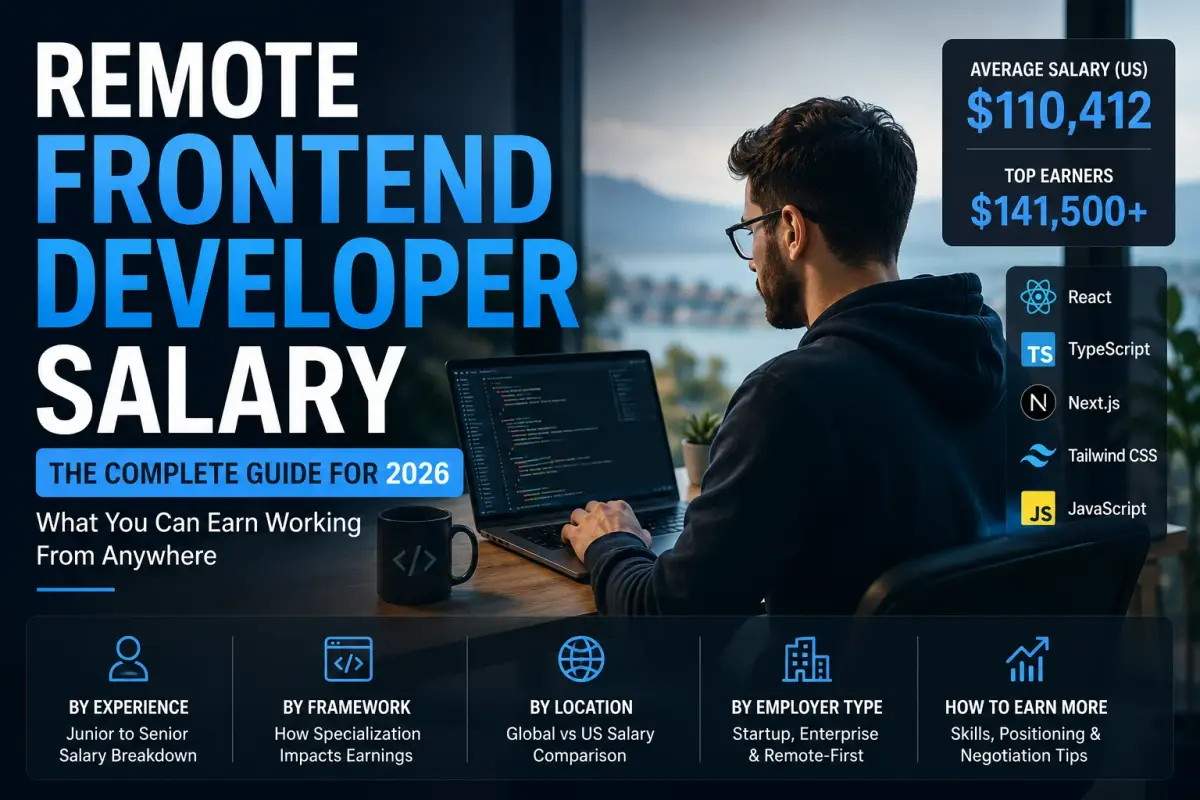
The average annual pay for a remote frontend developer in the United States is $110,412, with the majority of salaries ranging between $104,000 and $121,000, and top earners reaching $141,500 annually. At remote-first employers specifically, Built In reports the average total compensation for a remote frontend developer at $147,468, including an average of $12,003 in additional cash compensation on top of a $135,465 base salary.
The range is wide, and deliberately so. Remote frontend developer salaries start from $59,428 at the entry level and reach $85,429 and above globally, with a worldwide average of $71,213 when accounting for all geographies including emerging markets. The US market sits significantly above that global average, and remote-first technology companies at the top of the range pay more than the US average for senior engineers with specialised framework expertise.
For remote job seekers, the most important number is not the average, it is the range within your specific experience tier, framework specialisation, and employer type. A senior React engineer at a remote-first product company earns a fundamentally different salary from a mid-level generalist at a remote-allowed enterprise. This guide breaks those differences down so you know exactly where you sit and what moves you upward.
For remote employers, understanding this range is equally critical. The majority of remote frontend developer salaries range between $80,000 at the 25th percentile and $117,500 at the 75th percentile — and compensation packages outside this range in either direction will either lose you candidates or overpay for roles that do not require top-of-market investment.
Remote Frontend Developer Salary by Experience Level
Experience is the strongest salary driver in frontend development, stronger than framework choice at the entry and mid levels, and competitive with specialisation at the senior level.
Entry Level (0 to 2 years): $55,000 to $85,000
Entry-level remote frontend developers earn between $55,000 and $85,000 in 2026, with the upper end of the range reserved for candidates who combine practical portfolio work with documented proficiency in a major framework.
The entry-level remote frontend market in 2026 is more skills-focused than credential-focused. Employers evaluating remote junior developers cannot assess candidates through in-person pair programming or whiteboard sessions, they evaluate GitHub portfolios, live project demonstrations, and the quality of code in take-home assessments. Entry-level candidates with a strong public portfolio and documented React or Vue proficiency consistently outperform those with stronger academic credentials but thinner practical work.
For remote job seekers at entry level: Your portfolio is your primary salary lever before you have experience. Build three to five real projects that demonstrate component architecture, state management, API integration, and responsive design. Deploy them publicly. Write clear README documentation for each one. Remote employers use this portfolio as a proxy for the hands-on evaluation they cannot do in person — and the quality gap between strong and weak portfolios translates directly into offer ranges.
For remote employers hiring entry level: Remote entry-level frontend hires need more structured onboarding than co-located equivalents. Document your component library, your design system standards, your code review process, and your deployment workflow clearly before your hire's first day. Entry-level candidates who receive structured remote onboarding reach productive contribution significantly faster and stay longer.
Mid Level (3 to 7 years): $90,000 to $135,000
Mid-level remote frontend developers earn between $90,000 and $135,000 in 2026, with specialisation in a high-demand framework and experience with scalable component architecture driving the upper end of the range.
The most common remote frontend developer salary range at this experience level is between $120,000 and $130,000 at established remote-first employers. Mid-level developers who remain framework generalists see salary growth slow at this stage; those who develop genuine depth in React, still the dominant framework in remote frontend hiring, combined with TypeScript proficiency and state management expertise, see compensation track toward the upper portion of the range.
For remote job seekers at mid-level: The mid-career salary plateau is real in frontend development and it is almost always a specialisation problem. If your salary has not grown meaningfully in the past two years, the solution is not switching employers; it is building depth that commands a higher rate. React with TypeScript, Next.js, performance optimisation expertise, and design system contribution are the four areas where mid-level frontend developers consistently break through the $120,000 ceiling in remote roles.
For remote employers hiring mid level: Mid-level frontend candidates with React and TypeScript depth receive multiple simultaneous offers in the current market. If your hiring process takes longer than three weeks from first interview to offer, expect to lose your preferred candidates to faster-moving employers. Define your must-have versus nice-to-have criteria before you begin the search and move decisively when you find a strong match.
Senior Level (7+ years): $135,000 to $200,000+
Senior remote frontend developers earn between $135,000 and $200,000 in 2026, with the upper end reserved for engineers who combine deep framework expertise with architectural thinking, performance engineering capability, and demonstrated remote team leadership.
The salary range for senior-level frontend engineers is between $150,000 and $200,000 per year at established remote employers. Glassdoor data shows the salary trajectory for senior frontend developers ranging from $117,846 at the lower end to $342,317 at the highest seniority levels, the upper range reflecting staff and principal engineer compensation at major technology companies.
Senior frontend engineers who move into architecture scope, leading component system design, establishing frontend performance standards, mentoring distributed junior engineers, and owning the technical direction of frontend platforms, are in the strongest compensation position in the remote market. This profile is the hardest to find and the hardest to retain, which gives these candidates genuine negotiating leverage.
For remote job seekers at senior level: At this stage, your ability to work and lead effectively in a remote environment is as important to employers as your technical depth. Senior remote frontend engineers who can demonstrate distributed team leadership, running async code reviews, mentoring junior engineers across time zones, producing clear technical decision records, and communicating architectural trade-offs in writing, command the strongest offers. Make your remote leadership experience explicit in every application and interview.
For remote employers hiring senior: Average time to fill a senior remote frontend role is four to six months. The candidates you are competing for are receiving three to five simultaneous offers and will make decisions based on the totality of the package, compensation, equity where available, remote-first culture authenticity, and growth trajectory. Location-agnostic compensation is increasingly a threshold requirement for the strongest senior candidates.
Remote Frontend Developer Salary by Framework
Framework specialisation is the second most powerful salary driver in remote frontend development after experience level. Here is what each major framework commands in the current remote market.
React Developer Salary
Remote salary range: $100,000 to $185,000
React remains the dominant framework in remote frontend hiring in 2026. It appears in the majority of remote frontend job postings globally, which means the React talent pool is large — but so is the demand. Senior React engineers with TypeScript proficiency, Next.js experience, and performance optimisation expertise are at the top of the frontend salary range across the remote market.
React developers who add server-side rendering knowledge through Next.js, state management depth through Redux or Zustand, and testing discipline through Jest and React Testing Library position themselves for the strongest remote salary offers. The combination of React with TypeScript is now the baseline expectation at most remote-first product companies rather than a differentiator — what moves salaries at the senior level is architectural scope and performance engineering capability.
For remote employers: React is the safest framework choice for remote team growth because the talent pool is the deepest. But depth within React matters enormously, a developer who lists React on their resume and a developer who has built and maintained a production design system in React at scale are very different profiles. Define which you need before you post.
Vue.js Developer Salary
Remote salary range: $90,000 to $160,000
Vue.js is the second most widely used frontend framework in remote hiring and commands salaries slightly below React at equivalent experience levels, reflecting the smaller talent pool demand rather than any technical inferiority. Senior Vue developers with Nuxt.js experience are in strong demand at European and Asia-Pacific remote employers where Vue adoption is particularly high.
For remote job seekers: Vue specialisation is a strong choice for remote developers targeting European employers specifically. Vue's adoption in Germany, France, and the Netherlands is significantly higher than the US average, which means Vue expertise opens remote doors with European tech companies that React developers frequently overlook.
Angular Developer Salary
Remote salary range: $95,000 to $165,000
Angular developers command competitive salaries in remote hiring, particularly at enterprise technology companies and government contractor remote roles where TypeScript-first development and opinionated framework structure are valued. Angular's steeper learning curve reduces the supply of proficient developers, which supports salary premiums for those who have genuine production Angular experience.
Next.js and Full Stack Frontend Salary
Remote salary range: $115,000 to $195,000
Next.js has become one of the most valuable frontend skills in the remote market in 2026. Developers who combine React proficiency with Next.js — enabling server-side rendering, static site generation, and API route development — cross into full stack territory and command salaries that reflect that broader scope. Remote employers increasingly want frontend engineers who can own the full rendering and data-fetching layer without requiring backend handoff for every feature.
Web3 and Blockchain Frontend Salary
Remote salary range: $120,000 to $240,000
The average yearly salary for a frontend developer in Web3 is $149,000, with a minimum base of $70,000 and a maximum of $240,000. Web3 frontend development, building interfaces for decentralised applications, NFT platforms, and blockchain protocols, commands a significant premium over traditional frontend roles, reflecting both the technical complexity and the smaller qualified talent pool.
Remote Frontend Developer Salary by Geography
Remote work has changed the geographic salary landscape more than any other employment model. Here is what remote frontend developers earn across key global markets in 2026.
United States
The average remote frontend developer salary in the United States is $110,412 per year, with top earners at the 90th percentile making $141,500 annually. Remote-first employers in the US pay location-agnostic rates that compete with San Francisco and New York co-located roles — a significant advantage for remote professionals based outside major tech hubs.
Canada
Remote frontend developers in Canada earn CAD $85,000 to $145,000, with USD-denominated packages at US-based remote employers frequently exceeding these figures for senior candidates. Toronto and Vancouver anchor the strongest domestic frontend markets; remote professionals in other provinces access the same opportunities through distributed hiring.
Europe (Germany, France, Netherlands)
Senior remote frontend developers at European tech companies earn EUR $80,000 to $130,000, with Berlin, Amsterdam, and Paris-based remote employers at the top of the European range. US-headquartered remote-first companies hiring European frontend talent typically pay USD-benchmarked salaries that sit above the European domestic average.
Latin America (Argentina, Brazil)
Remote frontend developers in Argentina earn $40,000 to $85,000 USD when working for domestic employers, but those hired by US and European remote-first companies frequently earn $70,000 to $110,000 USD, creating one of the most compelling remote work arbitrage opportunities in the global tech market. Brazil's frontend market is similarly structured, with domestic rates below global benchmarks and international remote rates significantly higher.
Global Average
The global average remote frontend developer salary across all geographies is $71,213 USD per year, starting from $59,428 at the entry level. This figure is pulled down by lower domestic rates in emerging markets, for professionals in those markets targeting global remote employers, the gap between domestic and international remote compensation is one of the strongest financial arguments for pursuing remote work specifically.
What Moves a Remote Frontend Developer's Salary Upward
TypeScript proficiency is the most universally requested skill addition in remote frontend job descriptions in 2026. Developers who add TypeScript to their React or Vue expertise see an immediate and measurable increase in the roles they qualify for and the offers they receive.
Performance engineering expertise — Core Web Vitals optimisation, bundle size management, lazy loading architecture, and rendering performance tuning, is a skill that a small percentage of frontend developers have at a genuine depth. Those who do command consistent premiums because performance problems are expensive and the engineers who can solve them are scarce.
Design system ownership is one of the strongest senior-level salary signals in remote frontend hiring. Engineers who have built or maintained a component library at production scale, with documentation, versioning, and cross-team governance, demonstrate the architectural thinking that separates senior engineers from those who build features within existing systems.
Accessibility expertise is an increasingly valued and genuinely undersupplied skill in the remote frontend market. Developers who understand WCAG standards, implement accessible components by default, and can audit existing interfaces for accessibility compliance are sought after by enterprise and government-adjacent remote employers who face legal and compliance requirements.
Testing discipline — specifically Jest, React Testing Library, and end-to-end testing with Cypress or Playwright, is a consistent filter in remote frontend hiring. Remote teams rely on automated testing more heavily than co-located teams because manual review cycles are slower in distributed environments. Developers who write comprehensive tests as a default practice rather than an afterthought are valued explicitly in remote hiring.
Stack Overflow's annual Developer Survey tracks framework adoption, salary benchmarks, and remote work preferences across hundreds of thousands of developers globally, a useful reference for frontend professionals benchmarking their skills and compensation against the broader market.
For Remote Job Seekers: How to Maximise Your Frontend Salary
Benchmark before you negotiate. Know the market rate for your specific combination of experience, framework, and role scope before entering any salary conversation. The data in this guide gives you the framework, apply it to your specific profile and enter negotiations with a specific range anchored to market data, not to your current salary or your personal financial needs.
Target remote-first employers deliberately. Remote-first companies pay location-agnostic salaries and compete for global talent. Remote-allowed companies frequently apply geo-banded adjustments of 10 to 25 percent below major metro rates for distributed workers. The employer's remote-first credibility affects your long-term earning trajectory, not just your starting salary. Research how each company structures remote compensation before applying.
Make your remote work capability explicit. Remote employers evaluate your ability to work distributed as a primary criterion alongside technical skill. Your resume, portfolio, and interview answers should describe your home setup, your async communication approach, and your self-management system explicitly, not as an afterthought but as core professional positioning.
Specialise in one high-demand area. TypeScript depth, Next.js expertise, performance engineering, or design system ownership, pick one and build genuine depth. Generalist frontend developers plateau at mid-range salaries. Specialists with documented expertise in a high-demand area consistently earn at the top of their experience tier.
FarCoder lists verified remote frontend developer positions across every framework and experience level, with salary ranges included in every listing.
Browse current remote frontend listings with published salary ranges at farcoder.com/remote-frontend-developer-jobs.
For Remote Employers: How to Hire and Retain Remote Frontend Talent
The direct answer: The remote frontend job market in 2026 strongly favours candidates at the mid and senior levels. React developers with TypeScript depth receive multiple simultaneous offers, and slow or below-market hiring processes consistently lose the strongest candidates to faster-moving employers.
Set compensation at current market rates. Frontend salaries have grown 8 to 12 percent year-over-year for the past three years. Budgets based on 2023 data are materially below current market rates. Audit your compensation range against 2026 benchmarks before opening any search, an offer that lands below the 50th percentile for the role will be declined by any candidate who has done their own research.
Publish salary ranges in your job descriptions. Remote frontend candidates are filtering job listings by compensation range before reading the role requirements. Listings without salary information receive significantly fewer qualified applications than those with ranges published — and the candidates who apply without knowing the range frequently decline offers when the number is below their expectation. Publish the range upfront and attract candidates who have already self-selected as a match.
Move fast on strong candidates. A hiring process that takes more than three weeks from first interview to offer loses mid and senior React developers to employers who move in two weeks. Define your hiring stages, your evaluation criteria, and your decision timeline before you open the search, and stick to it.
Invest in remote onboarding. New remote frontend hires who receive structured onboarding, access to your design system, component library documentation, codebase architecture overview, and scheduled introductions to product and design teammates, reach productive contribution in two to three weeks rather than six to eight. The investment pays back in productivity and retention.
Post your remote frontend developer role on FarCoder and reach a global pool of verified remote tech professionals actively looking for their next distributed role.
Post your remote tech role on FarCoder → farcoder.com
Frequently Asked Questions (FAQ)
What is the average remote frontend developer salary in 2026?
+−
The average remote frontend developer salary in the United States is $110,412 per year as of March 2026. At remote-first employers specifically, average total compensation reaches $147,468 including base salary and cash bonuses. Global averages are lower when accounting for all geographies.
Do remote frontend developers earn less than office-based developers?
+−
Not at remote-first employers. Companies that built distributed operations from the ground up pay location-agnostic salaries competitive with major tech hubs. Some hybrid or remote-allowed employers apply geo-banded pay adjustments. Always ask whether compensation is role-based or location-based before accepting any offer, the answer affects your long-term earning trajectory significantly.
Which frontend framework pays the most remotely?
+−
Web3 and blockchain frontend development commands the highest salaries, averaging $149,000 with maximums reaching $240,000. Among mainstream frameworks, React with TypeScript and Next.js proficiency commands the strongest salaries in the $115,000 to $185,000 range for mid to senior developers. Angular commands competitive rates at enterprise employers. Vue.js is particularly well compensated at European remote companies.
What skills move a remote frontend salary upward fastest?
+−
TypeScript proficiency, Next.js expertise, performance engineering knowledge (Core Web Vitals, bundle optimisation), design system ownership, and accessibility implementation are the five skills that most consistently move remote frontend salaries above the median for each experience tier in 2026.
How do I negotiate a higher salary for a remote frontend role?
+−
Anchor your ask to documented market data for your specific experience level, framework, and role scope. Give a specific range, not an open-ended "I am flexible" answer. Address the remote-first versus remote-allowed distinction directly, since location-agnostic compensation is a legitimate negotiating point. Know your alternatives, candidates with competing offers negotiate from a position of genuine strength.
As an employer, what should I budget for a remote frontend developer in 2026?
+−
Budget $55,000 to $85,000 for entry-level remote frontend roles, $90,000 to $135,000 for mid-level developers with framework depth, and $135,000 to $200,000 for senior engineers with architectural scope and TypeScript expertise. Add a minimum $3,000 to $5,000 per year for professional development, conference access, course subscriptions, and certification support, as a retention investment that pays back significantly above its cost. Post your remote frontend role at FarCoder to reach qualified remote candidates globally.
What is the highest-paying remote frontend developer role in 2026?
+−
Glassdoor data shows the salary trajectory for senior frontend developers reaching up to $342,317 at the highest seniority levels, reflecting staff and principal engineer compensation at major tech companies. Outside those top-tier companies, senior remote frontend architects and principal engineers at well-funded product companies earn $180,000 to $230,000 in total compensation including equity.