Remote Designer Salary: The Complete Guide for 2026

Far Coder Team
Sat Jun 06 2026
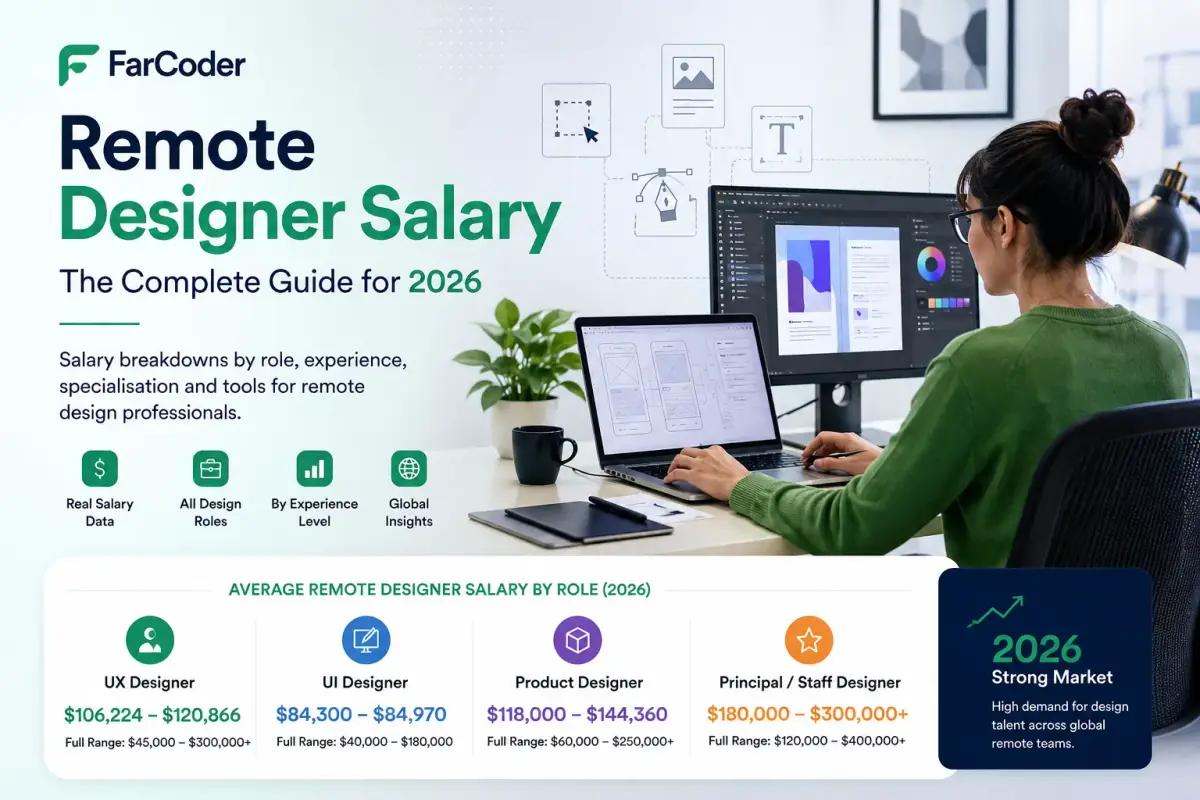
Remote design is one of the most accessible and fastest-growing disciplines in the global remote tech job market in 2026. UX designers, UI designers, product designers, and design system engineers are all actively hired by distributed teams, and the salary range spans from $61,000 at the entry level to $300,000 or more for principal and staff-level designers at top-tier technology companies. Whether you are a designer evaluating your market value for a remote role or an employer building a distributed design team, this guide gives you the real numbers by role, experience level, specialisation, and employer type, and shows you exactly how to act on them.
What Do Remote Designers Earn in 2026?
Remote designer salaries in 2026 range from $61,000 at the entry level to over $200,000 for senior and principal product designers at established remote-first technology companies, with averages varying significantly by design specialisation. UX designers average $106,224 to $120,866, UI designers average $84,300 to $84,970, and product designers combining both disciplines average $144,360 at the UX/UI product design level.
The range is wide because design is not a single discipline. A junior UI designer at a startup and a staff product designer at a Series B SaaS company are doing fundamentally different work at fundamentally different compensation levels, even though both carry the word "designer" in their title. Understanding which part of the design spectrum your role occupies is the first step to benchmarking your salary accurately.
For remote design professionals specifically, 2026 represents a strong market. Design work is inherently digital; sketching, prototyping, testing, and handoff all happen in tools that function identically from a home office as from a studio. Remote employers have recognised this, and design roles are among the most consistently listed remote positions on FarCoder across every industry sector.
Remote Designer Salary by Role
Remote UX Designer
Average salary: $106,224 to $120,866 Full range: $45,000 to $300,000+ Typical range (25th to 75th percentile): $81,172 to $151,063
UX designers are responsible for the entire user experience, conducting user research, creating information architecture, building wireframes and prototypes, running usability tests, and translating findings into product decisions. The role is inherently collaborative and research-driven, which makes it one of the most valuable in any product team building for real users.
The average salary for a remote UX designer is $108,229 per year, with top earners at the 90th percentile making up to $198,059 annually. ZipRecruiter data shows the average annual pay for a remote UX designer in the United States at $106,224, with the majority of salaries ranging between $91,000 at the 25th percentile and $125,000 at the 75th percentile, and top earners reaching $152,000.
For remote job seekers: UX design is the most research-intensive design discipline and the one where remote work is most naturally compatible. User research, synthesis sessions, prototype reviews, and stakeholder presentations all operate effectively over video and async tools. UX designers who can demonstrate a portfolio of research-driven design work — including how they facilitated remote research sessions and communicated findings to distributed product teams — are in the strongest position for senior remote roles.
For remote employers: UX designers are the highest-value design hire for product teams building user-facing software at any stage. Remote UX designers with experience in unmoderated testing, async research synthesis, and distributed design critique are immediately productive in distributed environments. Budget $90,000 to $130,000 for experienced mid-level remote UX designers at current market rates.
Remote UI Designer
Average salary: $84,300 to $84,970 Full range: $44,000 to $150,000 Typical range (25th to 75th percentile): $68,000 to $106,000
UI designers focus on the visual layer of digital products, typography, colour systems, component design, icon sets, spacing, and the visual language that makes a product feel coherent and professional. The role requires strong visual sensibility, deep knowledge of design systems, and the ability to produce pixel-precise specifications that engineering teams can implement without ambiguity.
The average salary for a remote UI/UX designer is $84,300 per year, with top earners reporting up to $130,760 at the 90th percentile, and the typical pay range falling between $68,000 at the 25th percentile and $106,000 at the 75th percentile.
Built In data shows the average UI designer salary for remote roles at $84,970, with average additional cash compensation of $4,050 bringing total compensation to approximately $89,020.
For remote job seekers: UI design is the most tool-dependent design discipline, Figma proficiency is now the absolute baseline expectation, not a differentiator. The skills that move remote UI designer salaries above the median are design system ownership, component library expertise, accessibility implementation, and the ability to produce engineering-ready specifications that reduce back-and-forth in handoff. UI designers who have contributed to or maintained a production design system consistently earn at the upper end of the range.
For remote employers: UI designers are the hire that makes your product visually coherent and your engineering handoff smooth. When evaluating remote UI designer candidates, assess their design system thinking, not just the visual quality of their work, because that is where their daily remote collaboration value is created.
Remote Product Designer (UX + UI Combined)
Average salary: $144,360 Full range: $50,000 to $205,500 Typical range (25th to 75th percentile): $131,000 to $155,000 Top earners (90th percentile): $188,000
Product designers combine UX research, interaction design, and visual design into a single role, owning the end-to-end design process from user research through to production-ready specifications. This is the most in-demand remote design title in 2026 at product companies, SaaS businesses, and technology startups.
The average annual pay for a UX/UI product designer in the United States is $144,360, with the majority of salaries ranging between $131,000 at the 25th percentile and $155,000 at the 75th percentile, and top earners at the 90th percentile making $188,000 annually.
The product designer salary premium over pure UI or UX roles reflects the breadth of scope, these professionals own the complete design arc of a product feature, from research to shipped interface, without requiring coordination between separate UX and UI roles. For startups and growing product companies with lean teams, this end-to-end ownership capability is highly valued and compensated accordingly.
For remote job seekers: If you are currently a pure UI or pure UX designer, expanding your scope toward full product design is the highest-return career move for salary growth. The product designer's premium over a pure UI designer averages $55,000 to $60,000 annually at current market rates. Build the skills on the side of your current role you are weaker in, if you are UI-strong, invest in user research and information architecture; if you are UX-strong, invest in visual execution and Figma component system depth.
For remote employers: Product designers are the most cost-efficient design hire for product teams at growth stage, one strong product designer with full end-to-end capability produces more coordinated output than two separate UX and UI specialists who must align their work across a distributed environment. Budget $130,000 to $160,000 for experienced remote product designers at current market rates.
Remote Design Systems Engineer / Design Technologist
Salary range: $130,000 to $200,000
Design systems engineers, sometimes called design technologists or frontend designers, sit at the intersection of design and engineering. They build and maintain the component libraries, design tokens, and documentation systems that bridge the gap between Figma design files and production code. This role is one of the fastest-growing and highest-paying design-adjacent positions in the remote tech market.
For remote job seekers: If you are a designer with frontend engineering skills, particularly React component development, TypeScript, and CSS-in-JS, design systems engineering is one of the highest-salary paths available in the remote design market. The combination of design sensibility and engineering capability is genuinely rare and commands a premium that neither pure designers nor pure engineers command alone.
For remote employers: Design systems engineers eliminate the most expensive and time-consuming coordination overhead in distributed product development, the back-and-forth between design and engineering on component implementation. A single strong remote design systems engineer can unlock significantly faster product development velocity across your entire engineering team.
Remote Motion Designer / Interaction Designer
Salary range: $75,000 to $145,000
Motion designers and interaction designers create the animated transitions, micro-interactions, and motion language that make digital products feel polished and responsive. Demand for this specialisation has grown significantly as product teams recognise the role of motion in user experience quality, and as tools like Framer, Lottie, and Rive make motion integration into production apps more accessible.
For remote job seekers: Motion design is a strong salary-growth path for designers who are already proficient in static UI design. Adding After Effects, Principle, or Framer Motion expertise alongside Figma prototyping capability positions you for roles at the intersection of visual design and interaction design that command a meaningful premium over pure static UI work.
Remote UX Researcher
Salary range: $85,000 to $155,000
UX researchers design and execute the research programmes that inform product decisions, user interviews, usability testing, survey design, data synthesis, and insight communication to product and design teams. The role is inherently remote-compatible: user interviews happen over video, unmoderated testing happens through tools like Maze or UserTesting, and research synthesis happens in collaborative documentation tools.
For remote job seekers: UX research is one of the most under-supplied design specialisations in the remote market. Companies that are serious about research-driven product development and cannot find qualified UX researchers locally are actively hiring remotely, and paying above-average rates for candidates with strong research methodologies and the ability to communicate findings clearly to distributed product teams.
Remote Creative Director
Salary range: $120,000 to $220,000
Creative directors lead the visual and brand direction of a company or product line, setting design standards, mentoring design teams, and owning the aesthetic coherence of everything the company produces publicly. Remote creative director roles exist primarily at companies with established remote-first cultures and distributed design teams of five or more designers.
For remote job seekers: The path to remote creative director typically requires a strong portfolio of senior design leadership, leading design teams, establishing design systems, and owning visual brand strategy across products or campaigns. Candidates who can demonstrate remote leadership specifically, async critique culture, distributed team mentorship, and design review processes that work without in-person presence are the strongest candidates for remote creative director roles.
Remote Designer Salary by Experience Level
Entry Level (0 to 2 years): $61,000 to $80,000
Entry-level remote designers earn between $61,000 and $80,000 in 2026, with the upper end of the range reserved for candidates who combine a strong portfolio with documented Figma proficiency and some evidence of real product work.
Entry-level design positions start at $61,000 for professionals who combine UX and UI expertise.
The entry-level remote design market is portfolio-driven. Remote employers evaluating junior designers cannot run whiteboard design sessions or in-person portfolio reviews, they assess your publicly available work, your case studies, and the quality of your design process documentation. Entry-level candidates with three to five well-documented case studies, showing research, process, iteration, and final outcome, consistently outperform candidates with stronger educational credentials but thinner portfolios.
For remote employers hiring entry level: Remote entry-level designers need structured onboarding and regular design critique sessions with senior designers to develop effectively. Invest in a clear design review process — weekly crits, async feedback norms, and documented design system access, before your first entry-level remote hire's start date.
Mid Level (3 to 7 years): $90,000 to $140,000
Mid-level remote designers with a defined specialisation, product design, UX research, design systems, or motion design, earn between $90,000 and $140,000 in 2026, with specialisation depth being the primary differentiator between the lower and upper ends of the range.
Designers who remain generalists through their mid-career see salary growth plateau. Those who develop genuine depth in a specific area, design systems ownership, user research methodology, interaction design, or accessibility implementation, see compensation grow consistently year over year.
For remote job seekers at mid level: The most valuable mid-level skill addition in remote design in 2026 is design systems proficiency. Designers who can build, document, and maintain a component library at production quality are sought after by every product company with a distributed engineering team. If you do not have design systems experience, contributing to an open source design system or rebuilding your portfolio in a documented component framework builds demonstrable expertise that remote employers value immediately.
Senior Level (7+ years): $140,000 to $200,000+
Senior remote designers, senior product designers, senior UX researchers, and design leads, earn between $140,000 and $200,000+ in 2026, with the upper end reserved for staff and principal designers at well-funded technology companies.
The salary trajectory of a UX designer starts at approximately $92,936 per year and goes up to $300,259 per year for the highest level of seniority.
Senior remote designers are the hardest design profiles to find and the most sought-after. The combination of deep craft skills, strategic product thinking, and the distributed team leadership capability that remote design leadership requires, async critique culture, design review systems, cross-timezone collaboration, is genuinely rare. Candidates at this level have genuine negotiating leverage and typically receive multiple simultaneous offers.
For remote employers hiring senior: Average time to fill a senior remote product designer or design lead role is three to five months. Move quickly on strong candidates. Senior designers with strong portfolios and documented remote design leadership experience have multiple offers within two to three weeks of starting their search.
What Skills Move a Remote Designer's Salary Upward
Figma mastery at component system level is the baseline expectation in 2026, not a differentiator. What moves salaries is what you build with Figma: auto-layout mastery, component variant management, design token implementation, and the ability to structure files that engineering teams can actually use in handoff without a coordination call.
Design systems ownership is the single highest-return skill investment for remote designers at any level. Designers who have built or maintained a production design system, with documentation, versioning, and cross-team governance, command consistent premiums over those who have only consumed design systems built by others.
User research methodology adds measurable salary premium for product designers who can independently plan and execute research programmes. Remote employers increasingly value designers who do not need a dedicated researcher to validate their design decisions, the combination of research and design skill in one person reduces coordination overhead and accelerates product cycles.
Accessibility expertise is an undersupplied skill in the remote design market. Designers who understand WCAG standards, implement accessible components by default, and can audit existing interfaces for accessibility compliance are sought after by enterprise and government-adjacent remote employers who face legal and compliance requirements, and command a premium that pure visual designers do not.
Quantitative design skills, understanding conversion data, A/B test results, funnel analytics, and how to use product analytics tools like Mixpanel or Amplitude to evaluate design decisions, are increasingly valued at product companies where design is expected to demonstrate business impact. Designers who speak data fluently alongside their craft skills are positioned for principal and staff-level roles at the upper end of the salary range.
Nielsen Norman Group's annual UX careers report and Figma's State of Design survey are two widely referenced resources for remote designers benchmarking their skills and compensation against the broader market.
Remote Designer Salary by Geography
United States: The US market offers the strongest absolute remote designer salaries. Remote UX designers average $106,224 and senior product designers at remote-first employers reach $188,000 to $200,000+ for top performers. Remote-first US employers pay location-agnostic rates nationally.
Europe (Germany, Netherlands, UK): Senior remote designers in Europe earn EUR €70,000 to €120,000, with London and Amsterdam at the upper end of the European range. US-headquartered remote companies hiring European design talent typically pay USD-benchmarked salaries that exceed European domestic averages for senior roles.
Latin America (Argentina, Brazil): Remote designers in Argentina and Brazil earn $30,000 to $65,000 USD working for domestic employers, but those hired by US and European remote companies earn $60,000 to $100,000 USD, creating one of the strongest remote work salary arbitrage opportunities in the global design market.
Global average: Remote designers globally earn $63,583 at the entry and mid level when accounting for all geographies, with significant upside for those targeting US and European remote-first employers through platforms like FarCoder.
For Remote Job Seekers: How to Maximise Your Design Salary
Lead with outcomes, not process. Remote employers evaluating design candidates review portfolios without the benefit of an in-person walkthrough. Your case studies must communicate the problem you solved, the decisions you made, the trade-offs you navigated, and the measurable outcome your design produced, without a presenter to fill in the gaps. Every case study should answer: what changed because of your design work?
Target remote-first employers. Remote-first companies pay location-agnostic salaries and compete globally for design talent. Remote-allowed companies apply geo-banded adjustments. Research each employer's remote compensation model before applying; the difference between location-agnostic and geo-banded pay can be $15,000 to $30,000 annually for the same role title.
Publish salary range expectations early. Remote design job applications move faster when compensation expectations are aligned upfront. Research the market range for your specific role, experience level, and tool stack before applying, and include your salary expectation in your initial application, it saves both you and the employer time and positions you as a professional who knows their market value.
Make your remote collaboration skills explicit. Remote employers evaluate your ability to give and receive design feedback asynchronously, run distributed design critiques, and communicate design decisions in writing. In your portfolio, your resume, and your interviews, describe how you work in distributed environments specifically, not just that you have worked remotely.
FarCoder lists verified remote design positions across every specialisation and experience level, with salary ranges included in every listing.
Browse remote design jobs → farcoder.com/remote-design-jobs
For Remote Employers: How to Hire and Retain Remote Design Talent
The remote design hiring market in 2026 strongly favours candidates at the mid and senior product designer level. Strong portfolios with documented product outcomes receive multiple simultaneous offers, and slow or below-market processes consistently lose the best candidates to faster-moving employers.
Evaluate portfolios before interviews. The portfolio review is the most important step in remote design hiring, and it should happen before you invest time in any interview. Define what a strong portfolio looks like for your specific role before you post: the industries, the product types, the research depth, and the visual quality that indicate fit. Screen portfolios rigorously and move to interview only candidates whose portfolios genuinely match your standards.
Publish salary ranges in your job descriptions. Remote design candidates filter listings by compensation range. Listings without salary ranges receive fewer qualified applicants, and those who apply without knowing the range frequently decline when the offer arrives below their expectation. Publishing the range attracts self-selected candidates and reduces time wasted on misaligned conversations.
Invest in remote design critique infrastructure. Remote design teams that have structured, regular async and synchronous critique processes, clear feedback norms, documented decision records, and consistent design review rhythms, retain designers at significantly higher rates than teams without these structures. Designers grow through feedback; remote designers who receive no structured feedback leave within 12 to 18 months.
Frequently Asked Questions (FAQ)
What is the average remote designer salary in 2026?
+−
The average varies by design specialisation. Remote UX designers average $106,224 per year. Remote UI designers average $84,300 to $84,970. Remote product designers combining UX and UI average $144,360. Senior and principal designers at established remote-first technology companies earn $150,000 to $200,000 or more.
Do remote designers earn less than office-based designers?
+−
Not at remote-first employers. Companies that built distributed operations structurally pay location-agnostic salaries competitive with major design markets. Some remote-allowed employers apply geo-banded adjustments of 10 to 25 percent for workers outside major metros. Always ask whether compensation is role-based or location-based when evaluating any remote design offer.
Which remote design role pays the most in 2026?
+−
Product designers combining UX and UI command the highest average salaries at $144,360. Design systems engineers at the intersection of design and frontend engineering earn $130,000 to $200,000. Creative directors leading distributed design teams earn $120,000 to $220,000. Staff and principal designers at top-tier technology companies reach $200,000 to $300,000 in total compensation.
What is the most in-demand remote design skill in 2026?
+−
Figma at component system level is the baseline. Design systems ownership is the most consistently rewarded specialisation skill, designers who can build, document, and govern production-quality component libraries command premiums across every design role level. User research methodology and accessibility expertise are the two fastest-appreciating skill additions for designers at mid and senior levels.
How do I negotiate a higher salary for a remote design role?
+−
Anchor your ask to documented market data for your specific role, experience level, and tool specialisation. Frame your value in terms of business outcomes your design work produced, conversion improvements, user retention, development velocity gains from design system work — rather than years of experience alone. Candidates with competing offers negotiate from genuine strength
As an employer, what should I budget for a remote design hire in 2026?
+−
Budget $61,000 to $80,000 for entry-level remote design roles, $90,000 to $140,000 for mid-level product or UX designers, and $140,000 to $200,000 for senior product designers with design systems experience. Add a minimum $2,000 to $3,000 per year per designer for professional development, tool subscriptions, design conference access, and portfolio project time, as a retention investment that pays back at a significant multiple.
What is the difference between a UX designer and a product designer salary?
+−
UX designers specialising in research and information architecture average $106,224 to $120,866 in remote roles. Product designers who combine UX research with visual UI design average $144,360, a premium of approximately $25,000 to $38,000 for the broader scope. The salary gap reflects the end-to-end ownership capability of product designers and their ability to reduce coordination overhead in distributed product teams.
About the Author

Muhammad Mansoor Ishaq
**Muhammad Mansoor Ishaq** is the Co-Founder of FarCoder and an experienced web developer specializing in WordPress, Shopify, Wix, and Squarespace. In addition to his technical expertise, he is a regular contributor to FarCoder’s blog, where he writes about remote work, software development careers, web development, freelancing, digital transformation, workplace productivity, hiring trends, and the future of distributed teams. Drawing from both hands-on industry experience and ongoing research, Muhammad creates practical, insightful content that helps job seekers, developers, and employers succeed in an increasingly remote-first world. His work focuses on bridging the gap between technology, talent, and modern work opportunities across global markets.
Connect on LinkedIn