Remote Cybersecurity Salary: The Complete Guide for 2026

Far Coder Team
Tue May 19 2026
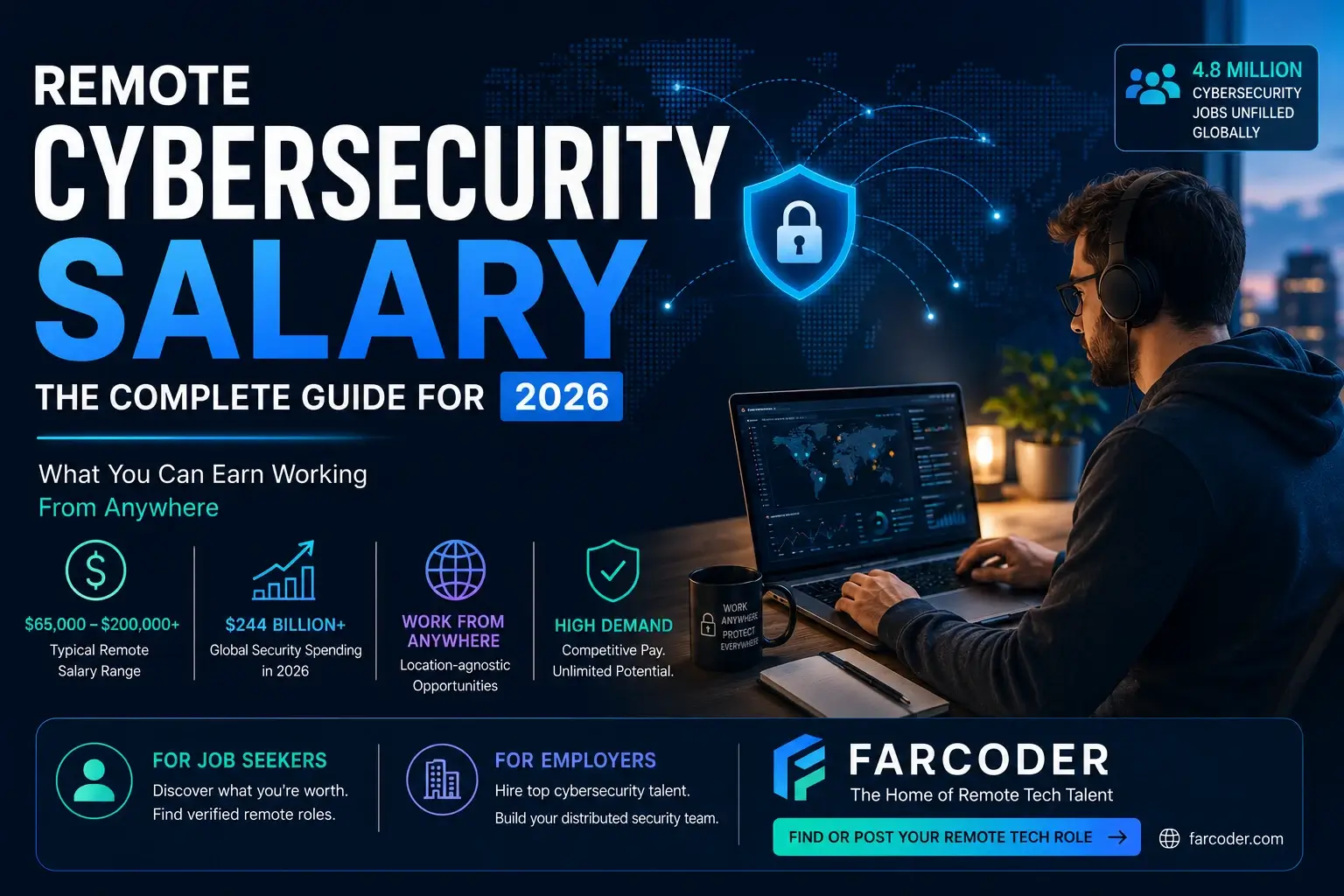
Remote cybersecurity is one of the highest-paying and most actively hiring categories in the global remote tech job market in 2026. With 4.8 million unfilled cybersecurity positions worldwide and global security spending projected to exceed $244 billion this year, organisations are hiring distributed security talent at salaries that compete directly with co-located roles — and in many cases exceed them. Whether you are a cybersecurity professional evaluating your market value for a remote role, or an employer building a distributed security team and setting competitive compensation, this guide gives you the real numbers by role, experience, certification, and geography, and shows you exactly where to act on them.
What Do Remote Cybersecurity Professionals Earn in 2026?
Remote cybersecurity professionals earn between $65,000 and $200,000+ annually depending on their role and experience level, with salaries at fully remote-first employers competitive with, and frequently matching, equivalent co-located positions. The global workforce gap of 4.8 million unfilled cybersecurity roles means remote employers cannot afford to discount distributed talent.
The U.S. Bureau of Labor Statistics reports a median annual wage of $124,910 for Information Security Analysts, but this figure covers all employment models. For remote-specific roles, the picture is more nuanced. Some employers apply geo-banded compensation, paying 10 to 25 percent less for remote workers outside major metropolitan areas. Remote-first companies, those that built distributed operations from the ground up, typically pay location-agnostic salaries benchmarked to global market rates, which for senior cybersecurity professionals means $150,000 to $200,000 regardless of where they live.
For remote job seekers, understanding which employers apply location-based pay adjustments versus which pay globally benchmarked rates is one of the most important pieces of salary research to do before entering any negotiation. For remote employers, understanding that the best cybersecurity candidates have multiple offers and will choose the combination of compensation, flexibility, and remote-first culture that serves them best is equally critical.
Remote Cybersecurity Salary by Role
Remote SOC Analyst
Entry-level (Tier 1): $65,000 to $85,000 Mid-level (Tier 2): $85,000 to $105,000 Senior (Tier 3): $100,000 to $130,000
SOC analysts are the most widely available remote cybersecurity role in 2026. The work is inherently digital, monitoring alerts, investigating suspicious activity, escalating confirmed incidents, which makes it one of the most naturally remote-compatible positions in security. Remote employers hire SOC analysts across time zones specifically to achieve 24/7 coverage without shift premiums or physical operations centres.
For remote job seekers: Tier 1 SOC roles are the most accessible entry point into remote cybersecurity employment. AI tools are automating routine Tier 1 triage tasks in 2026, which means moving toward Tier 2 and Tier 3 capabilities as quickly as possible is the fastest path to salary growth. Tier 3 SOC analysts who can manage and interpret AI-driven security tools are among the most actively hired remote profiles on FarCoder.
For remote employers: SOC analysts are the first remote cybersecurity hire most organisations make. A distributed SOC team covering overlapping time zones provides better coverage than a co-located team at lower cost. Expect competitive salary pressure at Tier 2 and Tier 3, the candidates with deep investigation skills have multiple offers.
Remote Incident Responder
Salary range: $90,000 to $155,000
Remote incident response has become standard practice at organisations with distributed infrastructure. Responders connect to affected environments through secure remote access tools, conduct forensic investigations without physical presence, and deliver structured findings and remediation plans entirely asynchronously when needed.
For remote job seekers: Incident response is one of the most remote-compatible senior cybersecurity roles available. If you have confirmed incident response experience — containment, eradication, recovery, and can demonstrate that you have led or contributed to response investigations across distributed environments, you are in one of the strongest salary positions in the remote cybersecurity market. Document your experience in terms of incident scope, systems affected, and time-to-containment metrics. Remote employers evaluate these specifics in interviews.
For remote employers: Incident responders working remotely should have secure, reliable home office infrastructure and documented experience with the remote access and forensic tools your team uses. The average time to fill a remote incident response role is six to nine months for experienced candidates. Set your compensation at the upper half of the range and move quickly on strong candidates, counter-offers are common at this level.
Remote Threat Intelligence Analyst
Salary range: $80,000 to $145,000
Threat intelligence is one of the most naturally remote-compatible cybersecurity disciplines. Tracking active campaigns, analysing indicators of compromise, producing intelligence reports, and distributing findings to defensive teams are all digital activities with no dependency on physical location.
For remote job seekers: Threat intelligence analysts with documented experience in a specific threat category, financial sector threats, nation-state campaigns, ransomware ecosystems, or supply chain attacks, command the strongest remote salaries in this category. Generalist analysts compete on a wider field; specialists command premium pay from employers whose risk profile matches their expertise. Build your specialisation deliberately and make it visible in your resume and professional presence.
For remote employers: Threat intelligence is a role where the global remote talent pool genuinely expands your access. Analysts based in regions with proximity to specific threat actor ecosystems, Eastern Europe, Southeast Asia, Latin America, bring contextual knowledge that domestic-only hiring cannot access. Consider geographic diversity in your threat intelligence team as a capability investment, not just a staffing decision.
Remote Penetration Tester
Salary range: $95,000 to $180,000
Remote penetration testing has grown substantially as an employment model. External network assessments, web application testing, phishing simulation campaigns, and cloud environment testing all operate effectively without the tester being physically present at the client site.
For remote job seekers: OSCP certification is the most powerful salary lever in remote penetration testing. Holding OSCP moves advertised remote pen testing salaries into the $117,600 to $151,000 range. CEH and PNPT certifications add credibility at the entry and mid-career levels. Bug bounty participation, with documented, disclosed findings, is one of the strongest portfolio signals for remote penetration testing roles because it demonstrates real offensive security capability in a verifiable format.
For remote employers: Penetration testing roles require the strongest security controls in your remote access infrastructure, the irony of a penetration tester needing a tightly controlled remote access environment is not lost on security leaders. Define your testing scope, engagement model, and remote access requirements clearly in the job description. Candidates with OSCP who are actively engaged in the bug bounty community are the highest-signal remote penetration testing profiles.
Remote Cloud Security Engineer
Salary range: $130,000 to $200,000
Remote cloud security engineering is the fastest-growing and fastest-appreciating remote cybersecurity role in 2026. As organisations operate across multiple cloud platforms simultaneously, the professionals who can secure AWS, Azure, and GCP environments, including infrastructure-as-code security, container security, and cloud-native identity management, are the most sought-after remote cybersecurity hires in the current market.
For remote job seekers: Cloud security is the single highest-return specialisation you can invest in as a remote cybersecurity professional in 2026. Cloud security credentials add up to 25 percent above base cybersecurity engineering salaries. AWS Certified Security Specialty, Google Professional Cloud Security Engineer, and Microsoft Security certifications all deliver documented salary premiums. If you are a security engineer weighing your next specialisation move, cloud is where the remote compensation ceiling is highest.
For remote employers: Cloud security engineers with genuine multi-cloud experience are extraordinarily difficult to find. The global shortage in this specific profile means you will compete against multiple simultaneous offers for strong candidates. Location-agnostic compensation, equity where available, and a clearly remote-first culture are the three factors candidates at this level weigh most heavily in making decisions.
Remote Security Architect
Salary range: $155,000 to $230,000
Security architects design the entire security posture of organisations, determining how systems, networks, and applications are protected at the architectural level. At companies that have committed to remote-first operations, security architects work fully distributed, reviewing designs asynchronously, conducting architecture sessions over video, and documenting decisions in shared knowledge bases.
For remote job seekers: Security architecture is the highest individual contributor salary ceiling in remote cybersecurity outside CISO-level leadership. Reaching this role typically requires deep engineering experience followed by a deliberate move toward architectural scope, leading security design reviews, producing architecture decision records, and demonstrating the strategic thinking that separates architects from engineers. CISSP is the standard credential at this level and delivers a documented 22 percent salary premium for holders.
For remote employers: Remote security architects are rare. If your architecture work is genuinely achievable in a distributed model, and for most cloud-native organisations it is, lead with that flexibility in your job description. Candidates at this level are evaluating your remote-first credibility as much as your compensation.
Remote DevSecOps Engineer
Salary range: $120,000 to $185,000
DevSecOps engineers integrate security into CI/CD pipelines, automate security testing, manage container and infrastructure security, and work at the intersection of development, operations, and security. The role is deeply compatible with remote work, pipeline management, code review, and security automation are all tools-driven activities with no location dependency.
For remote job seekers: DevSecOps is one of the best adjacent moves for remote backend developers or DevOps engineers who want to enter cybersecurity at a senior level with strong salary positioning. If you have CI/CD experience and want to move into security, building DevSecOps skills, SAST/DAST tooling, container security, secrets management, is a faster path to $130,000+ remote cybersecurity salary than starting in a SOC analyst role.
For remote employers: DevSecOps candidates come from both the developer side and the security side. Specify which background you prioritise in your job description, security engineers who learned DevOps, or DevOps engineers who developed security depth. The candidate pool and salary expectations differ meaningfully between these two profiles.
Remote Cybersecurity Salary by Experience Level
Entry Level (0 to 2 years): $65,000 to $90,000
Entry-level remote cybersecurity roles, junior SOC analyst, entry-level security engineer, junior threat analyst, are the most accessible starting point for professionals entering the remote cybersecurity job market.
For remote job seekers entering the field: The entry-level remote cybersecurity market in 2026 rewards candidates who combine certifications with demonstrable hands-on practice. CompTIA Security+ appears in over 70 percent of cybersecurity job postings and adds approximately 11 percent above uncertified entry-level salaries. Pair it with documented practical experience from platforms like TryHackMe or Hack The Box, and you become a significantly stronger candidate for remote roles where employers cannot evaluate you through a physical interview environment.
For remote employers hiring entry level: Remote entry-level cybersecurity candidates need more structured onboarding than co-located equivalents because they cannot learn by proximity. Budget for a 60 to 90 day structured remote onboarding programme and clear documentation of your security tools, processes, and escalation paths. Entry-level candidates who receive strong remote onboarding have significantly higher retention rates.
Mid Level (3 to 7 years): $95,000 to $155,000
Mid-level remote cybersecurity professionals with a defined specialisation, cloud security, incident response, penetration testing, or threat intelligence, are among the most actively hired profiles in the remote tech market in 2026.
For remote job seekers at mid career: Specialisation is the most powerful salary lever at this stage. Remote cybersecurity professionals who maintain generalist profiles see salary growth stall; those who develop genuine depth in a high-demand specialisation see compensation grow at 7 to 10 percent annually. Pick your specialisation deliberately based on where remote demand is strongest, cloud security, incident response, and DevSecOps are the three categories with the most active remote hiring in 2026.
For remote employers hiring mid-level: Counter-offers are a significant risk at this level, 65 percent of cybersecurity professionals who accept an offer receive a counter-offer from their current employer. If your offer is not compelling from day one, expect to lose 30 to 40 percent of accepted candidates before their start date.
Senior Level (7+ years): $150,000 to $230,000+
Senior remote cybersecurity professionals, senior engineers, architects, senior penetration testers, and security leads, are the most competitive hiring category in the entire remote cybersecurity market. Demand consistently and significantly exceeds supply at this experience level.
For remote job seekers at senior level: At this stage, your remote work capability is as important to employers as your technical depth. Senior candidates who can demonstrate a track record of remote leadership, distributed team management, async communication quality, remote incident coordination, command the strongest salary positioning. CISSP delivers a documented 22 percent salary premium at this level. Make your remote work experience explicit and specific in your resume and interviews.
For remote employers hiring senior: Average time to fill a senior remote cybersecurity role is six to nine months. Every month the position remains open, your existing team carries additional workload and burnout risk accumulates. Set compensation at the upper half of the market range and move decisively when you find a strong candidate. Slow hiring processes lose senior cybersecurity candidates to faster-moving employers consistently.
How Certifications Increase Your Remote Cybersecurity Salary
Certifications in cybersecurity deliver measurable, documented salary premiums that are particularly valuable for remote professionals, where credentials serve as a primary trust signal for employers who cannot evaluate you through an in-person environment.
|
Certification |
Salary Impact |
Best For |
|
CompTIA Security+ |
+11% at entry level |
All entry-level remote roles |
|
CompTIA CySA+ |
Average holder salary $106,490 |
Remote SOC analyst career path |
|
OSCP |
Moves pen testing salary to $117K–$151K |
Remote penetration testing |
|
CISSP |
+22% average salary boost |
Senior remote engineers and architects |
|
CISM |
+18% average salary boost |
Remote security management and leadership |
|
AWS/GCP/Azure Security |
Up to +25% |
Remote cloud security engineering |
The ISC2 Cybersecurity Workforce Study, published annually, provides the most comprehensive global view of cybersecurity workforce supply, demand, and compensation, a foundational reference for remote professionals benchmarking their market value and for employers setting competitive remote compensation.
For Remote Job Seekers: How to Maximise Your Cybersecurity Salary
Negotiate on market data, not personal need. In a remote salary negotiation, anchor your ask to documented market rates, not to what you currently earn or what you need. The cybersecurity talent shortage gives qualified remote professionals genuine negotiating leverage. Use it by presenting specific market benchmarks for your role, experience level, and certification profile.
Target remote-first employers over remote-allowed employers. Remote-first companies, those that built distributed operations from the ground up, pay location-agnostic salaries and compete for global talent. Remote-allowed companies often apply geo-banded pay adjustments of 10 to 25 percent for workers outside major metros. The employer's remote-first credibility directly affects your long-term earning trajectory.
Specialise in the highest-demand remote categories. Cloud security engineering, DevSecOps, and senior incident response are the three remote cybersecurity specialisations with the strongest salary growth trajectory in 2026. If you are choosing your next specialisation move, build toward one of these categories.
Make your remote work capability explicit. Remote employers evaluate your ability to work distributed as seriously as your technical skills. In your resume, your LinkedIn profile, and your interviews, describe your remote work infrastructure, your async communication approach, and your self-management system explicitly. Remote cybersecurity candidates who demonstrate remote-readiness alongside technical depth consistently receive stronger offers.
FarCoder lists verified remote cybersecurity positions across every specialisation with salary ranges included in every listing so you can benchmark your expectations before you apply.
For Remote Employers: How to Hire and Retain Remote Cybersecurity Talent
The remote cybersecurity hiring market in 2026 is a candidate's market at every level above entry. The 4.8 million unfilled positions globally mean that qualified candidates have choices, and the employers who win consistently are those who combine competitive compensation with genuine remote-first culture and a fast, clear hiring process.
Set compensation at market from the start. Cybersecurity salaries have increased 7 to 10 percent year-over-year for three consecutive years. Salary budgets based on data from 2023 are 25 to 40 percent below current market rates. Candidates who receive below-market offers do not negotiate up, they move to the next employer. Research current remote market rates for each specific role before opening a search.
Move fast. Average time to fill specialised remote cybersecurity roles is six to nine months. The candidates you want are on the market briefly. A hiring process that takes three months to reach an offer will consistently lose strong candidates to employers who move in three weeks.
Invest in remote onboarding. New remote security employees who receive structured onboarding, clear documentation of tools, processes, and escalation paths, scheduled introductions to teammates, and defined 30-60-90 day milestones — reach full productivity faster and stay longer. Retention for remote cybersecurity professionals costs a fraction of the 1.5 to 2 times annual salary that replacing them requires.
Post where remote cybersecurity professionals look. FarCoder connects remote employers with verified cybersecurity professionals actively building distributed careers — SOC analysts, incident responders, threat intelligence analysts, penetration testers, cloud security engineers, and security architects, all in one verified remote job platform.
Browse current remote cybersecurity listings with salary ranges at farcoder.com/remote-cybersecurity-jobs.
Frequently Asked Questions (FAQ)
What is the average remote cybersecurity salary in 2026?
+−
The average cybersecurity salary in the US is approximately $135,969 in 2026. For remote-specific roles, compensation varies by employer model, remote-first companies typically pay location-agnostic salaries competitive with major tech hubs, while remote-allowed companies may apply geo-banded adjustments of 10 to 25 percent for workers outside major metros.
Which remote cybersecurity role pays the most?
+−
Cloud security engineering and security architecture are the highest-paying individual contributor remote cybersecurity roles in 2026, with salary ranges of $130,000 to $230,000 depending on experience and employer. CISO roles at remote-first companies represent the highest total compensation category, frequently exceeding $300,000 in total package value.
Do remote cybersecurity jobs pay less than office jobs?
+−
Not at remote-first employers. Companies that built distributed operations from the ground up pay location-agnostic salaries benchmarked to global market rates. Some hybrid or remote-allowed employers apply geo-banded adjustments. When evaluating a remote offer, ask specifically whether the salary is location-based or role-based, the answer significantly affects your long-term earning trajectory.
What certifications increase remote cybersecurity salary the most?
+−
CISSP delivers the largest salary premium at senior levels, a documented 22 percent average boost. Cloud security certifications add up to 25 percent for engineering roles. OSCP is the strongest salary credential for remote penetration testing. CompTIA Security+ is the most effective entry-level certification for clearing initial screening at remote employers.
How do I find remote cybersecurity jobs with salary ranges published?
+−
FarCoder lists salary ranges in remote cybersecurity job listings across every specialisation, SOC analyst, incident response, threat intelligence, penetration testing, cloud security, and security architecture.
As an employer, what should I budget for a remote cybersecurity hire in 2026?
+−
Budget $85,000 to $105,000 for a mid-level remote SOC analyst, $120,000 to $155,000 for a remote incident responder or DevSecOps engineer, $130,000 to $200,000 for a remote cloud security engineer, and $155,000 to $230,000 for a remote security architect. Add a minimum $5,000 per year per security professional for training and certification support — it is the highest-return retention investment at every level. Post your remote cybersecurity role on FarCoder to reach qualified distributed candidates globally.
About the Author

Muhammad Mansoor Ishaq
**Muhammad Mansoor Ishaq** is the Co-Founder of FarCoder and an experienced web developer specializing in WordPress, Shopify, Wix, and Squarespace. In addition to his technical expertise, he is a regular contributor to FarCoder’s blog, where he writes about remote work, software development careers, web development, freelancing, digital transformation, workplace productivity, hiring trends, and the future of distributed teams. Drawing from both hands-on industry experience and ongoing research, Muhammad creates practical, insightful content that helps job seekers, developers, and employers succeed in an increasingly remote-first world. His work focuses on bridging the gap between technology, talent, and modern work opportunities across global markets.
Connect on LinkedIn