Networking Tips for Remote Workers: How to Build a Career-Defining Network From Anywhere

Far Coder Team
Wed Jun 10 2026
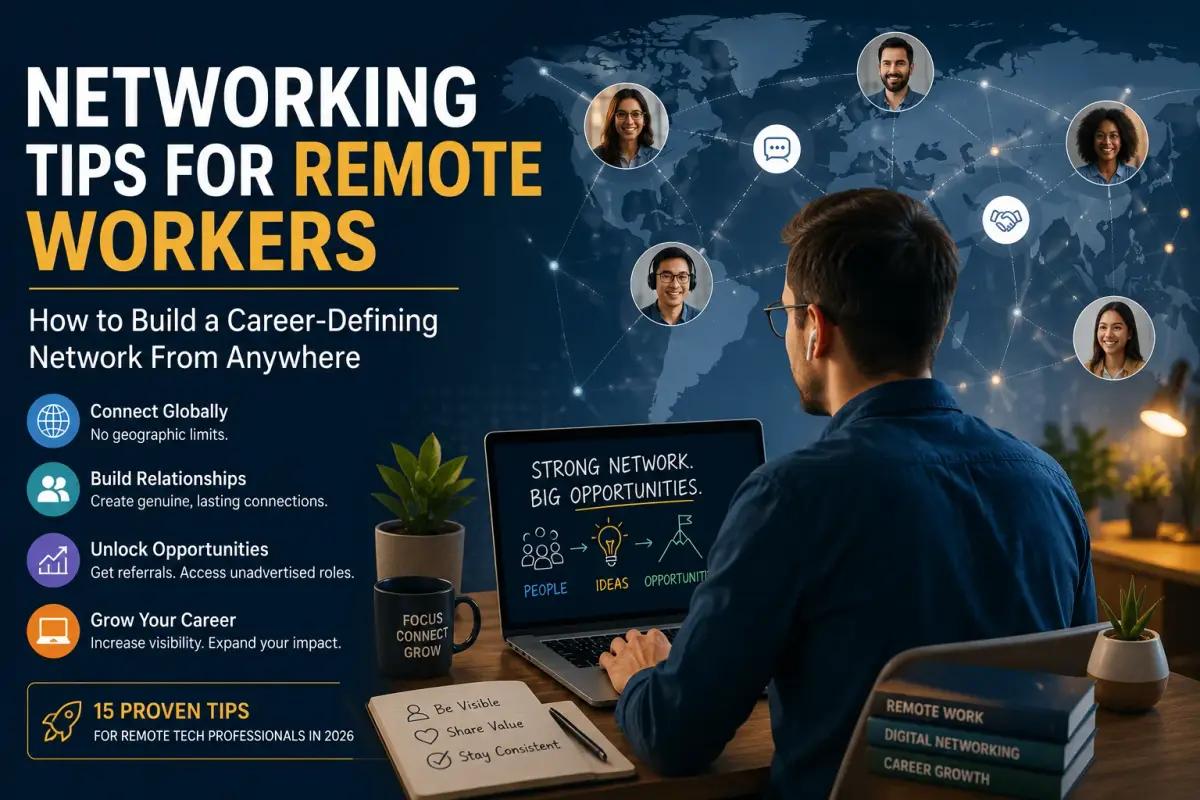
Remote work has eliminated the casual hallway conversation, the conference handshake, and the after-work drinks that office professionals use to build their networks, but it has not eliminated the need for professional connections. In fact, 15% of remote workers cite loneliness as their greatest struggle, and for tech professionals building long-term careers, a weak network means fewer referrals, fewer opportunities, and less access to the unadvertised roles that fill the majority of senior positions. This guide covers 15 proven networking tips for remote tech workers, practical, specific, and designed for the platforms and workflows of distributed teams in 2026. Whether you are a job seeker building connections for your next opportunity or an employer looking to develop your distributed team's professional reach, these strategies work.
Why Remote Networking Is Different: And Why It Matters More Than Ever
Remote workers cannot rely on the incidental professional contact that office environments provide automatically; every valuable professional connection must be built deliberately, through digital channels, with intentional effort. The upside is that remote networking has no geographic limit and no commute cost; the global professional community is accessible from a single device.
21% of remote workers say they stay at home too often, a pattern that, left unaddressed, produces professional isolation that compounds over time. For tech professionals, professional isolation means fewer referrals to unadvertised roles, less access to the peer knowledge exchange that accelerates skill development, and reduced visibility to the employers and decision-makers who make senior hiring decisions.
The stakes are real. Remote job postings attract 340% larger candidate pools, which means that for every remote tech role you apply to cold, you are competing against a global applicant pool. The professionals who consistently land the best remote roles are not always the most technically qualified, they are the ones whose network brings them opportunities before the role is ever posted publicly.
Networking for remote tech professionals is not about collecting LinkedIn connections. It is about building genuine professional relationships that create mutual value, relationships where people remember your work, recommend you for opportunities, and refer you to the communities and employers that match your goals.
Tip 1: Optimise Your LinkedIn Profile as Your Remote Networking Hub
For remote professionals, LinkedIn is not a supplementary networking tool, it is the primary professional identity that every employer, collaborator, and hiring manager will check before engaging with you. An incomplete or generic LinkedIn profile is a networking liability.
Your LinkedIn headline should communicate your specialisation, your remote experience, and the value you deliver, not just your job title. "Senior Backend Engineer | Go / Kubernetes | Remote" is a more effective headline than "Senior Software Engineer at Acme Corp" because it immediately tells any visitor what you do, what you specialise in, and that you are remote-experienced.
Your About section should include three elements: a direct statement of what you do and who you do it for, evidence of your most significant professional contributions, and a signal that you are open to relevant connections and conversations. Keep it to three to four paragraphs, specific, confident, and written in the first person.
Publish long-form content on LinkedIn regularly. A post about a technical problem you solved, a lesson learned from a distributed team challenge, or your perspective on a trend in your specialisation builds professional visibility at a scale that no resume submission achieves. Remote job postings see 13% higher offer acceptance rates and 16% faster hiring. Professionals with a visible LinkedIn presence are the ones who capture that advantage.
Tip 2: Contribute to Open Source Projects in Your Specialisation
Open source contribution is the most credible public signal of technical capability available to a remote tech professional; it produces a permanent, reviewable record of how you write code, communicate in a technical community, and collaborate with distributed teams.
For remote frontend developers, backend engineers, DevOps professionals, and security researchers, a strong GitHub contribution history communicates more to hiring managers than any resume bullet point. Your code is public. Your communication in pull requests and issues is public. Your ability to work asynchronously with a distributed team is demonstrated every time you submit a contribution that gets merged.
Start with projects you already use. File issues for bugs you encounter. Submit pull requests for documentation improvements. Review open pull requests and leave constructive, specific comments. Gradually work toward code contributions in areas where your skills are strongest. The networking outcome compounds over time, contributors who engage consistently become known in their project communities, and project maintainers become professional references who can speak to your technical capability and async collaboration quality from direct experience.
Tip 3: Engage Actively in Tech Community Spaces
Online tech communities, Discord servers, Slack workspaces, Reddit communities, and specialised forums, are where remote tech professionals build the peer relationships that produce referrals, collaborations, and career opportunities outside the formal job application process.
The most valuable online communities are specific rather than broad. A Discord server for your frontend framework, a Slack workspace for your security specialisation, or a forum for your cloud platform produces higher-quality professional connections than a generic "remote workers" group because the shared context creates natural, substantive conversation.
Contributing value, answering questions, sharing resources, writing useful posts, is what turns community membership into professional network building. The professionals who are known in their communities as people who help others are the ones who receive referrals when opportunities arise. Passive membership produces nothing. Consistent, helpful contributions build a professional reputation organically.
Specific communities worth investing in for remote tech professionals in 2026 include, Dev.to and Hashnode for software developers, HackerNews for broad tech discourse, OWASP Slack for cybersecurity professionals, Figma's community forum for designers, and the subreddits and Discord servers for your primary programming language or framework.
Tip 4: Attend and Speak at Virtual Conferences and Meetups
Virtual conferences and online meetups remove the geographic and cost barrier to professional visibility, and speaking at even a small virtual event produces significantly more networking return than attending as a passive audience member.
Remote work has accelerated the growth of online professional events. Most major tech conferences now offer fully virtual or hybrid attendance, and hundreds of smaller virtual meetups run weekly for every tech specialisation. These events are attended by the engineers, managers, and decision-makers who influence hiring in your field.
Attending with intent means more than watching sessions. Use the chat, ask specific questions of speakers, and follow up with presenters and other attendees on LinkedIn within 24 hours while the interaction is still fresh. A brief, specific follow-up, "I found your session on Kubernetes security hardening genuinely useful, I ran into a similar issue with pod security policies last month", is far more effective than a generic connection request.
Speaking at a virtual event, even a small community meetup with 50 attendees, produces professional visibility that passive attendance never matches. You are not a face in the crowd; you are the person who shared something worth learning. Even a 15-minute lightning talk on a technical problem you solved builds professional credibility that compounds into referrals and opportunities over time.
Tip 5: Build a Personal Technical Blog or Newsletter
Writing publicly about technical topics in your specialisation builds professional authority, creates organic inbound connections from peers and employers, and produces a permanent record of your expertise that any hiring manager can access without asking.
A technical blog does not require daily publishing or long-form essays. Two to four well-written posts per month, solving a specific problem, explaining a concept clearly, or sharing a lesson from a real project, produce compounding professional visibility over a 6 to 12 month period. Engineers who write clearly about their work are consistently perceived as more senior and more thoughtful than those who do not, regardless of their actual experience level.
The inbound networking return on consistent technical writing is significant. Developers find your post through search. They read it. They follow you on LinkedIn or GitHub. Some of them work at companies that are hiring. Some of them are hiring managers themselves. The network builds toward you rather than requiring you to build out toward it.
Platforms that support technical writing with built-in audience: Dev.to for developer-focused content, Substack for newsletter format, and Medium's technical publications for broader reach. Your own domain, firstname.dev or firstname.io, adds professional credibility and is one of the strongest personal brand investments available for under $15 per year.
Tip 6: Schedule Virtual Coffee Chats Deliberately
Virtual coffee chats, short, one-on-one video calls with professionals in your field, are the remote equivalent of the informal office conversation that produces the majority of career-advancing relationships in co-located environments. They must be scheduled deliberately because they never happen accidentally.
Identify five to ten professionals per month whose work you find interesting, people you follow on LinkedIn, contributors to open source projects you use, speakers from events you attended, or authors of technical posts you found valuable. Send a brief, specific message requesting a 20-minute conversation: explain who you are, what you found interesting about their work, and what you would like to discuss. Keep the ask small and specific, 20 minutes is a much easier yes than an open-ended "let's catch up."
The goal of a virtual coffee chat is not to ask for a job referral. It is to build a genuine professional relationship through authentic curiosity. Ask about their work, their career path, what problems they are solving, and what they find interesting in your shared field. Most people enjoy talking about their work with someone who is genuinely interested. The relationship that results from a good conversation is the one that produces a referral or recommendation six months later when an opportunity arises that matches your profile.
Tip 7: Engage Your Own Remote Team as a Network Asset
Your current distributed teammates are your most immediate and most underused professional network; they work with your output daily, can recommend you directly, and will be distributed across multiple companies within five years, each with hiring influence at their next employer.
Remote teams have fewer organic relationship-building opportunities than co-located teams, which means the professionals who invest deliberately in teammate relationships build disproportionately strong connections compared to those who treat their distributed colleagues as purely task-based collaborators.
Invest in your distributed team relationships through consistent, thoughtful communication. Acknowledge great work in team channels. Ask genuine questions about your teammates' career interests and professional goals. Offer to help with challenges outside your immediate responsibilities. The professional who is known within their distributed team as someone who raises others alongside themselves builds the kind of reputation that generates referrals and recommendations for decades.
For employers building distributed tech teams: team relationships are one of the most significant networking and retention factors at your disposal. Remote employers who create structured social rituals, virtual team events, async get-to-know-you threads, optional social channels, build stronger internal networks that reduce turnover and produce more peer referrals in hiring.
Tip 8: Be Consistent and Specific on Twitter / X and Bluesky
Tech Twitter, and its growing successor community on Bluesky, remains one of the most active spaces for real-time professional discourse in software development, DevOps, design, and cybersecurity. Consistent, specific engagement builds visibility with the exact professionals and hiring managers who matter most in your specialisation.
Generic posts, motivational content, vague observations about the industry, retweets without commentary, produce no professional networking return. Specific posts, sharing a solution to a real technical problem, a perspective on a framework decision, or a concise explanation of a concept, attract followers who share your professional context and create conversations that become professional relationships.
The investment required is modest: three to five substantive posts per week, consistent engagement with replies to posts from professionals you respect, and the discipline to write about your actual technical work rather than performing expertise you do not have. Over 6 to 12 months, consistent specific presence in tech Twitter communities builds the kind of professional visibility that produces inbound opportunities.
Tip 9: Build a Presence on GitHub Beyond Code Repositories
GitHub is not only a code host, it is the professional identity platform for software engineers, and the quality of your presence there is evaluated directly by technical hiring managers before any interview conversation begins.
Your GitHub profile should include a well-written README that describes who you are, what you build, and what you are currently working on. Pin your most significant repositories. Write clear, specific README files for each project that explain what the project does, why it exists, and how to use it. Contribute to other repositories with well-written pull request descriptions and constructive issue comments.
The networking return on GitHub presence is direct: technical hiring managers and engineering leaders visit the GitHub profiles of candidates they are considering. A GitHub profile that communicates genuine engineering depth, through code quality, documentation quality, and contribution history, produces a stronger first impression than any resume bullet point.
Tip 10: Use LinkedIn's Creator Mode and Content Strategy
LinkedIn's Creator Mode increases your visibility to professionals outside your existing network, the exact people you need to reach to build a professional network that grows beyond your current employer and immediate contacts.
Enable Creator Mode in your LinkedIn settings and select five to seven topics that align with your professional specialisation. This signals to LinkedIn's algorithm what your content is about and surfaces it to professionals interested in those topics regardless of whether they follow you.
Post consistently, two to three times per week, about technical topics, career lessons, and professional observations in your field. Mix formats: short text observations get broad reach, document carousels perform strongly for tutorials and process explanations, and long-form articles build authority for complex technical topics. Engage with comments on your posts within the first hour of publishing, early engagement signals quality to LinkedIn's algorithm and extends your post's reach significantly.
Tip 11: Contribute to Technical Documentation and Community Resources
Contributing to documentation for open source projects, technical wikis, or community knowledge bases builds professional visibility and genuine credibility in the communities where your target employers and collaborators are already active.
Documentation contributions are underrated as a networking strategy because they demonstrate two capabilities simultaneously: technical depth sufficient to write accurately about a subject, and communication skill sufficient to write clearly for an audience. Both are capabilities that remote employers value explicitly, and both are visible in the public record of your contributions.
Documentation contributions are also lower-barrier than code contributions for professionals building their open source presence for the first time. Start with small improvements, fixing unclear explanations, updating outdated examples, adding missing context, and build toward more substantial documentation contributions as your familiarity with the project grows.
Tip 12: Build Cross-Functional Relationships Inside Your Organisation
Remote tech professionals who build genuine relationships with colleagues outside their immediate team, across product management, design, security, data, and business leadership, build professional networks with broader reach and more diverse opportunity access than those who network only within their technical discipline.
In distributed organisations, cross-functional relationships are structurally harder to build because the incidental contact that creates them in offices, shared lunch queues, cross-departmental all-hands interactions does not happen naturally. Building these relationships requires deliberate effort: attending company-wide meetings with genuine engagement, contributing to cross-functional Slack channels, and reaching out to colleagues in adjacent teams with the same intentionality you would apply to external networking.
The career value of cross-functional relationships is significant. Product managers refer engineers to their next companies. Design leads recommend developers they have worked well with to hiring managers. Security professionals who have strong relationships with engineering leadership get considered for strategic roles that never reach external job boards.
Tip 13: Set a Weekly Networking Goal and Track It
Remote networking without a defined system defaults to zero, because there is no office environment providing networking opportunities passively; every professional connection requires deliberate initiation, and without a goal and a tracking system, deliberate initiation rarely happens consistently.
A simple weekly networking goal is sustainable and effective: two new LinkedIn connections per week with personalised messages, one virtual coffee chat per fortnight, one community contribution per week (a helpful answer, a useful post, a pull request comment), and one piece of content published per week. These targets are achievable in under two hours per week and produce compounding professional visibility over a 12-month period.
Track your networking activity in a simple spreadsheet or Notion database: who you connected with, how you met, what you discussed, and when to follow up. A professional relationship that is never followed up after the initial conversation produces no long-term career value. The professionals with the strongest networks are not those who meet the most people, they are those who maintain the most relationships.
Tip 14: Engage Hiring Managers and Technical Leaders Directly
Remote job seekers who engage with hiring managers and technical leaders on LinkedIn before applying for roles are significantly more likely to have their applications noticed and reviewed than those who apply cold through job boards alone.
The mechanism is straightforward: when a hiring manager sees a candidate's name in an application who has previously engaged thoughtfully with their LinkedIn content, that name registers as familiar rather than anonymous. Familiarity produces attention. Attention produces review. Review produces interviews.
The engagement must be genuine and specific, a substantive comment on a technical post, a thoughtful response to a perspective piece, or a well-framed question about a challenge they shared publicly. Generic "great post!" comments produce no professional relationship value. Specific, informed engagement demonstrates that you have read their work and have something worthwhile to contribute to the conversation.
Tip 15: Leverage FarCoder's Remote Tech Community
Using a platform built specifically for remote tech professionals, rather than a general job board, puts you in direct contact with employers, hiring managers, and fellow professionals who share your remote-first professional context.
FarCoder's community of remote tech professionals and employers spans every tech specialisation. Applying for roles through FarCoder connects you directly with employers who have chosen to build distributed teams, professionals who understand remote work, value distributed collaboration, and are actively looking for the kind of career-focused remote professional that this guide is designed for.
Beyond applications, browsing FarCoder's listings gives you direct visibility into which companies are actively hiring remotely, what skills they are valuing in 2026, and what salary ranges are current for your specialisation, all of which informs your LinkedIn positioning, your community contributions, and your networking conversations with far more precision than general market research.
Browse Remote jobs: https://farcoder.com/jobs
For Employers: How Networking Supports Your Remote Hiring Strategy
The strongest remote tech candidates are not browsing job boards, they are being referred by their professional networks. Employers who build a visible, credible presence in the remote tech community receive inbound candidate interest that cold job postings cannot generate.
Remote job postings attract 340% larger candidate pools and see 13% higher offer acceptance rates, but the best candidates within that pool are still choosing between multiple opportunities. Employers whose engineering leaders contribute to technical communities, whose company brand is visible and credible in the platforms where remote tech professionals spend time, and whose current employees are engaged enough to refer peers, these employers consistently hire faster and better than those whose only recruiting channel is job board postings.
Invest in your engineering team's external presence. Encourage technical blog posts, conference talks, open source contributions, and community engagement. Your engineers' professional visibility is your employer brand. The candidates they attract through their networks are pre-qualified by the relationship, they already know someone at your company, they already trust the technical culture, and they are applying because they want to work with that person specifically.
LinkedIn's Global Talent Trends report consistently identifies employee referrals as the highest-quality hiring channel available, producing faster time-to-hire, lower cost-per-hire, and stronger retention than any other source. Remote employers who invest in their teams' professional networks are investing in their most effective recruiting channel.
Frequently Asked Questions (FAQ)
How do remote workers network without a physical office?
+−
Remote professionals network through digital channels, LinkedIn engagement, open source contributions, virtual events, online tech communities, and deliberate virtual coffee chats. The absence of incidental office networking means every connection must be initiated deliberately, but the tools available make global professional networking more accessible than any in-person model. Start with the platforms where your professional community is already active: GitHub, LinkedIn, Discord, and the virtual conferences in your specialisation.
How often should I network as a remote tech professional?
+−
Consistency beats intensity. Two to three meaningful professional interactions per week, a thoughtful LinkedIn comment, a helpful community answer, a virtual coffee chat produce more compounding value than a periodic burst of intensive networking. Set a weekly goal you can sustain: two new connections, one community contribution, and one piece of published content is achievable in under two hours and produces significant results over 12 months.
Does networking actually help remote tech professionals get jobs?
+−
Yes, significantly. The majority of senior tech roles are filled through referrals before they are ever posted publicly. 15% of remote workers cite loneliness as their greatest remote work struggle. Professionals who address that isolation through deliberate networking build the professional relationships that produce referrals, recommendations, and direct opportunities. Cold applications through job boards compete with hundreds of candidates; referred applications compete with far fewer.
What are the best platforms for remote tech networking in 2026?
+−
LinkedIn is the primary professional identity platform. GitHub is the primary technical credibility platform for developers. Twitter/X and Bluesky are the primary real-time discourse platforms for tech professionals. Discord and Slack host the most active community spaces for specific specialisations. Virtual conferences and meetups provide the relationship-building context that structured events create. Use all of them with a content strategy specific to each platform's culture and audience.
How do I network when I am introverted?
+−
Written async networking is naturally suited to introverted professionals. Contributing to technical discussions in writing, publishing thoughtful posts, and engaging in GitHub or forum discussions all produce professional visibility without requiring real-time social interaction. Virtual coffee chats with clear agendas and specific conversation topics are significantly less socially demanding than open-ended in-person networking events. Start with the lowest-friction channel, a helpful answer in a tech forum, and build from there.
About the Author

Muhammad Mansoor Ishaq
**Muhammad Mansoor Ishaq** is the Co-Founder of FarCoder and an experienced web developer specializing in WordPress, Shopify, Wix, and Squarespace. In addition to his technical expertise, he is a regular contributor to FarCoder’s blog, where he writes about remote work, software development careers, web development, freelancing, digital transformation, workplace productivity, hiring trends, and the future of distributed teams. Drawing from both hands-on industry experience and ongoing research, Muhammad creates practical, insightful content that helps job seekers, developers, and employers succeed in an increasingly remote-first world. His work focuses on bridging the gap between technology, talent, and modern work opportunities across global markets.
Connect on LinkedIn