How to Make a Good Impression in a World of Remote Work

Far Coder Team
Sun Jun 14 2026
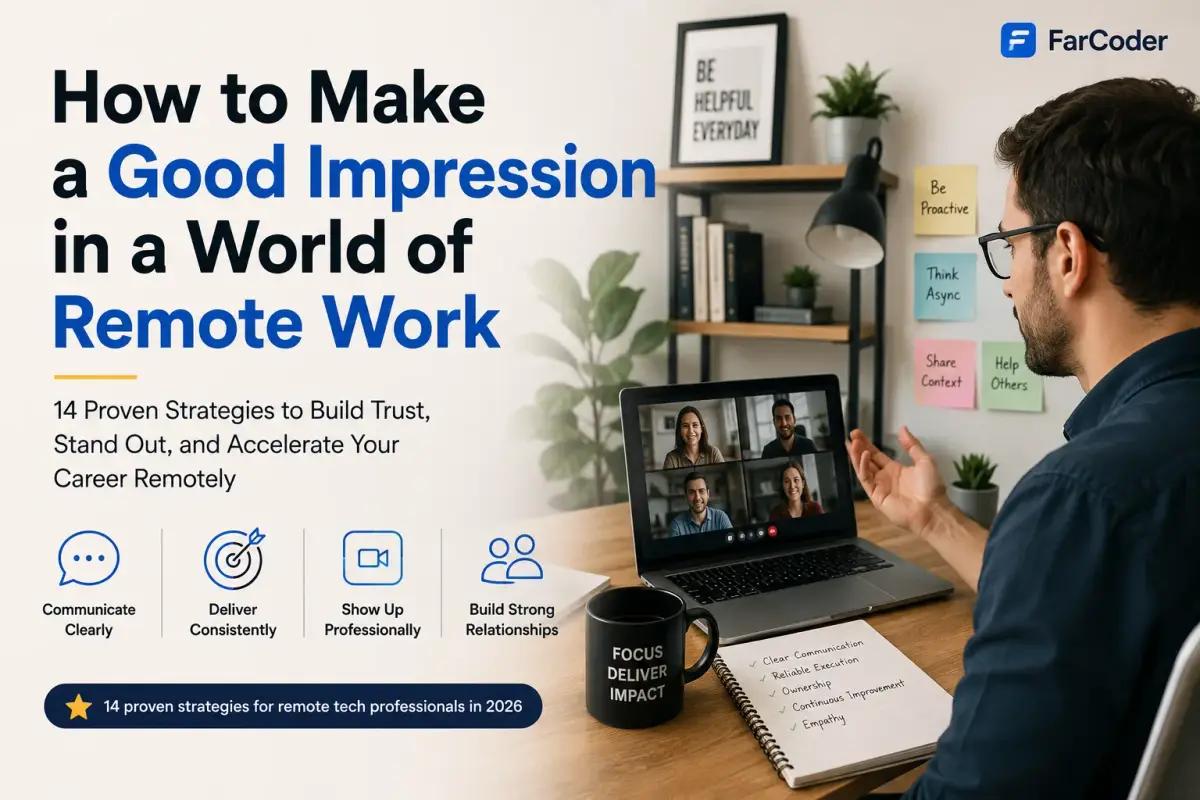
In an office, first impressions happen in person. In remote work, they happen in writing, on camera, in pull request descriptions, in the speed and clarity of your async responses, and in the quality of your work across digital channels your manager and teammates can see in full. Making a good impression in remote work is not harder than in a physical office — but it is different. This guide covers 14 proven strategies for remote tech professionals who want to build a reputation that opens doors, earns trust fast, and compounds into career advancement — whether you are starting a new remote role, applying for one, or building your professional profile for the employers watching your work from a distance.
Why First Impressions Work Differently in Remote Work
In remote work, first impressions are formed through the quality of your written communication, the professionalism of your video presence, the speed and completeness of your async responses, and the visible output you produce in your first 30 to 90 days, not through in-person presence, body language, or the social signals that office environments rely on.
Research on remote work impressions consistently shows that communication quality is the primary signal remote colleagues and managers use to form professional judgments. In an office, a quiet engineer can build a reputation through visible presence, helpfulness in shared spaces, and informal interactions over time. In a remote environment, that same engineer is invisible if they do not communicate deliberately; they exist only as the quality of their output and the clarity of their written voice.
This dynamic creates both a risk and an opportunity. The risk: remote professionals who do not invest in their professional communication and digital presence are consistently underestimated relative to their actual capability. The opportunity: remote professionals who communicate clearly, show up professionally on camera, deliver reliably, and engage generously in distributed team spaces build strong reputations faster than comparable office professionals, because everything they do well is visible and documented in a way that hallway impressions never are.
Before You Start: Setting Up for a Strong Remote Impression
Tip 1: Build a Professional Remote Work Environment Before Day One
Your physical setup: camera quality, audio clarity, lighting, and background, forms the first impression in every video interaction you have, and a poor technical setup signals a lack of professional seriousness before you say a single word.
A laptop camera pointing upward from a desk, poor lighting from a window behind you, or audio that picks up household noise communicates that you have not invested in your remote work infrastructure. Hiring managers, managers, and senior colleagues register this immediately, often unconsciously, as a signal about how seriously you take professional remote work.
The minimum professional setup for remote tech work in 2026 is achievable at modest cost: a camera at eye level (either a dedicated webcam or a laptop raised on a stand), a light source in front of your face rather than behind it, a microphone or headset that captures your voice without background noise, and a background that is clean and professional. You do not need a ring light or a studio, you need adequate, forward-facing lighting and a quiet space.
Test your setup before every important call. Join a test meeting, check your audio levels, and confirm your background is visible and appropriate. The professional who has tested their setup looks like someone who cares about the interaction. The professional whose camera freezes, whose audio drops, and whose background is cluttered looks like someone who does not.
Tip 2: Research the Company, Team, and Culture Before Your First Day
Remote onboarding gives you less organic context than office onboarding; you will not overhear conversations, read the room, or pick up cultural signals through observation. You must build that context deliberately before you arrive.
Before your first day at any new remote role, invest three to four hours in deliberate research. Read the company's public documentation, their blog, their engineering posts, their GitHub repositories, their product changelog. Research your direct manager's professional background on LinkedIn. Understand the company's product, its competitive position, and the specific problems your team is solving. If the company has a public handbook (as many remote-first companies do), read it entirely.
This preparation pays back immediately. On your first calls, you can reference specific product decisions, ask informed questions about technical challenges your new team is working on, and demonstrate that you have invested in understanding the context before asking your colleagues to explain it to you. That level of preparation is noticed, and remembered.
During Your First 30 Days: Building a Strong Remote Reputation Fast
Tip 3: Communicate With Completeness From Your First Message
In remote work, the quality of your async communication is the primary signal your colleagues use to form a professional impression of you, and the most common mistake new remote professionals make is communicating with insufficient context, creating back-and-forth that makes them appear less capable than they are.
Every async message you send should be complete enough that the recipient can act on it without asking a follow-up question. This means including the context behind your request, the specific action you need, and the timeline you are working to, in one message, without requiring a synchronous conversation to fill in the gaps.
Compare these two Slack messages:
Version A: "Hey, quick question about the auth flow — do you have a minute?"
Version B: "Hey — I am working on the OAuth integration for the mobile app. I have the token refresh working but I am hitting a 401 on the first authenticated request after a refresh. I have checked the header format against the API docs and it matches. Before I dig further — is there a known timing issue with the token cache that might cause this? Happy to share the request logs if useful."
Version A creates a synchronous meeting request disguised as an async message. Version B is a complete async message that demonstrates technical thinking, shows work already done, and asks a specific question that the recipient can answer without a call. The impression created by version B is consistently stronger, and it compounds with every subsequent message you send at that quality level.
Tip 4: Deliver on Your First Commitments Visibly and on Time
Nothing builds trust faster in a remote team than delivering what you said you would deliver, when you said you would deliver it, and making that delivery visible in the channels where your team communicates.
In a remote environment, your manager cannot see you working. They cannot observe your focus, your effort, or your progress. The only evidence of your professional reliability is the record of your commitments and your delivery against them. Professionals who deliver consistently and communicate their delivery proactively build trust in distributed teams at a pace that office workers who show up reliably but deliver inconsistently never match.
When you complete a task, ship a feature, or resolve a ticket, say so, briefly and specifically, in the appropriate channel. Not in a self-promotional way, but in the natural course of team communication: "PR up for the auth token fix, addressed the header format issue, added a test for the refresh edge case, notes in the PR description." That single message communicates delivery, quality of thought, and async documentation simultaneously. It is the remote equivalent of walking over to your manager's desk and saying the work is done.
Tip 5: Ask Smart Questions, Not Constant Questions
In remote work, the frequency and quality of your questions signal your professional capability more directly than in office environments. Asking too many questions without demonstrating prior effort signals low initiative, while asking well-framed, specific questions after genuine investigation signals strong professional judgment.
Give yourself a defined time box, 20 to 30 minutes, to work through any problem independently before asking for help. Use documentation, search the codebase, review previous issues and pull requests, and try to define the problem precisely in writing. After that window, if you are still blocked, ask, but frame your question with what you tried, what you found, and what specifically you need.
The quality of your questions is a visible signal of your thinking quality. Senior remote professionals who are asked for help consistently form stronger impressions of colleagues who come with well-framed questions than of those who ask the same question multiple times, ask without context, or ask questions they could answer with ten minutes of documentation review.
Tip 6: Show Up Proactively in Team Channels
Remote team members who participate actively and helpfully in team communication channels, sharing relevant resources, acknowledging colleagues' work, and contributing to discussions beyond their immediate tasks, build visible professional reputations that silent, task-only contributors never develop.
Proactive presence does not mean flooding channels with messages. It means contributing when you have something genuinely useful to add: sharing a tool or resource you discovered that addresses a problem your team is working on, acknowledging a colleague's strong pull request in the engineering channel, or adding context to a discussion that you have relevant experience with. These contributions take minutes and build professional visibility consistently over weeks and months.
The remote professionals who become known as valuable team members, the ones who get recommended for stretch projects, who get considered for senior roles, who receive referrals, are almost always those who are generous with their knowledge and presence in team spaces. This is not about personality type. It is a professional practice that anyone can deliberately build.
Tip 7: Write Pull Requests, Tickets, and Documentation as a Professional Showcase
For remote tech professionals, pull request descriptions, ticket write-ups, and technical documentation are the most-read professional writing you produce, and the quality of that writing is evaluated constantly by your teammates, your manager, and any technical leader who reviews your contributions.
A pull request description that explains what changed, why it changed, what trade-offs were considered, and how to test the implementation communicates engineering depth and professional thoroughness that a minimal "fixes bug" description never does. The engineer who writes well-structured PR descriptions is consistently perceived as more senior, more thoughtful, and more reliable than the engineer who ships equivalent code with minimal documentation.
Apply the same standard to ticket write-ups and technical documentation. A bug report that includes reproduction steps, environment details, expected versus actual behaviour, and relevant logs eliminates the back-and-forth that poorly written tickets create. A technical design document that explains the problem clearly before proposing a solution demonstrates the thinking quality that separates senior engineers from those who jump immediately to implementation.
Ongoing: Sustaining a Strong Remote Professional Reputation
Tip 8: Be Camera-Ready and Engaged on Video Calls
Your behaviour on video calls, your camera status, your engagement level, your on-camera framing, and your participation quality are some of the highest-visibility signals of your professional presence in a remote team.
Show your camera on calls where the team norm is cameras on, it signals engagement and respect for the interaction that camera-off attendance does not. Frame your camera at eye level, look toward the camera rather than at your screen when speaking, and close unnecessary applications before the call begins. These details communicate that you are present and invested in the interaction.
Active participation in calls matters as much as attendance. Remote professionals who attend calls silently, contribute no questions or input, and leave as soon as their required presence is satisfied are noticed, and not positively. Contribute one specific, relevant point or question to every meeting you attend. It is a minimal investment that consistently distinguishes engaged remote professionals from passive ones.
Tip 9: Respect Time Zones and Async Norms
Remote professionals who demonstrate awareness of their teammates' time zones, scheduling calls within reasonable hours, sending async messages without expecting immediate responses, and documenting decisions so that distributed team members can stay aligned without synchronous participation, build reputations as considerate, mature distributed collaborators.
Scheduling a meeting at 8 pm for a colleague in a time zone five hours ahead is a small inconsideration that accumulates into resentment over time. Sending a Slack message and following up ten minutes later, asking if they saw it violates the fundamental async communication norm that distributed teams depend on. These are not trivial habits; they signal how well you understand and respect the distributed team environment.
Check the time zones of your distributed teammates before scheduling. Batch your async messages rather than sending multiple small pings. Set your Slack status to reflect your working hours. Respond to async messages within your stated window rather than immediately or never. These practices are professional hygiene in distributed teams, and their absence is noticed at least as quickly as their presence.
Tip 10: Give Credit and Acknowledge Contributions Publicly
Remote teams lack the visible social cues that office teams use to signal appreciation and respect, which means public, specific acknowledgment of your colleagues' contributions in team channels is both rarer and more impactful than in co-located environments.
When a teammate helps you solve a problem, ships a feature that unblocks your work, or produces analysis that improves a team decision, say so, specifically and publicly, in the appropriate team channel. "Thanks to Priya for the database query optimization that cut our API response time by 40%, the approach is documented in the PR if anyone wants to see how it works." communicates three things simultaneously: genuine appreciation, specific acknowledgment of the contribution, and a knowledge-sharing gesture for the team.
Remote professionals who give credit generously build reputations as collaborative, high-trust teammates. Those who never acknowledge others' contributions, or who acknowledge them only in private, build no such reputation. The habit costs nothing and compounds significantly over time.
Tip 11: Set and Communicate Your Boundaries Professionally
Remote professionals who communicate their working hours, their response time expectations, and their availability boundaries clearly and consistently build reputations as reliable, professional distributed collaborators, rather than as either unavailable or always-on at the expense of sustainable performance.
Set your working hours in Slack or your team's communication platform and update your status when you are in deep work, in meetings, or offline. Respond to async messages within the window you have communicated, not necessarily immediately, but predictably. When you are unavailable for an extended period, communicate it in advance and ensure your current tasks are either complete or clearly handed off.
The remote professional who communicates boundaries clearly is trusted precisely because they are predictable. Colleagues and managers know when you are available, what your response window is, and how to reach you urgently when needed. That predictability is a professional asset, it is the remote equivalent of being someone whose office door is always open when they are in, and closed when they need focus.
Tip 12: Invest in Relationships Beyond Your Immediate Tasks
Remote professionals who build genuine relationships with colleagues, expressed through curiosity about their work, interest in their professional development, and support beyond immediate task dependencies, build the professional trust that produces referrals, advocacy, and career advancement opportunities.
Schedule occasional virtual coffee chats with teammates who are not your direct collaborators. Ask a colleague about a project you saw mentioned in a channel. Send a brief message when a teammate ships something significant, not as a formality but as a genuine acknowledgment of work you noticed. These small investments build the relationship depth that purely task-based remote interactions never produce.
For employers managing distributed teams: the remote professionals who build strong internal relationships stay longer, refer peers more often, and advocate for the employer more credibly than those who experience the organisation purely through tasks and deliverables. Invest in structured social rituals, virtual team events, async introduction threads for new hires, optional social channels, that create the conditions for relationship building without requiring it.
Tip 13: Manage Your Digital Footprint as a Professional Asset
Everything you publish publicly, on LinkedIn, GitHub, technical forums, and professional communities, is part of the impression you make on employers, colleagues, and collaborators who will search for you before engaging professionally. Managing that footprint deliberately is a professional practice, not vanity.
Audit your LinkedIn profile, your GitHub presence, and any public professional accounts annually. Ensure that what appears when someone searches your name reflects your current professional positioning, not a version of yourself from three years ago. Publish content that demonstrates your current thinking and capability, technical posts, project documentation, or community contributions, so that your visible professional presence is a living, accurate representation of what you can do.
For remote tech professionals applying for roles, the impression your digital footprint makes before your first interview call often determines whether that call happens at all. Use FarCoder's free AI Resume Matcher to ensure your resume matches the specific role you are applying for → farcoder.com/tools/resume-analyzer
Tip 14: Ask for Feedback and Act on It Visibly
Remote professionals who proactively request feedback, and who demonstrably act on the feedback they receive, build reputations for self-awareness and professional growth that passive recipients of annual performance reviews never develop.
In remote environments, feedback loops are slower than in office environments because the informal, real-time feedback that happens naturally in co-located settings, a manager's expression, a senior colleague's quick note after a presentation, does not exist. Building your own feedback loop is therefore a professional responsibility, not an optional extra.
After completing a significant project, ask your manager or closest collaborators one specific question: "What could I have done differently to have made more impact here?" After a presentation or design review, ask one attendee for their honest assessment of what landed well and what did not. Act on the feedback you receive visibly, reference it explicitly in how you approach the next similar challenge. This visible responsiveness to feedback is one of the strongest signals of professional maturity available in a remote environment.
Harvard Business Review's research on trust-building in virtual teams consistently identifies communication quality, reliable delivery, and proactive engagement as the three primary drivers of professional reputation in distributed work environments.
For Employers: How to Help Your Remote Team Make Strong Impressions
Remote employers who invest in onboarding infrastructure, communication norms documentation, and structured feedback cycles create the conditions where new remote hires make strong impressions quickly and sustain them over time, reducing the performance ramp and retention risk that poorly structured remote onboarding produces.
Document your team's communication norms before your next remote hire's first day. How do you use Slack versus email? What does a good pull request description look like on your team? What are your meeting norms, cameras on or off, async agendas or spontaneous? What are your response time expectations for different message types? New remote hires who receive this documentation can match your team's professional norms from day one rather than discovering them through costly misalignments.
Invest in a structured 30-60-90 day remote onboarding programme that includes scheduled introductions to key teammates, defined early deliverables that produce visible wins, and regular check-ins with a dedicated onboarding contact. Remote professionals who receive this structure build strong impressions and strong relationships in their first 90 days. Those who are left to figure out a distributed environment without structure frequently disengage before they ever reach their full contribution potential.
Frequently Asked Questions (FAQ)
How do I make a good first impression when starting a new remote job?
+−
Research the company, team, and culture before day one. Set up a professional camera, audio, and lighting environment. Communicate with completeness from your first message. Deliver your first task on time and communicate the delivery proactively. Ask smart, well-framed questions. These five actions consistently produce strong first impressions in remote onboarding environments.
How important is camera quality for remote work impressions?
+−
Significantly important. Your camera framing, lighting, and audio quality form the first impression in every video interaction before you speak. A camera at eye level with forward-facing light and clear audio communicates professional seriousness. Poor technical setup signals low investment in your remote work environment, a signal that is registered quickly by hiring managers, managers, and senior colleagues.
How do I stand out as a remote worker when no one can see me working?
+−
Your visibility in remote work comes from communication quality, delivery consistency, and generous contribution to team spaces, not from being seen at a desk. Communicate proactively about your progress and delivery. Write complete, specific async messages. Acknowledge your colleagues' contributions publicly. Contribute helpful context in team discussions. These visible professional behaviours produce stronger reputations in remote teams than physical presence does in offices.
How do remote employers evaluate professional impression during hiring?
+−
Remote employers evaluate impression through the quality of your written application materials, the professionalism of your video interview presence, the specificity and depth of your interview answers, and, for technical roles, the quality of your GitHub profile, portfolio, and any take-home assessment.
What is the biggest mistake remote workers make with professional impressions?
+−
Under-communicating. Remote professionals who do their work quietly without communicating progress, delivery, and contribution proactively are consistently underestimated relative to their actual capability. The remote team only knows what you communicate, and professionals who communicate well, consistently, and generously build the strongest reputations regardless of whether their technical skills are the highest on the team.
How do I maintain a strong professional impression over the long term in a remote role?
+−
Deliver reliably, communicate consistently, give credit generously, and invest in genuine relationships with your distributed teammates. Request feedback regularly and act on it visibly. These habits compound, a remote professional who maintains them over 12 to 18 months builds a reputation that produces promotions, referrals, and career opportunities that visible, short-term performance alone never generates.
About the Author

Muhammad Mansoor Ishaq
**Muhammad Mansoor Ishaq** is the Co-Founder of FarCoder and an experienced web developer specializing in WordPress, Shopify, Wix, and Squarespace. In addition to his technical expertise, he is a regular contributor to FarCoder’s blog, where he writes about remote work, software development careers, web development, freelancing, digital transformation, workplace productivity, hiring trends, and the future of distributed teams. Drawing from both hands-on industry experience and ongoing research, Muhammad creates practical, insightful content that helps job seekers, developers, and employers succeed in an increasingly remote-first world. His work focuses on bridging the gap between technology, talent, and modern work opportunities across global markets.
Connect on LinkedIn