How to Find Remote Contract Jobs in Tech (Beginner-Friendly Guide)

Far Coder Team
Mon May 04 2026
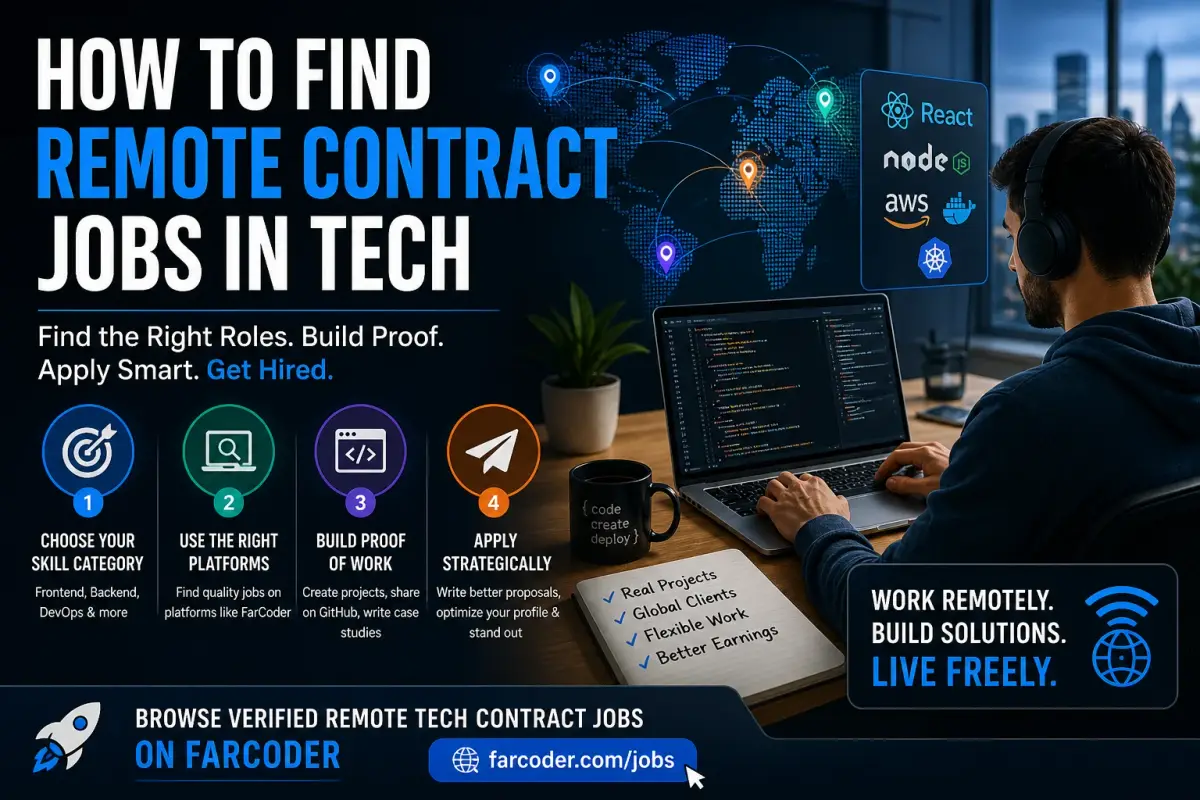
This guide explains how to find remote contract jobs in tech using structured steps, platform selection, and skill alignment. It covers job types, hiring processes, beginner strategies, and application optimization. It also introduces FarCoder as a categorized platform for targeting frontend, backend, DevOps, and other tech roles efficiently.
Finding remote contract jobs in tech requires 4 steps: choosing a skill category, using the right platforms, building proof of work, and applying strategically. These jobs include roles like frontend development, backend engineering, and DevOps automation. Examples include React interfaces, Node.js APIs, and AWS deployments.
The demand for remote tech talent continues to grow. Over 4 million developers are needed globally, according to IDC. This demand creates opportunities for beginners and experienced professionals.
This guide explains how to identify the right roles, use platforms like FarCoder, and improve selection chances. It covers job types, hiring processes, and application strategies. The goal is to match skills with real contract opportunities and reduce job search time.
What Are Remote Contract Jobs in Tech?
Remote contract jobs in tech are fixed-duration roles where professionals deliver specific technical services for 3 to 12 months without permanent employment. These roles focus on defined outputs like backend systems, cloud setups, and security audits. Examples include Python API development, React frontend interfaces, and AWS cloud deployment. According to Upwork, 36% of the global workforce engaged in freelance or contract work in 2023, showing rapid adoption. Companies use remote contracts to reduce infrastructure costs and access global talent pools.
How Tech Contract Jobs Work
Tech contract jobs operate through 4 stages: sourcing, agreement, execution, and delivery. Companies source candidates from platforms like Upwork, Toptal, and LinkedIn. Contracts define scope, duration, and payment terms. Execution includes tasks like API integration, UI development, and database tuning. Delivery involves measurable outputs like deployed apps, tested modules, and performance reports. Time tracking tools like Hubstaff and Time Doctor monitor hourly work.
Contract vs Freelance vs Full-Time in Tech
There are 3 main tech work models: contract roles, freelance gigs, and full-time employment. Contract roles last 3 to 12 months with defined deliverables like SaaS migration, cloud setup, and system integration. Freelance gigs last 1 to 8 weeks and focus on tasks like bug fixes, UI edits, and landing pages. Full-time roles involve ongoing responsibilities like infrastructure management, team coordination, and product scaling. Each model differs in duration, stability, and scope, but all support software development, data analysis, and DevOps workflows.
Types of Remote Tech Contracts (Short-Term, Long-Term, Project-Based)
There are 3 types of remote tech contracts: short-term, long-term, and project-based agreements. Short-term contracts last 1 to 3 months and handle urgent tasks like fixing vulnerabilities, MVP builds, and data migration. Long-term contracts last 6 to 12 months and support scaling systems like SaaS platforms, DevOps pipelines, and enterprise software. Project-based contracts focus on single deliverables like mobile apps, AI models, and analytics dashboards. Examples include Flutter apps, TensorFlow models, and Power BI dashboards.
Why Remote Contract Jobs Are Popular in Tech
Remote contract jobs are popular in tech due to 3 main factors: high demand for specialists, flexible global work, and cost-efficient hiring for companies. The global shortage exceeds 4 million developers, according to IDC. This demand increases contract hiring for roles like frontend developers, backend engineers, and DevOps specialists.
Flexibility allows professionals to work across regions like the United States, Germany, and the UAE. Examples include remote teams using tools like Slack, GitHub, and Zoom.
Companies prefer contract developers to reduce costs by 20% to 30%, according to Deloitte. Examples include hiring blockchain developers, cloud architects, and data engineers for project-based execution.
Where to Find Remote Contract Jobs (Best Platforms + FarCoder)
Remote contract jobs can be found on 3 main platform types: general job boards, freelance marketplaces, and niche tech job boards like FarCoder. Over 70% of job seekers use online platforms, according to Statista. These platforms list roles like frontend development, backend engineering, and DevOps automation. Examples include companies hiring for React dashboards, Node.js APIs, and AWS infrastructure projects.
General Job Boards (LinkedIn, Indeed)
General job boards list thousands of remote contract jobs across multiple industries and experience levels. Platforms like LinkedIn and Indeed offer filters for contract roles, remote locations, and salary ranges. Examples include software engineering jobs, data analyst roles, and cybersecurity positions. These platforms support job alerts, recruiter connections, and company insights. They suit candidates seeking structured hiring processes and verified employers.
Freelance Platforms (Upwork, Toptal)
Freelance platforms connect developers with clients for short-term and project-based tech contracts. Platforms like Upwork and Toptal host contracts for web development, mobile apps, and AI projects. Examples include building Shopify stores, developing Flutter apps, and training machine learning models. These platforms provide escrow payments, client reviews, and proposal systems. They suit independent professionals managing multiple contracts simultaneously.
Niche Tech Job Boards (FarCoder)
Niche tech job boards like FarCoder focus on specialized remote contract roles across 10 defined categories. These categories include frontend development, backend development, and full stack engineering. Additional categories include design, mobile development, and DevOps systems. Advanced fields include blockchain development, game development, data analytics, and cybersecurity.
Examples include React frontend roles, Django backend systems, and Kubernetes DevOps pipelines. FarCoder centralizes tech-only listings, improving relevance and reducing search time. It acts as an internal hub for developers targeting specific stacks and contract types.
How to Find the Right Tech Contract Job for Your Skills
The right tech contract job is found by aligning 3 factors: skill category, market demand, and experience level. Developers who match skills with demand receive 2x more interview responses, according to LinkedIn. Start by selecting a category like frontend jobs, backend jobs, or DevOps roles. Examples include React interfaces, Node.js APIs, and Kubernetes deployments.
Matching skills with demand increases success rates. High-demand skills include JavaScript, Python, and cloud tools. Examples include frameworks like Angular, Django, and AWS.
Experience level defines job type. Beginner roles include bug fixing, UI edits, and testing tasks. Advanced roles include system architecture, AI modeling, and distributed systems.
Using structured platforms like FarCoder improves targeting by grouping jobs into 10 categories. Examples include mobile development, blockchain engineering, and cybersecurity analysis.
How the Hiring Process Works for Remote Tech Contract Jobs
The hiring process for remote tech contract jobs follows 4 stages: application review, technical evaluation, interview, and contract offer. After applying, recruiters screen profiles within 3 to 7 days. Candidates with strong portfolios receive faster responses. Examples include GitHub repositories, live SaaS apps, and case studies.
Companies evaluate developers using technical tests and code reviews. Examples include algorithm challenges, system design tasks, and UI assignments. Platforms like GitHub and GitLab show code quality and activity.
Most applicants receive no response due to weak portfolios or mismatched skills. Only 2% of applicants reach interviews, according to Toptal. Strong candidates demonstrate real projects, consistent commits, and clear technical documentation.
How to Apply and Get Selected for Tech Contract Jobs
Getting selected for tech contract jobs requires 4 actions: writing targeted proposals, building proof-based portfolios, optimizing resumes, and demonstrating expertise. Candidates with tailored applications achieve 30% higher response rates, according to LinkedIn. Strong applications include role-specific content and measurable results. Examples include highlighting React dashboards, Python APIs, and AWS deployments.
Writing Proposals for Tech Roles
Effective proposals include 3 elements: problem understanding, technical solution, and relevant experience. Recruiters scan proposals within 30 to 60 seconds. Examples include explaining API fixes, UI redesigns, and database optimizations. Use clear structures with tools like Upwork and Notion. Include metrics like response time improvements, load speed reductions, and uptime increases.
Building a Strong Portfolio (GitHub, Projects, Case Studies)
A strong portfolio includes 3 components: code repositories, live projects, and documented case studies. Platforms like GitHub and GitLab display coding activity and collaboration. Examples include SaaS platforms, mobile apps, and AI models. Case studies show problem, solution, and results. Include metrics like performance gains, scalability improvements, and bug reduction rates.
Optimizing Your Resume for Remote Tech Jobs
An optimized resume highlights 5 elements: skills, tools, projects, metrics, and remote experience. Recruiters spend 6 to 8 seconds per resume, according to Glassdoor. Examples include listing JavaScript frameworks like React, backend tools like Node.js, and cloud services like AWS. Use bullet points with measurable outcomes like reduced latency, increased throughput, and improved security compliance.
How to Stand Out as a Developer or Designer
Standing out requires 4 differentiators: specialization, proof of work, communication clarity, and consistency. Specialists receive more offers than generalists. Examples include blockchain developers, DevOps engineers, and UI/UX designers. Share contributions on platforms like GitHub, design systems on Figma, and insights on LinkedIn. Consistent activity signals reliability and expertise.
How to Get Your First Remote Tech Contract Job (No Experience)
Getting your first remote tech contract job requires 3 steps: targeting beginner roles, building small projects, and applying through niche platforms like FarCoder. Entry-level roles account for 25% of tech job postings, according to LinkedIn. These roles require basic skills and demonstrable work.
Beginner-friendly roles include frontend tasks, QA testing, and junior backend support. Examples include fixing CSS layouts, testing APIs, and updating databases using MySQL, MongoDB, and Firebase.
Building small projects proves capability. Examples include portfolio websites using HTML, CSS, and JavaScript, simple APIs using Node.js, and dashboards using React.
Platforms like FarCoder categorize entry-level roles clearly. Examples include frontend jobs, backend jobs, and data analytics tasks.
Start browsing beginner-friendly jobs on FarCoder to access categorized entry-level opportunities and apply faster.
Is Remote Contract Work in Tech Worth It?
Remote contract work in tech is worth it for 3 reasons: higher earning potential, flexible work structure, and strong skill growth, but it includes income variability and limited job security. Contract developers earn 20% to 50% more hourly than full-time roles, according to Glassdoor. Examples include frontend developers using React, backend engineers using Node.js, and DevOps specialists using AWS.
Pros include flexible schedules, global opportunities, and diverse projects. Examples include working with teams in the US, Germany, and Canada on SaaS platforms, mobile apps, and AI systems.
Cons include inconsistent income, lack of benefits, and contract gaps. Examples include delayed payments, project cancellations, and limited healthcare coverage.
Remote contract work suits self-managed professionals, independent developers, and specialized engineers. Examples include freelancers, consultants, and remote-first engineers.
Long-term growth depends on skill depth and portfolio strength. Examples include advancing into system architecture, AI engineering, and cloud infrastructure roles.
Start Finding Remote Tech Contract Jobs on FarCoder
Start finding remote tech contract jobs on FarCoder by exploring 10 categories, applying to relevant roles, and building experience through real projects. Platforms with structured categories increase job matching efficiency by 40%, according to LinkedIn.
Browse categories like frontend development, backend development, and full stack engineering. Examples include React interfaces, Node.js APIs, and MERN stack applications. Explore advanced fields like DevOps systems, blockchain development, and cybersecurity. Examples include Kubernetes pipelines, smart contracts, and penetration testing.
Apply to roles that match skills and experience level. Examples include junior frontend tasks, API integrations, and data analysis projects.
Build experience by completing contracts and updating portfolios. Examples include GitHub repositories, deployed apps, and case studies.
Begin browsing FarCoder categories and apply to active remote tech contracts to gain real-world experience and consistent income. https://farcoder.com/jobs
Frequently Asked Questions (FAQ)
Where can I find remote contract tech jobs?+−
You can find them on general job boards like LinkedIn and Indeed, freelance platforms like Upwork and Toptal, and niche tech job boards like FarCoder, which focus on specialized roles.
Do I need experience to get a remote contract job?+−
No, beginners can start with entry-level roles like frontend fixes, QA testing, or basic backend tasks. Building small projects and a portfolio can significantly improve your chances.
Are remote contract jobs better than full-time roles?+−
They offer higher flexibility and often better hourly pay, but come with less job security and inconsistent income. They are ideal for self-managed professionals who prefer independent work.