How to Create a Remote Work Policy for the Tech Industry (Free Template)

Far Coder Team
Mon Jul 13 2026
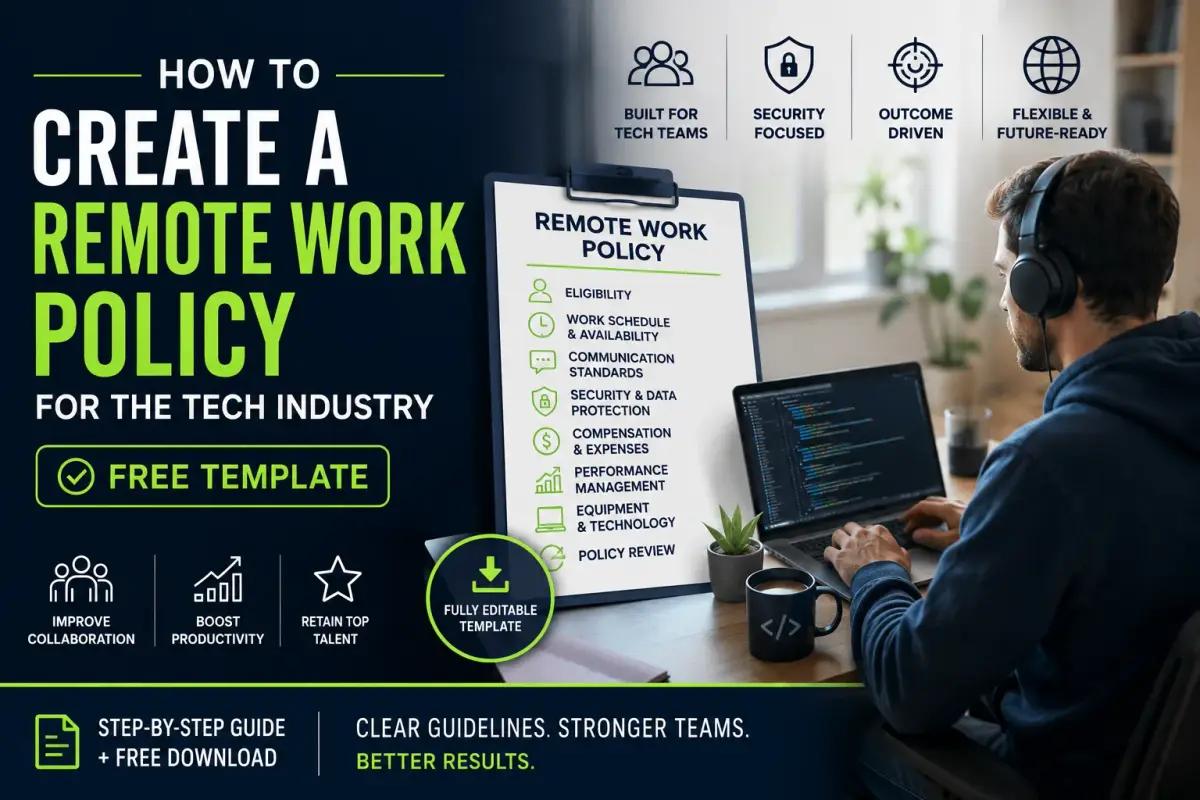
A remote work policy is no longer a nice-to-have document for technology companies; it is the operational foundation that determines whether a distributed tech team performs consistently, communicates effectively, and retains its best engineers. Poorly defined remote work policies are among the top contributors to employee frustration, burnout, and turnover in 2026. This guide covers every section a tech-specific remote work policy needs, explains why each element matters for distributed engineering, design, and security teams specifically, and provides a free, fully editable template you can adapt and deploy for your own organisation. Whether you are building your first remote work policy from scratch or updating an existing one that has not been revised since the pandemic, this is the complete starting point.
Why a Formal Remote Work Policy Matters More in 2026 Than It Ever Has
A formal remote work policy matters in 2026 because vague or undefined expectations are one of the leading causes of remote team underperformance and preventable attrition, and companies cannot afford informality when 63 percent of remote employees want written remote work policies documented in their employment terms.
What began as emergency remote work guidance in 2020 has matured into a permanent operational requirement. In 2026, approximately 65 percent of organisations offer remote or hybrid work, with 16 percent fully remote and 49 percent hybrid. The organisations that are getting distributed work right are those that approach it as a complete organisational system, documented, communicated, and consistently enforced, rather than a perk granted informally and managed by individual manager discretion.
The cost of informality is measurable. Teams operating without a documented remote work policy consistently report higher rates of communication misalignment, unclear performance expectations, security incidents from unguided device and network usage, and scheduling friction that erodes both productivity and team morale. For tech companies specifically, where engineers, designers, and security professionals are in high demand and actively evaluating employers on their remote-first credibility, a well-constructed remote work policy is also a hiring and retention asset, not just an HR compliance document.
75 percent of knowledge workers prefer hybrid or remote models. 49 percent want performance measured by outcomes, not hours. 63 percent want written remote work policies in their employment terms. These expectations are not aspirational preferences; they are baseline requirements that the strongest remote candidates evaluate employers against before accepting any offer.
What a Tech-Specific Remote Work Policy Must Cover
A tech-industry remote work policy must cover eight core areas, eligibility, work schedule and availability, communication standards, equipment and technology, security and data protection, performance management, compensation and expenses, and policy review, with each section written specifically for the realities of engineering, design, DevOps, and security roles rather than copied from a generic office-to-home template.
The specific requirements of tech roles create nuances that generic remote work policies miss. A security policy that works for a marketing team is insufficient for a cybersecurity team with access to sensitive client infrastructure. A communication standard written for a co-located support team does not account for the async-first communication that engineering teams use to manage pull requests, architecture decisions, and incident response across time zones. Tech-specific policies address these nuances deliberately.
Section 1: Purpose and Scope
Every remote work policy should open with a brief, clear statement of purpose, why the policy exists and who it applies to. This section is often treated as boilerplate, but for tech companies it should explicitly state the company's remote-first or remote-committed position, since this shapes how every subsequent section is interpreted.
A strong purpose statement for a tech company: "This policy establishes the standards, expectations, and operational guidelines for all [Company Name] team members working in fully remote or hybrid arrangements. It is designed to support consistent performance, effective distributed collaboration, and a remote-first working environment that attracts and retains the best global tech talent."
Scope should specify which roles are eligible for remote work, which are not, and any special conditions, for example, that new hires in certain roles may have an initial office-based onboarding period before transitioning to full remote.
Section 2: Eligibility and Role Classification
Not every role in a tech organisation is equally suited to full remote work, and a policy that applies the same remote rules to every position regardless of role requirements creates both operational problems and fairness concerns, eligibility criteria should be specific to role type, performance standing, and technical infrastructure requirements.
Define eligibility criteria clearly:
Remote-eligible roles are those where the work is primarily digital, deliverables can be produced independently, and the role does not require regular access to on-site infrastructure that cannot be replicated remotely. For most tech companies, this includes all software engineering roles, product design, DevOps, data analysis, cybersecurity, and product management.
Roles with modified eligibility may include junior engineers whose onboarding significantly benefits from in-person mentoring, roles requiring access to specialised on-site hardware, and security-sensitive roles that require physical access controls.
Performance conditions should be documented clearly, if remote work eligibility is subject to performance standing, the policy should state what standing is required and what process applies when it is not met, rather than leaving this to manager discretion.
For international remote workers, a growing category for tech companies in 2026, with 78 percent of companies now hiring internationally for remote positions, the policy should specify whether international remote work is supported, which countries are approved, and what legal and tax implications apply. This section requires legal review before finalisation.
Section 3: Work Schedule, Availability, and Core Hours
The most effective remote work schedules for tech teams are defined by core overlap hours, the minimum window when all team members are expected to be available synchronously, combined with flexible hours for deep work outside that window, rather than a rigid nine-to-five requirement that ignores time zone differences and individual productivity patterns.
Teams that default to async communication report 20 to 30 percent more deep focus time. The policy should reflect this, structuring synchronous time around genuine collaboration needs rather than requiring constant availability during traditional business hours.
Define the following in this section:
Core hours, the specific window, expressed in a reference time zone, when all remote team members are expected to be available for synchronous communication, meetings, and real-time collaboration. For globally distributed tech teams, a two to four hour daily core window that accommodates the majority of team time zones is both realistic and effective.
Response time expectations, the maximum response window for different message types. For example: Slack messages during core hours, response within two hours; async updates and pull request reviews, response within 24 business hours; critical production incidents, immediate response via defined escalation channel.
Deep work protection, an explicit statement that team members are expected and encouraged to protect extended uninterrupted work blocks outside core hours, and that these blocks should not be interrupted by non-urgent communications.
Time zone documentation, a requirement for all remote team members to maintain their working hours and time zone in their Slack status or team calendar, updated whenever they travel or change their working location temporarily.
Section 4: Communication Standards and Tools
Communication standards are the single most important section of a tech remote work policy because communication quality is the primary operational variable that distinguishes high-functioning distributed tech teams from fragmented ones, and standards that are vague, inconsistent, or unenforceable undermine everything else the policy tries to achieve.
Tech companies should define communication standards by channel, not just by tool. The goal is to give every team member a clear decision framework for which channel to use for which type of communication, so that important information does not get lost in the wrong channel and synchronous time is not wasted on conversations that async tools handle better.
Define these standards explicitly:
Real-time communication (Slack or equivalent): Used for time-sensitive questions, quick coordination during core hours, and team social channels. Not used as an email substitute for complex, multi-part information.
Async video (Loom or equivalent): Used for technical walkthroughs, architecture explanations, design reviews, and any communication where visual demonstration adds significant value over text. Replaces many meeting requests.
Documentation (Notion, Confluence, or equivalent): All significant decisions, architecture choices, retrospective findings, and process documentation live here. Meeting summaries posted within 24 hours of any synchronous session.
Project management (Linear, Jira, or equivalent): All task assignments, ticket details, and sprint progress tracked here with enough detail that any team member can understand the context and status of any work item without asking.
Video calls (Zoom, Google Meet, or equivalent): Used for decisions requiring real-time discussion, complex problem-solving sessions that benefit from synchronous back-and-forth, and relationship-building interactions. Agendas provided at least 24 hours in advance for all scheduled calls.
Writing quality standards: All async communications should be written with enough context that the recipient can act without a follow-up question. This is a professional standard, not a preference, and the policy should state it explicitly.
Section 5: Equipment, Technology, and Home Office Standards
Tech companies must define clearly what equipment the company provides, what minimum standards employees must meet for their own equipment and internet connection, and what the process is for equipment provisioning, support, and return, because equipment ambiguity is one of the most common sources of remote work friction and security risk.
Company-provided equipment: Specify which roles receive company-provided laptops, peripherals, and accessories. Define ownership (company property throughout employment), usage restrictions (personal use limitations), and return procedures on separation. For security-sensitive roles, DevOps engineers with infrastructure access, cybersecurity professionals with privileged credentials, company-managed devices with enforced security configurations should be mandatory rather than optional.
Minimum home office standards: Specify the minimum technical requirements for remote work. Recommended standards for tech roles in 2026: broadband internet with a minimum 50Mbps download and 10Mbps upload; a dedicated, private workspace for calls involving confidential information; professional audio capability (headset or dedicated microphone) for video calls; and a backup internet option (mobile hotspot) for critical on-call or production deployment scenarios.
IT support: Specify the process for reporting technical issues, the channels through which IT support is available, and the response time commitments for different severity levels. Remote team members should never be without a path to technical support, particularly for production incidents that require immediate infrastructure access.
Internet and home office stipend: Specify whether the company provides a monthly or annual stipend for internet costs and home office setup. This is increasingly standard in competitive remote tech hiring, GitLab, Buffer, and similar remote-first companies publish their stipend structures publicly as an employer brand differentiator. A home office setup stipend of $500 to $2,000 for new hires and a monthly internet stipend of $50 to $100 are common benchmarks in the remote tech market.
Section 6: Security and Data Protection
Security and data protection is the highest-stakes section of any tech company's remote work policy because remote work environments, home networks, personal devices, and distributed infrastructure access, create a significantly larger attack surface than a centralised office environment, and the policy must establish non-negotiable minimum standards that apply without exception.
Remote work environments have fundamentally changed the security perimeter of technology organisations. For companies with DevOps engineers managing cloud infrastructure, cybersecurity teams handling sensitive client data, or backend developers with database access, the security implications of an unsecured home network or an unmanaged personal device are serious enough to warrant explicit, enforceable policy standards.
Required security standards for tech remote work policies:
VPN usage: All access to company systems, internal tools, and production infrastructure must occur over the company VPN. No exceptions for convenience.
Device security: Company-managed devices must have current endpoint protection, encrypted storage, and automatic screen lock. Employees using personal devices (if permitted) must meet the same minimum security standards, enforced through mobile device management (MDM) where applicable.
Network security: Remote work over public or unsecured Wi-Fi networks is prohibited for any activity involving company data or systems. Home networks must use WPA2 or WPA3 encryption at minimum.
Credential management: All service accounts and infrastructure access must use strong, unique passwords managed through an approved password manager. Multi-factor authentication is mandatory for all company accounts and systems.
Incident reporting: Any suspected security incident, including lost devices, phishing attempts, unusual account activity, or data exposure, must be reported to the security team within one hour of discovery through the defined escalation channel.
Security training: Remote team members must complete security awareness training upon joining and quarterly thereafter. For roles with elevated access, DevOps, security, and backend engineers with production database access, additional role-specific security training is required.
Section 7: Performance Management and Accountability
Remote performance management must be output-based, not presence-based, evaluating what is delivered and at what quality rather than when team members are online, with clear, measurable expectations defined at the role level and documented in a format that remote employees can reference without requiring a manager to interpret them.
49 percent of remote employees want performance measured by outcomes, not hours, and the organisations that measure presence rather than output not only fail to capture the productivity benefits of remote work, they actively penalise the most effective remote workers who do their best work outside conventional hours.
Define performance standards clearly for each role category:
Engineering roles: Pull request velocity and code review turnaround, feature delivery against sprint commitments, documentation quality for technical decisions, and incident response time for on-call responsibilities.
Design roles: Deliverable completion against sprint goals, design review feedback turnaround, and quality assessment from cross-functional partners in engineering and product.
DevOps and security roles: System uptime metrics, deployment frequency and lead time, mean time to recovery for incidents, and security audit completion rates.
Performance review cadence: Specify how often formal performance reviews occur (typically quarterly for remote-first companies), what format they follow, and how performance concerns are addressed. Remote team members should never be surprised by a performance concern, proactive, async-documented feedback should precede any formal performance discussion.
Management expectations: Managers of remote teams are responsible for ensuring their team members have clear deliverables, timely feedback, and the resources to succeed without physical presence providing a substitute for genuine management support. This is a two-way accountability that should be stated explicitly.
Section 8: Compensation, Expenses, and Location Changes
Remote tech companies must document explicitly whether their compensation model is location-agnostic or geo-banded, what expenses are reimbursable, and what the process and implications are when a remote employee changes their work location, because compensation transparency is now a baseline expectation among remote tech professionals and ambiguity in this area consistently erodes trust.
Compensation model: State clearly whether salaries are location-agnostic (benchmarked to a global or primary market rate regardless of where the employee lives) or location-adjusted (based on cost of living in the employee's location). Both models are legitimate, but undisclosed geo-banding, where employees discover after joining that their salary will decrease if they relocate, is among the most damaging trust violations a remote employer can commit.
Reimbursable expenses: Specify exactly what work-related expenses the company reimburses, the process for submitting reimbursement requests, and any monthly or annual limits. Common categories for tech remote policies: internet service, home office furniture and equipment (up to a stated limit), professional development (courses, conferences, certifications), and productivity software not provided centrally.
Location change process: Employees who wish to change their remote work location, to a different city, region, or country, must follow a defined notification and approval process. International location changes require legal and tax review before approval, since working from a different country can create employment law obligations, tax liabilities, and visa complications for both the employer and the employee. Specify the minimum notice period (typically 30 to 60 days), the approval process, and any implications for compensation or employment terms.
Travel and in-person requirements: If the company holds periodic in-person team gatherings or requires occasional office visits, specify the frequency, the reimbursement structure, and the notice period for mandatory attendance. Remote team members who relocated specifically for the remote position need clear expectations about any in-person obligations before committing to a role.
Section 9: Wellbeing, Boundaries, and Burnout Prevention
A remote work policy that does not address employee wellbeing and work-life boundaries is incomplete, because remote work without explicit boundary norms produces the consistent, documented risk of work expanding to fill all available hours, leading to burnout that costs far more in productivity loss and attrition than any wellbeing investment requires.
Remote workers work an average of 1.4 more hours per day than office workers. Without explicit policy support for boundaries, this extra time is not evidence of engagement, it is evidence of an environment where work and personal time are not sufficiently separated, and it predicts burnout rather than sustained high performance.
Wellbeing policy elements for tech remote teams:
Right to disconnect: State explicitly that team members are not expected to respond to non-emergency communications outside their documented working hours, and that this boundary is respected by management. This should be a policy statement, not just a cultural aspiration.
Mandatory time off: Specify the minimum leave entitlement, any use-it-or-lose-it provisions, and an encouragement from leadership that time off is genuinely expected to be taken rather than accumulated as a performance signal.
Mental health support: List the mental health resources available to remote team members, employee assistance programmes, counselling services, or mental health days, and make these easy to access without requiring a formal request process that creates friction.
Ergonomics and health: Remote employees bear more responsibility for their own ergonomic setup than office workers, who typically have access to ergonomically assessed workstations. The policy should recommend a basic ergonomic self-assessment, offer a home office setup stipend that covers ergonomic equipment, and provide guidance on movement breaks and eye health.
Section 10: Policy Review and Updates
A remote work policy should be reviewed at minimum annually and updated whenever significant changes occur, in employment law, in the organisation's remote work model, in technology standards, or in response to documented policy gaps identified through team feedback, because a static policy in a rapidly evolving work environment quickly becomes inadequate and potentially non-compliant.
Build the following into your review process: a Q4 annual review incorporating any employment law changes in jurisdictions where remote employees are based, a feedback mechanism for employees to report policy gaps or areas of ambiguity on a rolling basis, a manager review process that surfaces operational issues the policy does not currently address adequately, and a requirement that all policy updates are communicated to employees with sufficient notice (typically two to four weeks) and require renewed acknowledgment.
FREE REMOTE WORK POLICY TEMPLATE FOR TECH COMPANIES
Copy, adapt, and apply this template to your organisation. Have a lawyer review the final document before distribution, particularly sections covering compensation, international work, and legal compliance.
[COMPANY NAME] REMOTE WORK POLICY Version: [1.0] Effective Date: [DD/MM/YYYY] Last Reviewed: [DD/MM/YYYY] Policy Owner: [HR / People Operations]
1. PURPOSE AND SCOPE
This policy establishes the standards, expectations, and operational guidelines for all [Company Name] team members working in fully remote or hybrid arrangements. It applies to all employees and contractors in remote-eligible roles as defined in Section 2.
[Company Name] is committed to being a remote-first organisation. This policy is designed to support consistent team performance, effective distributed collaboration, and the retention of exceptional global tech talent.
2. ELIGIBILITY
Remote-eligible roles: All software engineering, product design, DevOps, data analysis, cybersecurity, and product management roles are eligible for full remote work.
Modified eligibility: Junior engineers in their first 90 days of employment may be required to attend in-person onboarding sessions. Roles requiring access to specialised on-site hardware are assessed individually.
Eligibility conditions: Remote work eligibility is contingent on a satisfactory performance standing. Employees placed on a performance improvement plan may have remote work eligibility reviewed by their manager and HR.
International remote work: Remote work from countries outside [home country] requires prior written approval. Approved countries are listed in Appendix A. Employees must notify HR a minimum of 30 days in advance of any international location change.
3. WORK SCHEDULE AND AVAILABILITY
Core hours: All remote team members are expected to be available for synchronous communication between [TIME] and [TIME] [TIMEZONE], Monday through Friday.
Response time standards:
-
Slack messages during core hours: within 2 hours
-
Pull request reviews and async task updates: within 24 business hours
-
Production incidents (Severity 1): immediate response via the incident channel
-
Non-urgent email: within 2 business days
Deep work blocks: Team members are expected to protect at least 4 hours of uninterrupted deep work time per working day. Non-urgent communications should not interrupt declared deep work blocks.
Time zone documentation: All team members must maintain current working hours and time zone in their Slack status profile, updated when travelling or temporarily changing working location.
4. COMMUNICATION STANDARDS
|
Channel |
Used For |
Not Used For |
|
Slack |
Time-sensitive questions, quick coordination, team social channels |
Long-form decisions, formal documentation |
|
Loom / async video |
Technical walkthroughs, design reviews, architecture explanations |
Brief updates that work fine in text |
|
Notion / Confluence |
All decision documentation, process docs, meeting summaries |
Real-time discussion |
|
Linear / Jira |
All task assignments, sprint progress, ticket details |
Ad-hoc communication |
|
Video call |
Real-time decisions, complex problem-solving, team building |
Status updates, questions answerable async |
Writing standard: All async messages must include enough context for the recipient to act without a follow-up question. This is a professional requirement, not a preference.
Meeting documentation: All scheduled meetings must have an agenda posted at least 24 hours in advance. Meeting summaries must be posted in the relevant Notion space within 24 hours of the meeting.
5. EQUIPMENT AND HOME OFFICE
Company-provided equipment:
-
[Role categories] receive: [laptop model/spec], [peripherals]
-
All company equipment remains company property and must be returned on separation
-
Equipment loss or damage must be reported to IT within [TIMEFRAME]
Minimum home office requirements:
-
Internet: minimum 50Mbps download, 10Mbps upload
-
Backup internet: mobile hotspot capable of supporting video calls
-
Audio: headset or dedicated microphone for all calls
-
Workspace: private, quiet environment for calls involving confidential information
Stipends:
-
Home office setup: $[AMOUNT] one-time for new remote hires
-
Monthly internet: $[AMOUNT] per month, reimbursed via expense claim
-
Annual equipment refresh: $[AMOUNT] annually after first year
IT support: Available via [CHANNEL] during [HOURS]. Emergency IT support for production incidents available 24/7 via [ESCALATION CHANNEL].
6. SECURITY AND DATA PROTECTION
VPN: All access to company systems and production infrastructure requires connection to the company VPN. No exceptions.
Devices: All work on company systems must be performed on company-managed devices or personal devices enrolled in company MDM where applicable.
Network: Work involving company data or systems on public Wi-Fi networks is prohibited. Home networks must use WPA2 or WPA3 encryption.
Credentials: All company accounts require strong, unique passwords managed in [APPROVED PASSWORD MANAGER]. MFA is mandatory for all company accounts without exception.
Incident reporting: Any suspected security incident must be reported to [SECURITY CONTACT] within 1 hour of discovery via [ESCALATION CHANNEL].
Security training: All remote team members complete security awareness training at onboarding and quarterly thereafter. Role-specific training is required for DevOps, security, and backend engineers with production access.
7. PERFORMANCE MANAGEMENT
Performance is evaluated on output and contribution quality, not hours online or physical presence.
Engineering roles: Sprint delivery, PR velocity, code review quality, technical documentation, and incident response metrics.
Design roles: Deliverable completion, design review quality, and engineering handoff effectiveness.
DevOps and security roles: System uptime, deployment frequency, MTTR, and security compliance metrics.
Review cadence: Formal performance reviews occur [QUARTERLY / SEMI-ANNUALLY]. Performance concerns are communicated in writing via [CHANNEL] before any formal process begins.
8. COMPENSATION AND EXPENSES
Compensation model: [Company Name] uses a [LOCATION-AGNOSTIC / LOCATION-ADJUSTED] compensation model. [State clearly how salaries are determined and whether location affects compensation.]
Reimbursable expenses:
-
Internet service: up to $[AMOUNT] per month
-
Home office equipment: up to $[AMOUNT] annually
-
Professional development: up to $[AMOUNT] annually
-
Productivity software: as approved by manager
Expense submission: All reimbursement requests submitted via [EXPENSE TOOL] within 30 days of the expense date.
Location changes: Location changes within [HOME COUNTRY] must be communicated to HR with 14 days notice. International location changes require 30 days notice and prior written approval. [Company Name] will review compensation implications and legal requirements before approving any international location change.
9. WELLBEING AND BOUNDARIES
Right to disconnect: Team members are not expected to respond to non-emergency communications outside their documented working hours. Managers will not contact team members outside working hours except for declared production emergencies.
Time off: All team members are entitled to [X] days of annual leave. [Use-it-or-lose-it / Carry-over policy]. Leadership actively encourages all team members to take their full entitlement.
Mental health resources: [Employee Assistance Programme details, counselling access, mental health days policy.]
Ergonomics: Team members are responsible for maintaining an ergonomic work setup. The home office stipend in Section 5 is intended to support this. [Ergonomic assessment checklist linked.]
10. POLICY REVIEW
This policy is reviewed annually in Q4. Updates are communicated to all employees with a minimum of 4 weeks notice and require renewed written acknowledgment. Team members may submit policy feedback at any time via [FEEDBACK CHANNEL].
[Employee acknowledgment signature block]
For Job Seekers: What to Look For in an Employer's Remote Work Policy
A published, detailed remote work policy is one of the strongest signals of a genuinely remote-first employer, and the specific contents of that policy reveal how seriously the company has thought about distributed work, which predicts your experience as an employee more accurately than any recruiter call.
When evaluating a remote employer, ask to see their remote work policy or request answers to the specific questions this guide covers. An employer who cannot clearly describe their core hours, their communication standards, their equipment provision, their compensation model for location changes, and their performance evaluation criteria has not invested seriously in remote infrastructure. The policy quality is a proxy for the management quality you will experience daily.
Use FarCoder's Resume Matcher to ensure your application stands out to remote-first employers who have built the infrastructure worth joining → farcoder.com/tools/resume-analyzer
For Employers: Implementing Your Remote Work Policy Effectively
Building the policy document is step one. Implementing it effectively requires a structured rollout that most companies underinvest in.
Distribute the policy two to four weeks before its effective date, alongside an FAQ document that addresses the most common questions in plain language. Host a live Q&A session for the team, not to sell the policy, but to answer questions honestly and gather the feedback that will improve the document before it becomes official.
Train managers first and separately. Remote managers are the primary implementation mechanism for your policy, their daily decisions about communication, performance feedback, meeting cadence, and boundary respect are the policy in practice. Invest in management training that addresses the specific challenges of distributed team leadership before the policy goes live.
Pilot with a specific team or department if you are deploying a significant policy change. A pilot captures real-world gaps before they affect the entire organisation, and it generates the documented evidence of what works that you can use in the full rollout.
Review the policy after 90 days of implementation with direct employee feedback, not just leadership assessment. The people operating within the policy daily will identify the gaps and ambiguities that the policy authors did not anticipate.
Post your remote tech roles on FarCoder to attract professionals who evaluate your remote policy quality as part of their hiring decision → farcoder.com
The Society for Human Resource Management's remote work policy guidance and the Harvard Business Review's research on distributed team management practices are two widely referenced resources for employers refining their remote work infrastructure beyond the policy document itself.
Frequently Asked Questions (FAQ)
Is a formal remote work policy legally required?
+−
A formal remote work policy is not legally required in most jurisdictions, but it provides significant legal protection for both employer and employee by documenting expectations, security requirements, expense obligations, and employment terms in writing. Having a lawyer review your policy before distribution is strongly recommended, particularly for sections covering international remote work, compensation adjustments, and data handling obligations.
How long should a tech company's remote work policy be?
+−
A complete remote work policy for a technology company typically runs 8 to 15 pages when all sections are fully developed. The template in this guide provides the structural framework; your final document will be longer as you complete organisation-specific details, add appendices, and incorporate legal review feedback.
How often should a remote work policy be updated?
+−
Review your remote work policy at a minimum annually, and update it whenever employment laws change in jurisdictions where remote employees are based, when significant operational changes occur, or when documented feedback reveals policy gaps. Redistribute updated policies with a minimum of four weeks' notice and collect renewed employee acknowledgment.
What is the difference between a remote work policy and a hybrid work policy?
+−
A remote work policy covers employees working fully outside a physical office location. A hybrid work policy covers employees splitting time between remote and office environments and must additionally address in-office scheduling, office access expectations, and meeting equity for employees who are remote on days when others are in-person. Many organisations combine both into a single flexible work policy document.
How do we handle performance management for engineers we cannot see working?
+−
Output-based performance management is the answer: define clear deliverables, measurable quality criteria, and documented contribution expectations for each role, then evaluate against those criteria rather than presence signals. 49 percent of remote employees want this model, and it produces better performance data than any presence-based proxy. The performance management section of the template above provides the framework for each tech role category.
About the Author

Muhammad Mansoor Ishaq
**Muhammad Mansoor Ishaq** is the Co-Founder of FarCoder and an experienced web developer specializing in WordPress, Shopify, Wix, and Squarespace. In addition to his technical expertise, he is a regular contributor to FarCoder’s blog, where he writes about remote work, software development careers, web development, freelancing, digital transformation, workplace productivity, hiring trends, and the future of distributed teams. Drawing from both hands-on industry experience and ongoing research, Muhammad creates practical, insightful content that helps job seekers, developers, and employers succeed in an increasingly remote-first world. His work focuses on bridging the gap between technology, talent, and modern work opportunities across global markets.
Connect on LinkedIn