How Recruiters Evaluate Remote Job Applications

Far Coder Team
Thu Jul 09 2026
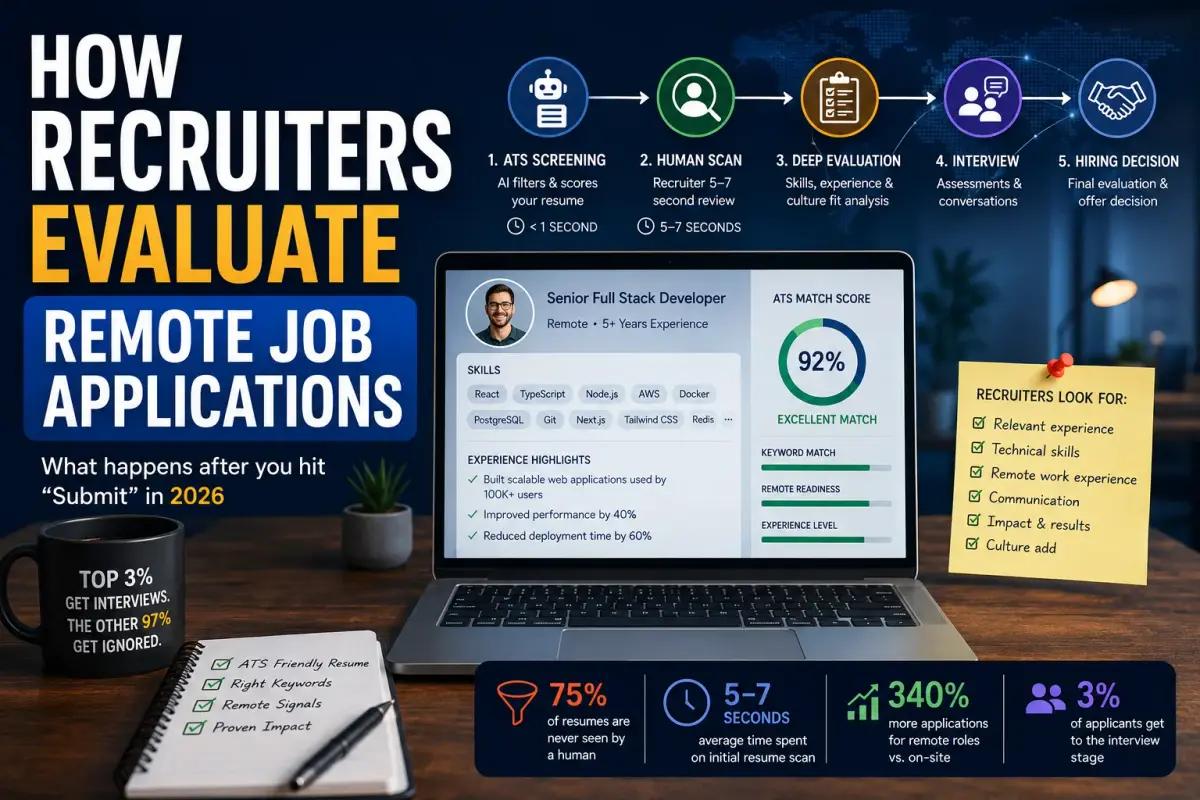
The applicant-to-interview ratio for remote job applications dropped to just 3 percent in 2024, down from 15.25 percent in 2016, and competition for fully remote tech roles has only intensified since. Understanding exactly how recruiters evaluate remote job applications is no longer a nice-to-have for job seekers; it is the difference between being in the 3 percent and the 97 percent. This guide takes you through every stage of remote application evaluation in 2026, from the moment your resume hits an ATS to the moment a hiring manager decides to extend an offer, with specific data on what is evaluated at each stage, what signals move a candidate forward, and what causes even qualified applicants to be eliminated before any human sees them. Whether you are a tech professional building your remote application strategy or an employer designing a screening process for distributed roles, this is the most complete picture of remote hiring evaluation available.
Stage 1: ATS Screening, The Filter Most Candidates Never See
75 percent of resumes are discarded without any human review due to AI-powered applicant tracking systems, with modern ATS tools able to reject a resume in as little as 0.3 seconds, making ATS optimisation the single most important factor determining whether your remote application is ever evaluated by a human being.
By the end of 2025, 83 percent of companies were using AI to screen resumes, and 88 percent of companies now use some form of AI for initial candidate screening. For remote roles specifically, which receive 340 percent larger candidate pools than on-site equivalents, automated screening is not a supplementary tool, it is the primary filter that determines which applications proceed to human review at all.
ATS systems in 2026 do not simply match keywords against a checklist. LinkedIn's AI-powered matching engine and the ATS platforms used by most enterprise remote employers now use semantic relevance matching, evaluating whether your resume demonstrates depth and context within a skill domain, not just whether the skill name appears. A resume that lists "Python" without "Django," "FastAPI," "asyncio," or any other contextual signals reads as shallow to a semantic ATS, regardless of how competent the actual Python developer is.
For remote applications specifically, ATS systems are increasingly filtering for remote-specific signals before passing candidates to human reviewers. The words "remote," "distributed," "asynchronous," "async-first," "time zone," and the names of remote collaboration tools, Slack, Notion, Linear, Loom, GitHub, are actively scanned for in remote role evaluations because they signal that the candidate understands and has experience with the operational environment they are applying to join.
The formatting of your resume is equally important to its content at this stage. Complex multi-column layouts, graphics, tables, and text boxes that look professional to a human eye frequently fail to parse correctly in ATS systems, with the result that an expensive, well-designed resume may be read as a largely blank document by the automated system that is the first and sometimes only evaluator of your application.
What you must do at Stage 1: Use a single-column, text-based resume format. Include the specific technical keywords from the job description, including variations and related tools, in your skills section and experience descriptions. Add remote-specific language explicitly, "remote," "async collaboration," and the names of distributed tools you use. Use FarCoder's free AI Resume Matcher to check your keyword alignment against the specific job description before submitting → farcoder.com/tools/resume-analyzer
Stage 2: The 5 to 7 Second Human Scan, What Recruiters Actually See First
Recruiters spend 5 to 7 seconds on a resume before deciding to move it forward, meaning the top third of your resume is the only content a recruiter processes in the initial scan, and everything below that threshold is read only if the top third earns continued attention.
With 73 percent of recruiters willing to read a longer resume if it looks relevant, the first impression of your resume's structure and top-of-page content is what determines whether the other 70 percent of the document gets read at all. In that initial scan, recruiters are pattern-matching for three signals: the job title that confirms you do the kind of work they are hiring for, the company names or contexts that establish credibility, and a measurable outcome or differentiator that signals above-average performance.
For remote applications, there is an additional signal that experienced remote recruiters scan for immediately: evidence that the candidate is remote-experienced, not simply remote-willing. A summary line that reads "Senior Backend Engineer with 5 years of fully remote experience" passes this filter in the first second. A summary that reads "Experienced backend engineer seeking remote opportunities" does not, it signals that the candidate wants to work remotely but has not done so, which in a competitive remote applicant pool is a significant differentiating factor.
Around 42 percent of recruiters rely on quick scanning to judge relevance, so strong headings, clear structure, and focused bullet points matter disproportionately. If the top part is weak or unclear, the resume may be skipped completely regardless of what appears further down.
What you must do at Stage 2: Lead your resume with a two-sentence professional summary that names your specialisation, your years of remote experience, and your clearest professional value. Use bold job titles and clean section headers that give a recruiter scanning an immediate structural map rapidly. Put your strongest, most relevant, most outcome-oriented bullet point first in every experience section, not saved for the end.
Stage 3: Remote Readiness Evaluation, The Filter Unique to Distributed Roles
Remote recruiters apply a second evaluation layer that office-based recruiters do not, explicitly assessing whether the candidate demonstrates the self-management, async communication capability, and distributed team experience that remote roles require, and applications that pass technical screening but fail this second filter are eliminated as unsuitable for the specific work environment regardless of their technical strength.
91 percent of job seekers ask about remote options when evaluating roles, and 84 percent are willing to reject offers without flexible arrangements, which means the remote label on a job posting attracts an enormous applicant pool, the majority of whom have not thought carefully about what remote work actually requires of them as a candidate. Remote recruiters develop pattern recognition for candidates who have simply added "remote" to their job search filters versus candidates who have genuinely built the work habits and communication infrastructure that distributed roles require.
The specific signals remote recruiters look for at this stage are consistent across the research:
Self-management evidence: specific accomplishment bullets describing outcomes delivered independently, projects owned from conception to delivery without close supervision, and timeline management in distributed environments.
Async communication language; mentions of async-first practices, documentation habits, written communication tools, and the specific discipline of writing with enough context that a teammate in a different time zone can act on a message without a follow-up call.
Remote tool proficiency: explicit naming of distributed collaboration tools across categories: communication (Slack, Microsoft Teams), documentation (Notion, Confluence), project management (Linear, Jira, Asana), async video (Loom), and version control (GitHub, GitLab).
Time zone experience: any reference to coordinating work across multiple time zones, managing handoffs in distributed teams, or structuring work day to accommodate global collaboration windows.
What you must do at Stage 3: Every experience section description should include at least one explicit reference to the distributed or async nature of the work, the team structure, the time zones involved, the async tools used, or the specific self-directed delivery context. Use the Cover Letter Generator to build a cover letter that reinforces your remote readiness narrative alongside your technical qualifications → farcoder.com/tools/cover-letter-generator
Stage 4: Technical Screening, What Remote Tech Roles Evaluate Differently
Technical screening for remote tech roles has shifted significantly in 2026 toward take-home assessments and structured asynchronous evaluations over live coding sessions, because take-home work samples are both more predictive of actual remote job performance and more practically executable for distributed hiring teams working across time zones.
70 percent of employers now use skills-based hiring, up from 65 percent the prior year, and 48 percent rely on skills assessments as a main evaluation factor alongside work experience. For remote tech roles, this shift is amplified by the practical reality that a strong live coding performance in a time-pressured synchronous session correlates less strongly with remote work performance than the quality of work produced under realistic conditions, independently, with documentation, over an appropriate time window.
A well-designed take-home technical assessment for a remote role evaluates several things simultaneously: the code itself, the documentation accompanying it (README quality, code comments, architectural explanation), the candidate's written communication of trade-offs and decisions, and the organisation and structure of the submission. A candidate who submits clean code with a clear README explaining their technical choices, acknowledging trade-offs, and describing how they would extend the work demonstrates the combination of technical depth and async communication quality that remote tech roles actually require.
The technical interview itself, when it occurs, is increasingly conducted via video with a shared coding environment rather than in person, and the evaluation includes how the candidate communicates their reasoning in real time, how they handle uncertainty and incomplete requirements, and how they ask clarifying questions, skills that translate directly to async and distributed team effectiveness.
For remote employers reading this: interview scheduling is a significant candidate drop-off point. 42 percent of candidates drop out when interview scheduling takes too long, and a majority expect interview dates within two to six days of the initial scheduling request. Slow, unclear, or disorganised scheduling processes signal organisational culture before any hiring decision is made, and they cost employers the strongest candidates who have multiple opportunities moving simultaneously.
Stage 5: Behavioural and Culture Fit Interview, What Distributed Teams Actually Screen For
Behavioural interviews for remote roles evaluate a specific set of distributed-work competencies, autonomous problem-solving, async communication quality under realistic conditions, remote work infrastructure and habits, and cultural alignment with a team that communicates primarily in writing, that are distinct from the competencies evaluated in co-located role interviews.
81 percent of hiring managers use work experience as a main evaluation factor in interviews, but for remote roles the framing of that experience matters as much as its content. An interviewer for a remote backend engineering role is not just evaluating whether you can build APIs, they are evaluating whether you can build APIs while working independently, communicating decisions asynchronously, and contributing to a distributed team without the social infrastructure of a physical office.
The behavioural questions that specifically signal remote readiness are:
"Tell me about a time you had to solve a complex problem without immediate access to help." Strong answers demonstrate a structured independent approach, time-boxing the investigation, documenting what was tried before escalating, and writing up the problem clearly for async review rather than waiting for a synchronous discussion.
"How do you manage competing priorities when you cannot get immediate input from your manager?" Strong answers describe self-prioritisation frameworks, proactive async communication of priority conflicts, and the discipline of making reversible decisions independently when synchronous input is unavailable.
"Describe how you communicate a technical decision to teammates who were not part of the discussion." Strong answers reference written documentation, architecture decision records, async video walkthroughs, and pull request descriptions that stand alone as technical communication without requiring a follow-up meeting.
"What does your remote work setup look like?" This question appears casual but is evaluating whether the candidate has a professional, reliable home office environment. A structured answer describing internet speed and backup, camera and audio quality, workspace setup, and working hours demonstrates that remote infrastructure has been thought through, a signal that correlates with long-term remote work effectiveness.
Only 26 percent of candidates trust AI to evaluate them fairly in the hiring process, a figure that reflects broader anxiety about automated screening. For remote applications specifically, the candidates who perform best throughout the full evaluation process are those who treat every written touchpoint as a demonstration of the communication quality remote roles depend on.
Stage 6: Cover Letter Evaluation, More Relevant Than Most Candidates Assume
26 percent of recruiters consider cover letters an important part of a remote application evaluation, and while 47 percent of job seekers do not submit a cover letter at all, a strong, tailored cover letter for a remote role is one of the clearest differentiators available between candidates with similar technical qualifications.
For remote roles specifically, the cover letter carries additional weight because it is the first extended piece of writing a recruiter receives from the candidate. Remote teams communicate primarily in writing, which means a cover letter that is well-structured, specific to the role, and clearly written is itself direct evidence of the written communication capability the role requires. Conversely, a generic cover letter that could have been submitted to any employer communicates both the absence of genuine interest and the kind of low-effort communication quality that remote employers are actively screening against.
A strong cover letter for a remote tech role does three things that a generic one does not. It mirrors the specific language of the job description, signalling that the candidate read and understood the requirements rather than applying to every listing they encountered. It includes a specific reference to the candidate's remote work experience or remote readiness, making that credential explicit rather than implied. And it makes a direct case for the match between the candidate's capabilities and the role's specific requirements, not a general claim of excellence, but a specific connection.
A personal follow-up combined with a well-optimised profile makes you stand out from 98 percent of applicants who simply submit and disappear, which means a brief, specific follow-up message to the hiring manager after submitting, where appropriate, is a differentiation strategy that the vast majority of remote applicants never use.
Stage 7: Reference and Background Checks: What Remote Employers Specifically Verify
Remote employers verify two categories of information that co-located employers evaluate less rigorously: the authenticity of the candidate's remote work experience and the quality of their distributed team collaboration, because both are more difficult to assess in a screening process and more consequential when they are misrepresented.
With 6 percent of candidates admitting to interview fraud, including impersonation, in recent surveys, and the distributed nature of remote work making in-person verification impossible, remote employers are more likely to conduct thorough reference calls and to ask references specifically about remote work performance rather than just general professional performance.
Questions that remote-specific reference checks typically include: "How did the candidate manage their work without daily supervision?" "How was the quality of their written communication and async updates?" "How did they handle problems when they could not immediately reach a teammate?" and "Would you hire this person for a remote role specifically?" These questions directly probe the self-management and communication capabilities that remote employers have been screening for throughout the process.
For candidates preparing references: brief your references on the remote-specific angle of the role you are applying to and the qualities you would like them to speak to: self-directed delivery, async communication, distributed team contribution, and professional reliability without close oversight. A reference who speaks specifically to remote work performance carries significantly more weight in a remote hiring decision than one who gives a general performance endorsement.
What the Data Tells Us About Improving Your Remote Application Success Rate
The success rate for cold online applications has dropped to just 0.1 to 2 percent in 2026, but targeted applications to verified remote roles, with tailored resumes and cover letters, consistently outperform volume-based approaches by a significant margin.
The applicant-to-interview ratio across all job applications in 2024 was just 3 percent. For volume-based applicants applying generically, 150 to 250 applications are typically required before receiving a single offer. For targeted applicants who tailor each application to the specific role, this number drops to 30 to 80 applications for most positions.
The practical implication is that investing 30 additional minutes in tailoring your resume and cover letter for each remote application produces better results than submitting ten generic applications in the same time. The tailored approach improves both ATS matching scores and human reviewer engagement at every subsequent stage of the evaluation process.
For Employers: Building a Remote Application Evaluation Process That Works
Remote employers who design their screening process around the specific capabilities that distributed work requires, rather than adapting co-located screening criteria to a video format, hire better remote workers, faster, with lower dropout rates and stronger retention outcomes.
The most common remote hiring failure is evaluating candidates primarily on technical skills while giving insufficient weight to self-management capability, written communication quality, and remote work infrastructure, then discovering six months into employment that the strongest technical candidate on paper is struggling with the independence, async communication, and distributed collaboration that the role actually requires daily.
Evaluate written communication quality deliberately at every stage. The cover letter, the take-home assessment README, the pull request descriptions in any code review exercise, and the written questions submitted before or after the interview are all writing samples that predict remote work communication quality far more accurately than anything a candidate says verbally in a video call.
Design technical assessments for the remote context. A take-home project that evaluates code quality, documentation quality, and the candidate's ability to explain technical decisions in writing tests the same skills that remote engineers use every day. A timed live coding session tests performance under artificial pressure in an unusual context, valuable, but less predictive of remote effectiveness than structured independent work.
Move quickly on strong candidates. 42 percent of candidates drop out when interview scheduling takes too long. Remote candidates who are genuinely qualified for your role are simultaneously advancing through other processes. A streamlined, candidate-respectful hiring process is itself a competitive advantage for remote employers.
Robert Half's 2026 Salary Guide and the Society for Human Resource Management's annual talent acquisition data are two widely referenced sources documenting how remote hiring screening practices have evolved alongside the broader shift to distributed work in the technology sector.
Post your remote tech role on FarCoder and reach candidates who understand what remote evaluation requires → farcoder.com/post-remote-jobs
Frequently Asked Questions (FAQ)
What do recruiters look for first in a remote job application?
+−
Recruiters scan the top third of your resume for three signals in 5 to 7 seconds: confirmation that you do the type of work they are hiring for, credibility signals from your work context or employer names, and one measurable outcome that distinguishes your performance. For remote roles specifically, they are also looking for explicit evidence of remote experience, a summary line stating your years of distributed work experience is the fastest way to pass this initial filter.
How does an ATS screen remote job applications differently?
+−
ATS systems for remote roles scan for remote-specific signals in addition to core technical keywords, the word "remote," async collaboration tools by name (Slack, Notion, Loom, Linear), and phrases that indicate distributed team experience. 75 percent of resumes are discarded without human review by these systems, making ATS-aligned formatting and language the single most important factor in whether your remote application reaches a human at all.
Does a cover letter actually matter for remote job applications?
+−
Yes, more than for co-located roles. For remote positions, your cover letter is the first extended piece of writing a recruiter receives, which means it functions as a writing sample for the communication skill that remote teams depend on most. 26 percent of remote recruiters explicitly consider it an important evaluation factor, and a strong, role-specific cover letter is one of the clearest differentiators available in a competitive remote applicant pool.
How long does a typical remote job application evaluation take?
+−
It takes an average of 27 working days to make a new hire, with only 25 percent of companies filling roles within two weeks. For specialised senior remote tech roles, evaluation timelines extend further, four to six months for senior engineering and architecture positions is common. For candidates, this means maintaining parallel active applications rather than waiting on a single process that has not given a clear timeline.
What is the biggest mistake candidates make on remote job applications?
+−
Failing to demonstrate remote readiness explicitly. The most common mistake is submitting a strong technical application that makes no specific reference to remote work experience, async collaboration practices, or distributed team capability, leaving a recruiter to infer remote readiness from general work history rather than from deliberate, specific evidence. Remote readiness must be stated explicitly, not assumed.
How do recruiters evaluate remote work experience for candidates who have never worked officially remote?
+−
They look for the underlying capabilities rather than the formal label. Freelance work, open source contributions, cross-location project coordination, and any experience delivering work independently without close supervision all demonstrate remote-relevant capability. Frame these experiences explicitly in your resume and cover letter in terms of the specific distributed-work competencies they evidence, independent delivery, written communication, and async coordination, rather than leaving the remote-relevant angle implicit.
About the Author

Muhammad Mansoor Ishaq
**Muhammad Mansoor Ishaq** is the Co-Founder of FarCoder and an experienced web developer specializing in WordPress, Shopify, Wix, and Squarespace. In addition to his technical expertise, he is a regular contributor to FarCoder’s blog, where he writes about remote work, software development careers, web development, freelancing, digital transformation, workplace productivity, hiring trends, and the future of distributed teams. Drawing from both hands-on industry experience and ongoing research, Muhammad creates practical, insightful content that helps job seekers, developers, and employers succeed in an increasingly remote-first world. His work focuses on bridging the gap between technology, talent, and modern work opportunities across global markets.
Connect on LinkedIn