How AI Is Changing Remote Work and How to Stay Ahead
Far Coder Team
Tue May 12 2026
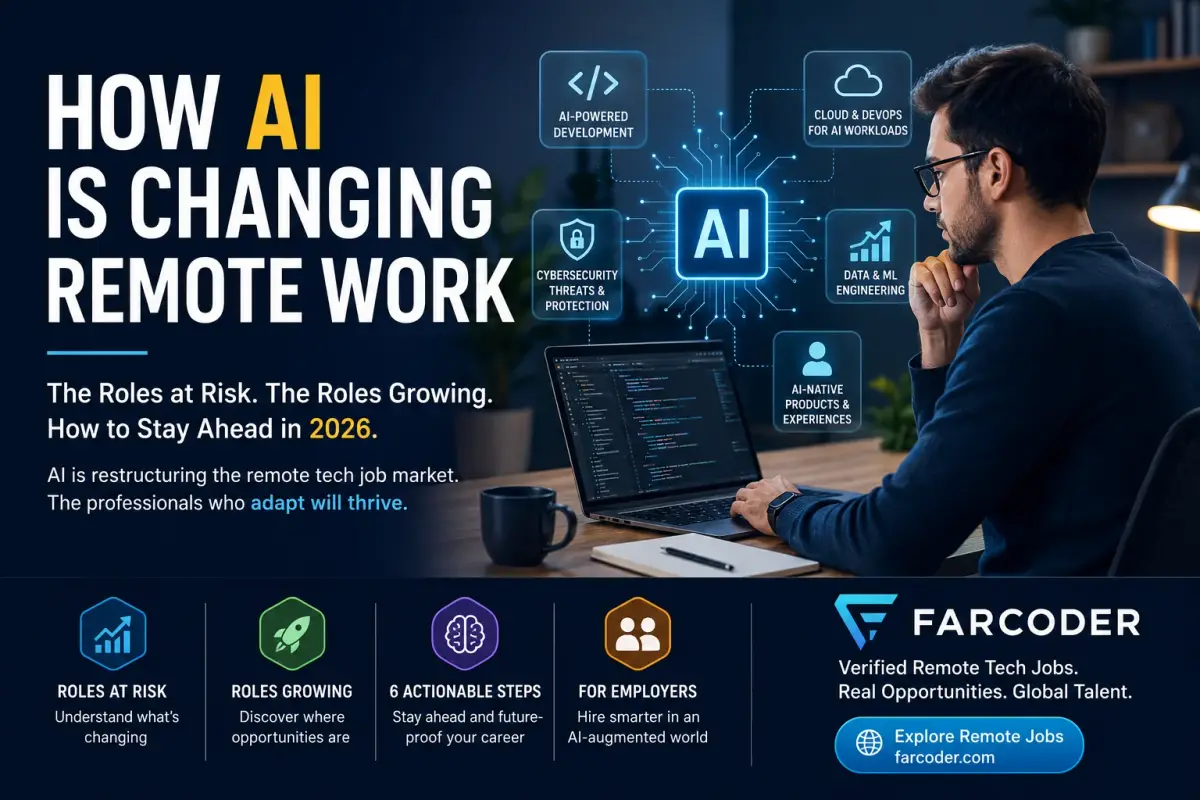
Artificial intelligence is not a future threat to remote work, it is an active, present force reshaping how distributed teams hire, build, and operate right now. Some remote tech roles are growing faster because of AI. Others are contracting. The professionals and employers who understand the difference are the ones positioned to win. This guide breaks down exactly how AI is changing remote work in 2026, which tech roles are most affected, what job seekers must do to stay competitive, and what remote employers need to know to hire the right talent for an AI-augmented workforce.
How AI Is Changing Remote Work: The Direct Answer
The direct answer: AI is changing remote work by automating repetitive task layers within tech roles, accelerating hiring processes, raising the skill floor for entry-level positions, and creating entirely new roles that did not exist three years ago. Remote tech professionals who adapt by developing AI fluency alongside their core specialisation will find more opportunity, not less. Those who ignore the shift will find their roles progressively narrowed or replaced.
The remote tech job market is not shrinking because of AI. It is restructuring. Understanding that restructuring, specifically where it creates gaps and where it creates demand, is the single most important thing a remote tech professional or remote employer can do in 2026.
The Scale of the Shift: What the Data Shows
The pace of AI adoption in remote work environments is not speculative. It is documented and accelerating.
Remote-first companies were the first adopters of AI productivity tooling precisely because distributed teams already operated digitally, making AI integration faster and lower-friction than in office environments. A remote developer already uses GitHub, Slack, Notion, and a CI/CD pipeline. Adding an AI code assistant, an automated testing tool, or an AI-powered project tracker requires no change to the physical working environment whatsoever.
The World Economic Forum's research on the future of jobs projects that automation, including AI-driven automation, will affect approximately one-third of all work tasks across the global economy by the end of this decade. In tech specifically, the impact is not evenly distributed. It concentrates heavily on the task layers within roles rather than eliminating roles wholesale, a distinction that matters enormously for how professionals should respond.
Goldman Sachs analysis has estimated that generative AI alone could affect hundreds of millions of knowledge worker positions globally. But the same analysis highlights that the jobs most resilient to this shift are those requiring human judgment, creative synthesis, and cross-domain reasoning, capabilities that are disproportionately concentrated in senior and specialist tech roles.
The McKinsey Global Institute has published extensively on AI's differential impact across knowledge worker roles — a resource worth reviewing for professionals building long-term career plans in the remote tech market.
For remote tech professionals, this translates to one practical reality: the value of being merely competent at a technical task is declining. The value of combining technical depth with AI fluency, strategic thinking, and effective remote communication is increasing sharply.
Remote Tech Roles Most Affected by AI
Which roles are at risk?
Remote tech roles most affected by AI are those built around repetitive, predictable task execution, particularly entry-level positions where the primary output is code generation, data processing, content production, or standard configuration work that AI tools can now perform faster and cheaper.
Junior and entry-level developer roles are experiencing the most significant compression. AI code generation tools have effectively shifted the baseline output expectation for development work. Tasks that previously required a junior developer — writing boilerplate code, generating standard API endpoints, producing unit tests for existing functions — are now handled by AI assistance used by senior developers. This does not mean junior developer roles disappear, but it means fewer are created per engineering team, and those that exist require a higher starting competency.
QA and manual testing roles face structural reduction as AI-powered testing frameworks automate test generation, regression testing, and bug identification across codebases. Remote QA engineers whose skill set is limited to manual testing and test case documentation are the most exposed. Those who understand automated testing infrastructure and can build or maintain AI-augmented testing pipelines are not at risk — they are in demand.
Data entry and basic data processing roles are the most immediately automatable category across all remote work. If a remote tech role's primary output is moving, formatting, or routing data according to fixed rules, that workflow is a prime target for AI automation in the near term.
Entry-level content and technical writing within tech teams is also contracting. AI writing tools produce adequate first drafts for documentation, product descriptions, and standard technical guides at a speed no human writer matches. Roles built entirely around volume content production at a junior level are shrinking. Roles focused on strategy, accuracy, editorial judgment, and technical depth are not.
Remote Tech Roles Growing Because of AI
Which roles are expanding?
Remote tech roles growing most rapidly in 2026 are those that either build AI systems, integrate AI into existing products and workflows, or require the human judgment and creative depth that AI cannot replicate — including senior engineering, DevOps, cybersecurity, and full-stack roles with AI integration experience.
AI and machine learning engineers represent the most direct growth category. Demand for remote engineers who can build, train, fine-tune, and deploy AI models has grown faster than the talent supply. These roles require strong fundamentals in mathematics, data science, and software engineering — and they command some of the highest salaries in the entire remote tech job market.
If you are a backend or full-stack developer, moving into AI/ML engineering is one of the most high-value upskilling paths available in 2026. Browse verified remote backend developer jobs on FarCoder, many listings now explicitly include AI integration experience as a preferred or required qualification → farcoder.com/remote-backend-developer-jobs
DevOps and cloud engineers are seeing accelerating demand as AI workloads require specialised infrastructure — GPU clusters, model deployment pipelines, inference optimisation, and AI-specific monitoring. Remote DevOps professionals who understand LLM infrastructure, model serving, and cloud cost management for AI workloads are among the most sought-after in the entire remote tech market.
Browse verified remote DevOps jobs on FarCoder → farcoder.com/remote-devops-jobs
Cybersecurity professionals are in higher demand because of AI, not despite it. AI tools have lowered the barrier to creating sophisticated cyberattacks — automated phishing campaigns, AI-generated malware, and faster vulnerability exploitation are all documented and growing threats. The professionals who detect and respond to these threats are more valuable and more urgently needed than before. Remote cybersecurity roles in SOC analysis, threat intelligence, and incident response are actively hiring globally.
Browse verified remote cybersecurity jobs on FarCoder → farcoder.com/remote-cybersecurity-jobs
Senior full-stack developers with AI integration experience are among the most consistently in-demand profiles on FarCoder. Product companies need engineers who can build AI features into existing applications — not just use AI tools, but architect the integrations that power them.
Browse verified remote full-stack developer jobs → farcoder.com/remote-full-stack-developer-jobs
UX and product designers who can design AI-native interfaces — creating experiences that make AI outputs interpretable, trustworthy, and actionable for end users — represent an emerging specialisation with very few qualified candidates and growing demand.
Browse verified remote design jobs on FarCoder → farcoder.com/remote-design-jobs
Mobile developers building AI-powered features into iOS and Android applications are similarly positioned. On-device AI, personalisation engines, and AI-driven UX improvements are now standard product roadmap items at companies of all sizes.
Browse verified remote mobile developer jobs → farcoder.com/remote-mobile-developer-jobs
How Remote Tech Professionals Can Stay Ahead: 6 Actionable Steps
What should remote tech professionals do right now?
Remote tech professionals stay ahead of AI by developing AI fluency within their existing specialisation, repositioning their output toward judgment and strategy rather than task execution, and actively demonstrating the human capabilities, complex problem solving, cross-team communication, architectural thinking, that AI amplifies but cannot replace.
1. Build AI fluency in your current stack first. You do not need to become a machine learning engineer to benefit from AI literacy. Start within your existing specialisation. Frontend developers should understand how to integrate AI APIs into UI components. Backend developers should understand vector databases, embeddings, and LLM API integration. DevOps engineers should understand AI infrastructure requirements. Being the person on your team who understands both the domain and the AI tooling is one of the highest-value positions in any remote tech team right now.
2. Reframe your experience descriptions toward outcomes and judgment. In your resume, your GitHub profile, and your interviews, shift the emphasis from tasks performed to decisions made and outcomes produced. AI can execute tasks. It cannot own the judgment calls that determine whether a system architecture scales, whether a product feature solves the right problem, or whether a security incident was contained correctly. Make your judgment visible in every professional communication.
3. Deepen one specialisation rather than spreading thin. The professionals most at risk from AI disruption are those with shallow breadth and no depth, generalists without any domain mastery. AI handles general tasks well. It handles the specific, contextual, expertise-dependent decisions of a senior specialist poorly. Deepening your specialisation makes you harder to replace and more valuable to the employers who need that depth.
4. Contribute to asynchronous communication at a high level. Remote teams run on written communication. The quality of your async output, your architecture decision records, your pull request descriptions, your incident post-mortems, is increasingly a primary signal of your value. AI can produce average written content. Humans who produce clear, precise, insightful written communication in technical contexts stand out sharply in remote teams where that skill is scarce.
5. Build in public. Open source contributions, technical blog posts, GitHub repositories, and conference talks, even virtual ones, build the professional presence that makes you discoverable to remote employers globally. AI cannot build your reputation. It can help you produce content faster, but the credibility that comes from demonstrated expertise and public contribution is entirely human.
6. Apply to roles that explicitly value AI integration experience. The fastest-growing segment of remote tech job listings in 2026 includes AI integration as a qualification. If you have built AI-powered features, worked with LLM APIs, or deployed models in production, even in personal or open source projects, list it explicitly and apply to roles that reward it. FarCoder's remote job listings across all tech categories now include AI-related roles filtered by specialisation.
How AI Is Changing Remote Hiring for Employers
What do remote employers need to know about AI's impact on hiring?
AI is changing remote hiring by accelerating candidate screening, raising the quality bar for technical assessments, and shifting the skills that the most valuable remote tech candidates demonstrate, from task proficiency to AI fluency, system thinking, and async communication quality.
AI screening cuts both ways. Remote employers using AI tools to screen applications at scale need to ensure their screening criteria are calibrated to capture the candidates who excel at judgment-dependent work, not just those who are most proficient at AI-generated application materials. The best candidates are using AI to write stronger applications. Screening criteria need to probe deeper.
Technical assessments need updating. If your take-home coding challenge assesses skills that any developer can now complete with AI assistance in twenty minutes, it no longer differentiates candidates. Remote employers who have not updated their technical assessments in the last eighteen months are likely hiring on criteria that no longer predict performance.
The profiles worth hiring have changed. In 2026, the most valuable remote tech hires are those who demonstrate AI integration experience, strong async communication, and the architectural or strategic depth that AI cannot substitute. Job descriptions that still list only framework proficiency without AI fluency signals are attracting a narrower pool than the market can offer.
FarCoder connects remote employers with verified tech professionals across every specialisation, developers, designers, DevOps engineers, cybersecurity analysts, and more, who are actively building remote careers in an AI-augmented market.
For Job Seekers: Your Next Remote Tech Role in the AI Era
The remote tech job market in 2026 is not harder to navigate than it was three years ago — it is different. The professionals who understand where demand is growing, who can demonstrate AI fluency alongside their technical depth, and who communicate their human judgment clearly are finding more opportunity than ever.
FarCoder lists verified remote positions across every tech specialisation — from AI-integrated backend roles to cybersecurity positions to full-stack and DevOps opportunities — all with remote work verified, salary ranges included, and employer details transparent.
Frequently Asked Questions (FAQ)
Will AI replace remote tech jobs?+−
AI is replacing specific task layers within remote tech roles, not the roles themselves, with the exception of highly repetitive entry-level positions built entirely around tasks AI now handles. Senior tech professionals with domain depth, AI fluency, and strong communication skills are more in demand in 2026 than before AI tools became mainstream.
Which remote tech roles are safest from AI disruption?+−
Roles requiring architectural judgment, cross-system thinking, security expertise, and creative design direction are the most resilient. DevOps engineers, cybersecurity analysts, senior full-stack developers, and product designers with AI integration experience are among the most actively hired remote profiles in 2026.
How do I add AI skills to my resume as a developer?+−
List specific AI tools and frameworks you have worked with, LLM APIs, vector databases, AI-powered testing tools, code generation tools, alongside the context in which you used them. Concrete project descriptions that include AI integration are more credible than generic claims of "AI familiarity."
How is AI changing the remote job application process?+−
AI tools are being used on both sides, candidates using AI to write stronger applications, and employers using AI to screen at scale. The applications that stand out in AI-screened pipelines are those with specific, detailed, outcome-oriented language that reflects genuine experience rather than generated content.
What is the highest-paying remote tech role in the AI era?+−
AI and machine learning engineering, senior DevOps with cloud AI infrastructure experience, and cybersecurity engineering are consistently among the highest-paying remote tech roles in 2026. All three are actively listed on FarCoder across global employer listings.
As an employer, how do I update my hiring process for AI-era candidates?+−
Update technical assessments to test judgment and architectural thinking rather than tasks that AI can complete automatically. Evaluate async communication quality, written samples, pull request descriptions, or documentation contributions, as a primary signal of candidate quality. Use FarCoder to reach a global pool of verified remote tech professionals who are actively navigating the AI transition.