Looking for Remote Jobs in Canada? Here Are 15 Companies Hiring

Far Coder Team
Thu May 14 2026
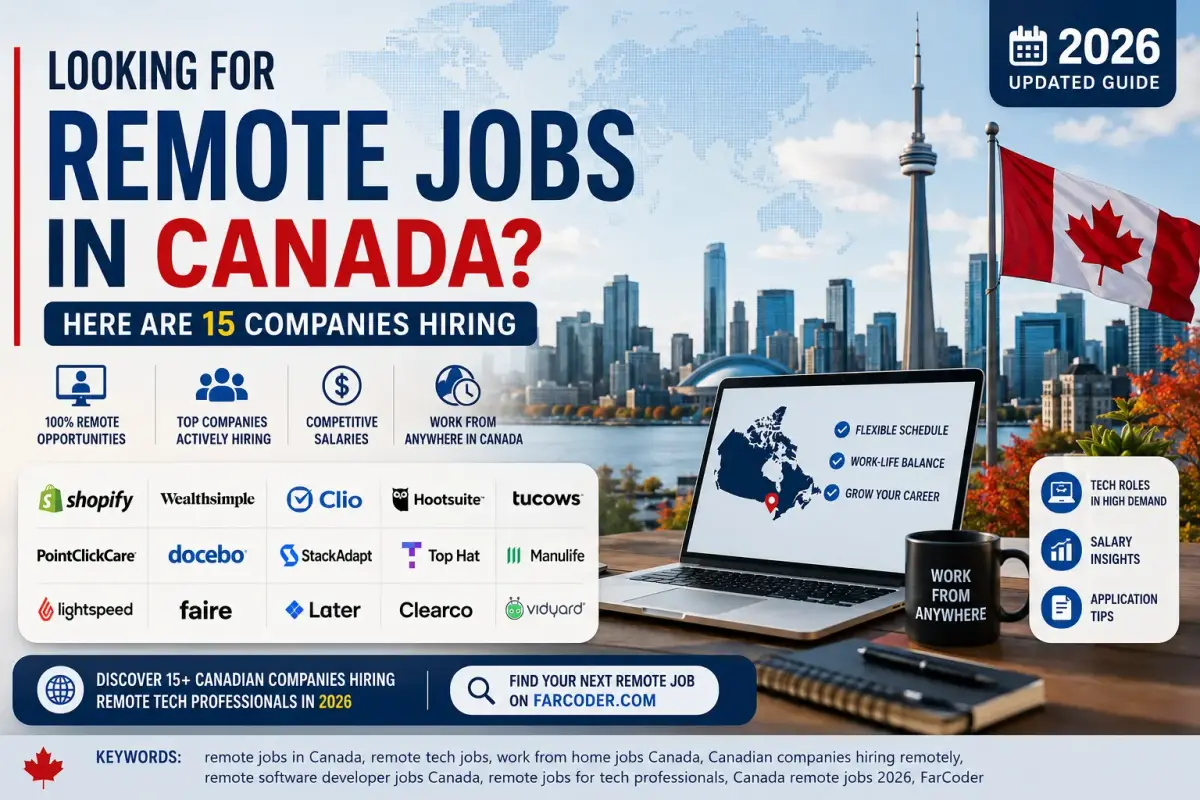
Canada is one of the strongest remote tech job markets in the world in 2026. Its concentration of technology companies, internationally competitive salaries, bilingual workforce, and time zone alignment with both US and European markets makes it a destination of choice for remote tech employers and job seekers alike. Whether you are a Canadian tech professional looking for a remote role with a domestic or global employer, an international professional exploring Canadian remote opportunities, or an employer building a distributed tech team in Canada, this guide covers the companies actively hiring, the roles in highest demand, the salary benchmarks to know, and exactly how to position yourself for success in the Canadian remote tech market.
Why Canada Is One of the World's Best Remote Tech Job Markets
Canada combines a deep tech talent pipeline, strong infrastructure, internationally competitive salaries, and a regulatory environment that supports remote-first hiring, making it one of the most active remote tech employment markets globally in 2026.
Canada's technology sector is not limited to one city or one province. Toronto, Vancouver, Montreal, Calgary, Ottawa, and Waterloo each host significant tech ecosystems, and because most tech work is distributed by design, professionals across every province and territory access these opportunities remotely without relocating.
For international tech professionals, Canada offers one of the clearest and most accessible pathways to legitimate remote employment at competitive pay. Canadian companies frequently hire globally for remote roles, and many Canadian employers pay in USD for international hires or offer salaries that convert favourably against global benchmarks.
For employers, Canada's tech talent pool offers several distinct advantages: a bilingual workforce (English and French) that supports North American and European client coverage, time zones that span UTC-3.5 to UTC-8 providing genuine overlap with both US and European business hours, and a strong university system producing consistent output in software engineering, data science, cybersecurity, and design.
The Canadian Remote Tech Job Market in 2026: What Is Hiring
Before diving into specific companies, understanding where Canadian remote tech demand is concentrated helps you target your search and tailor your application accurately.
Software development — frontend, backend, and full stack — remains the highest-volume category in Canadian remote tech hiring. Toronto and Vancouver anchor the largest concentrations of product companies, SaaS businesses, and technology-enabled financial services firms that hire remotely across Canada and internationally.
Cybersecurity is one of the fastest-growing remote tech categories in Canada. Financial institutions, healthcare technology companies, and government contractors are all expanding their distributed security teams. Canadian cybersecurity professionals — and international professionals hired by Canadian firms — are in strong demand across SOC analysis, incident response, cloud security engineering, and penetration testing.
DevOps and cloud engineering roles are consistently among the hardest to fill in Canadian remote tech hiring. AWS, GCP, and Azure expertise, particularly in combination with Kubernetes, Terraform, and CI/CD pipeline management, commands premium salaries and generates significant competition among employers.
Full-stack development with modern frameworks, React, Node.js, Django, Rails, and Laravel, is the most consistently posted category across Canadian tech employers of every size and sector.
Product design and UX roles are growing rapidly as Canadian SaaS and FinTech companies scale their product teams. Companies building consumer-facing products across financial services, healthcare technology, and education technology are actively hiring remote designers.
Mobile development: iOS, Android, and cross-platform, is in steady demand as Canadian companies invest in mobile-first product strategies. React Native and Flutter expertise are particularly well-rewarded in the current hiring market.
15 Companies Actively Hiring for Remote Tech Jobs in Canada
1. Shopify
Shopify is Canada's largest technology company by market capitalisation and one of the most prominent remote-first employers in the world. Headquartered in Ottawa, Shopify powers over two million businesses globally and operates a fully distributed workforce across Canada and internationally. Engineering, data, design, DevOps, security, and product roles are all consistently listed. Shopify is one of the few companies at its scale to have committed publicly and structurally to remote-first operations, making it a reliable and stable remote employer rather than a company that has bolted remote onto an office culture.
Tech roles commonly listed: Backend engineers (Ruby, Go), frontend engineers (React), data engineers, security engineers, UX designers, mobile developers.
2. Wealthsimple
Wealthsimple is one of Canada's leading FinTech companies, offering investing, savings, and tax products to millions of Canadians. Based in Toronto, the company has built a genuinely remote-flexible engineering and product organisation. Wealthsimple is particularly active in hiring backend engineers with financial systems experience, product designers with consumer app backgrounds, and data scientists with quantitative finance exposure.
Tech roles commonly listed: Backend engineers (Go, Python), staff product designers, data engineers, mobile developers.
3. Clio
Clio is a Vancouver-based legal technology company building cloud software for law firms globally. It is one of Canada's fastest-growing SaaS companies and hires remote engineers, designers, and product professionals across Canada and internationally. Clio's product work is technically interesting; legal workflow software requires robust data modelling, complex permissions systems, and high reliability, making it an attractive employer for senior engineers looking for meaningful technical challenges in a remote environment.
Tech roles commonly listed: Senior software engineers (Ruby on Rails, React), product designers, senior product managers, DevOps engineers.
4. Hootsuite
Hootsuite is a Vancouver-based social media management platform used by organisations in over 200 countries. The company has a long track record of distributed hiring and hires remote tech professionals across engineering, data, security, and product disciplines. Hootsuite's scale and global client base make it a strong employer for engineers interested in working on high-throughput systems and international product challenges.
Tech roles commonly listed: Backend engineers, data engineers, security analysts, product managers.
5. Tucows
Tucows is a Toronto-based internet services company operating several technology brands, including domain registrar services and telecom infrastructure. It is a proudly remote-first company that explicitly values autonomy and transparency in its distributed workforce. Tucows is a particularly good fit for engineers who want genuine ownership of their work in a remote environment without the bureaucratic overhead of larger organisations.
Tech roles commonly listed: Software engineers, AI engineers, technical product managers, DevOps engineers.
6. PointClickCare
PointClickCare is a Mississauga-based healthcare technology company whose cloud platform is used by thousands of senior care and skilled nursing facilities across North America. The company hires remote engineers, UX designers, and product professionals and is one of the more active Canadian tech employers in the health technology space. Engineers at PointClickCare work on systems that directly affect patient care outcomes — a meaningful context for professionals who want their technical work to have real-world impact.
Tech roles commonly listed: Software engineers (Java, React), UX designers, product managers, QA engineers.
7. Docebo
Docebo is a Toronto-based AI-powered learning management system used by global enterprises to manage and deliver employee training. It hires remote professionals across engineering, product, and design and has a strong culture of distributed collaboration. Docebo is a good fit for engineers interested in SaaS at scale with an AI integration component — the product is actively investing in AI-driven learning personalisation and content recommendation systems.
Tech roles commonly listed: Software engineers, product managers, learning experience designers, account executives.
8. StackAdapt
StackAdapt is a Toronto-based programmatic advertising technology company growing rapidly in the digital marketing infrastructure space. The company hires remote engineers to work on real-time bidding systems, data pipelines, and campaign management platforms — technically demanding work that requires comfort with distributed systems, high-throughput data processing, and low-latency architecture.
Tech roles commonly listed: Backend engineers (Go), data engineers, full stack engineers, DevOps engineers.
9. Top Hat
Top Hat is a Toronto-based education technology company building AI-enhanced learning tools for higher education. Recognised as one of Canada's top-growing companies, it hires remote engineers, designers, and product professionals across Canada and internationally. Top Hat is a good match for engineers and designers who want to work at the intersection of AI and education — a sector with both meaningful social impact and strong technical challenges.
Tech roles commonly listed: Platform engineers, test engineers, design leads, product managers.
10. Manulife
Manulife is one of Canada's largest financial services companies, offering insurance, wealth management, and investment products globally. Its technology teams, particularly in cloud engineering, data science, and cybersecurity, are actively hiring remotely. Manulife is among the most stable employers in Canadian tech hiring, with strong compensation structures and comprehensive benefits that make it competitive with smaller tech companies despite its institutional scale.
Tech roles commonly listed: Cloud engineers, data scientists, cybersecurity analysts, software engineers.
11. Lightspeed Commerce
Lightspeed is a Montreal-based commerce platform powering retail and hospitality businesses globally. It hires remote engineers across Canada and internationally, with particular demand for backend and full stack engineers experienced in building multi-tenant SaaS systems. Lightspeed is one of the more internationally diverse Canadian tech employers, with engineering teams distributed across Canada, Europe, and beyond.
Tech roles commonly listed: Backend engineers (PHP, Python), full stack engineers, DevOps engineers, mobile developers.
12. Faire
Faire is a wholesale marketplace connecting independent retailers with brands globally, with significant Canadian engineering operations. It hires senior engineers and data professionals remotely and is notable for its compensation, Faire is one of the higher-paying employers for remote Canadian tech talent, with packages competitive with US market rates.
Tech roles commonly listed: Senior software engineers, data scientists, machine learning engineers.
13. Later
Later is a Vancouver-based social media scheduling and analytics platform used by brands and creators globally. It hires remote engineers, product designers, and data analysts and has a strong remote culture developed over many years of distributed operations. Later is a solid employer for mid-career engineers and designers looking for a well-structured remote environment at a company that genuinely understands distributed work.
Tech roles commonly listed: Frontend engineers (React), backend engineers (Python, Rails), product designers, data analysts.
14. Clearco
Clearco is a Toronto-based FinTech company providing revenue-based financing to e-commerce businesses globally. Its engineering team builds financial infrastructure at scale — underwriting algorithms, payment systems, and data models that process high transaction volumes. Clearco hires remote engineers with strong backend and data engineering backgrounds.
Tech roles commonly listed: Backend engineers, data engineers, machine learning engineers, DevOps engineers.
15. Vidyard
Vidyard is a Kitchener-based video platform for business used by sales and marketing teams globally. It hires remote engineers, designers, and product managers across Canada and is known for its collaborative remote culture and strong onboarding process for distributed employees. Vidyard is a practical, accessible employer for mid-level tech professionals looking for a genuine remote-first environment at a company of manageable scale.
Tech roles commonly listed: Full-stack engineers, frontend engineers (React, Vue), product designers, DevOps engineers.
Remote Tech Salaries in Canada: What to Expect
The direct answer: Remote tech salaries in Canada are internationally competitive, ranging from CAD $70,000 to $200,000+ depending on specialisation, seniority, and employer, with many companies offering USD-denominated packages for international hires that exceed domestic benchmarks.
Entry-level remote developer roles in Canada typically range from CAD $65,000 to $90,000 annually. Frontend and backend developers at the entry level with one to three years of experience fall comfortably within this range at mid-size companies.
Mid-level remote tech roles: developers with three to seven years of experience, QA engineers, DevOps professionals, and junior data scientists typically earn CAD $90,000 to $140,000 at Canadian tech employers.
Senior remote tech roles: senior engineers, tech leads, senior DevOps and security engineers, senior designers, earn CAD $140,000 to $200,000 at established Canadian tech companies, with top-tier employers like Shopify and Faire frequently exceeding these ranges for exceptional candidates.
Cybersecurity specialists command premium rates across all experience levels. Entry-level SOC analysts earn CAD $60,000 to $80,000; senior incident responders and security engineers typically earn CAD $120,000 to $180,000 or more.
For international professionals hired by Canadian companies, many employers, particularly those with US investor bases or global operations, pay in USD at rates benchmarked to the US market, which at current exchange rates represents a premium over CAD-denominated packages.
Statistics Canada publishes annual employment data on technology sector compensation that provides a useful benchmark for evaluating Canadian remote tech offers across provinces and specialisations.
How to Get Hired for Remote Tech Jobs in Canada: 5 Practical Tips
Tailor your resume to Canadian hiring norms. Canadian employers typically prefer two-page resumes for experienced professionals over the single-page standard common in the US. Use the additional space for certifications, significant project outcomes, and technical contributions that demonstrate depth. Every section should serve a purpose, do not pad, but do not artificially compress either.
Lead with remote work capability explicitly. Canadian remote tech employers, particularly those hiring internationally, evaluate remote work readiness as a primary criterion. In your professional summary, state your time zone, your remote work experience, and your async communication approach directly. Do not assume employers will infer remote readiness from your work history.
Address the CAD versus USD question proactively. If you are an international candidate applying to Canadian employers, clarify your currency and compensation expectations early in the process. Many Canadian employers are accustomed to this conversation and will tell you directly whether they pay in CAD or USD for international hires. Do not leave this ambiguous until an offer stage.
Highlight bilingual capability if relevant. Bilingual English and French professionals have a meaningful advantage with Montreal-based employers and with any Canadian company serving Quebec or European French-speaking markets. If you have French proficiency at any level, include it explicitly on your resume and mention it in your cover communication.
Apply through verified remote job boards. Many Canadian remote tech roles, particularly at smaller companies and startups, are never posted on general job boards. They appear on platforms specifically built for remote tech hiring. FarCoder lists verified remote positions across every tech specialisation, with Canadian and globally remote employers posting actively across frontend, backend, full stack, DevOps, design, cybersecurity, and mobile categories.
For Employers: Why Canada Is a Strong Market for Remote Tech Hiring
The direct answer: Canada offers remote tech employers access to a deep, internationally trained talent pool, bilingual capability, time zone coverage across North American and European business hours, and a regulatory environment that is well-structured for distributed workforce management.
Canadian tech professionals are consistently rated among the most productive and reliable remote workers in global employer surveys, a function of strong educational institutions, high rates of English and French proficiency, and a professional culture that values clear communication and independent delivery.
For US-based companies expanding their distributed teams northward, Canadian hires offer time zone alignment that eliminates the async friction common in truly global team structures, while still providing geographic and legal diversification of the workforce.
For globally distributed companies, Canada's talent pool is deep across every tech specialisation FarCoder serves. Engineers, designers, DevOps professionals, cybersecurity analysts, and mobile developers with three to fifteen years of experience are all actively available in the Canadian remote market, and many are actively looking.
FarCoder connects remote employers globally with verified tech professionals across every specialisation. Posting your remote tech role on FarCoder puts your listing in front of a targeted, active audience of remote tech professionals, not general job seekers.
Browse FarCoder's job categories, frontend, backend, full stack, DevOps, design, cybersecurity, mobile, and filter by your preferred work location and salary range. All listings on FarCoder are verified remote positions. Canadian employers and global employers hiring Canadian talent both post actively on the platform.
Frequently Asked Questions (FAQ)
Can international professionals apply for remote jobs with Canadian companies? +−
Yes, many Canadian tech companies hire internationally for remote roles, particularly companies with US investor bases or global operations. Always check the location requirements in the job posting. Some roles require Canadian residency or a valid work permit; others are open to global applicants working in compatible time zones.
Do Canadian remote tech companies pay in CAD or USD? +−
It depends on the company and the hire's location. Most Canadian companies pay Canadian residents in CAD. For international hires, many larger tech companies offer USD-denominated packages or use employer-of-record services to process payroll in the hire's local currency. Always clarify currency and payment structure before accepting an offer.
What are the most in-demand remote tech roles in Canada in 2026? +−
Backend and full-stack engineers, DevOps and cloud engineers, cybersecurity analysts, and product designers with AI integration experience are among the most actively hired remote tech profiles in Canada in 2026. Browse all categories at FarCoder to see current listings.
Do I need to speak French to work remotely for a Canadian company? +−
Not for most remote tech roles. The majority of Canadian tech companies operate primarily in English. Bilingual English-French proficiency is an advantage for roles at Montreal-based companies or at organisations serving Quebec or European French-speaking markets, but it is rarely a hard requirement for engineering, design, or DevOps roles.
What time zones do Canadian remote workers cover? +−
Canada spans six time zones, from Newfoundland Standard Time (UTC-3.5) to Pacific Standard Time (UTC-8). This range provides Canadian remote teams with genuine overlap coverage for both US Eastern and US Pacific business hours, and partial overlap with Western European business hours in the morning.
As an employer, how do I hire remote tech professionals in Canada through FarCoder? +−
Post your remote tech role at farcoder.com to reach a global pool of verified tech professionals, including Canadian-based candidates across every specialisation. FarCoder's audience is specifically built around remote tech professionals — every applicant you receive is an active remote worker who understands what distributed employment demands.