Benefits of Hiring Remote Workers: The Complete Guide for Tech Employers in 2026

Far Coder Team
Sat May 30 2026
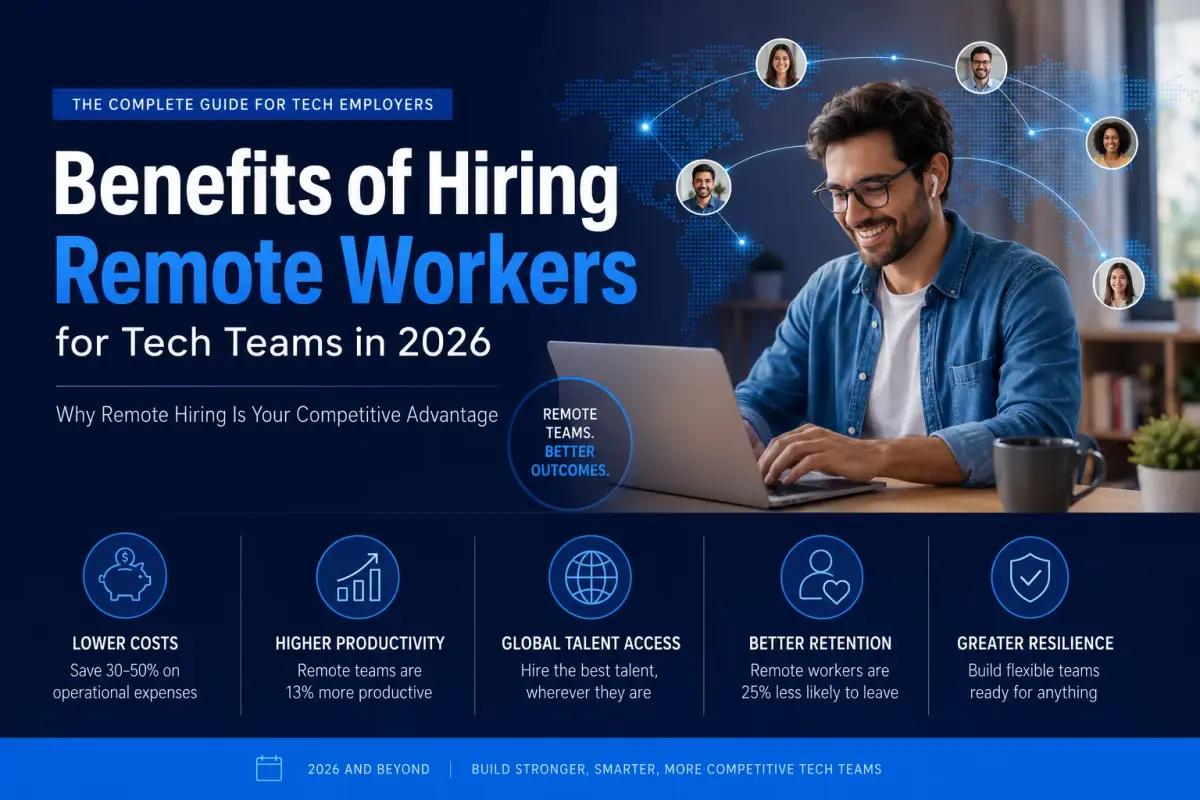
Hiring remote workers is no longer a risk management decision or a pandemic-era concession, it is the primary competitive advantage in tech talent acquisition in 2026. Companies that hire remotely access a global talent pool, reduce operational costs significantly, retain engineers longer, and build teams that outperform co-located equivalents on measurable productivity metrics. This guide covers the ten most significant benefits of hiring remote workers for tech teams, with specific data, actionable guidance, and what each benefit means for both employers building distributed teams and job seekers evaluating remote-first employers.
Why Do Companies Hire Remote Workers?
Companies hire remote workers to access a larger and higher-quality talent pool than local hiring allows, to reduce the operational costs of co-located teams, to increase employee productivity and retention, and to build organisational resilience that geographically concentrated teams cannot provide. In the tech industry specifically, remote hiring has become the default model for the most competitive employers, not because it is convenient, but because it consistently produces better outcomes on every metric that matters to a growing technology business.
The data on remote work outcomes is no longer anecdotal. Stanford economist Nicholas Bloom's research documented a 13 percent productivity increase among remote workers in controlled conditions. Global Workplace Analytics estimates that employers save an average of $11,000 per remote worker per year in reduced real estate, turnover, and absenteeism costs. IBM reported saving $50 million in real estate costs through distributed workforce programmes. Sun Microsystems documented $68 million in annual savings from remote work infrastructure.
These are not outlier results. They are the documented outcome of a structural shift in how technology work is organised, and they explain why the most competitive tech employers in 2026 default to remote hiring rather than treating it as an exception.
Benefit 1: Access to a Global Tech Talent Pool
Remote hiring eliminates the geographic constraint that is the single biggest limitation in tech talent acquisition, allowing employers to hire the most qualified candidate for every role, regardless of where they live, rather than the most qualified candidate within commuting distance.
The global shortage of tech talent is severe and structural. There are an estimated 4.8 million unfilled cybersecurity positions worldwide. Developer shortages are documented across every major market. In specific specialisations, cloud security engineering, AI/ML engineering, senior DevOps, the talent deficit in any single city or region is so significant that local-only hiring frequently cannot fill open roles at all, regardless of how long the position remains open or how much compensation is offered.
Remote hiring solves this directly. A company based in Manchester can hire the best React developer in Warsaw, the strongest DevOps engineer in Buenos Aires, and the most qualified cybersecurity analyst in Nairobi, simultaneously, without any of them relocating. The hiring pool expands from thousands of candidates within commuting distance to millions of candidates globally.
The competitive implication is significant. Employers who restrict hiring to local candidates compete for the same small pool as every other local employer. Employers who hire remotely compete in a global market where the strongest candidates are still available — they are simply located somewhere else.
For tech job seekers: The global talent pool cuts both ways. Remote hiring means you are competing with a larger applicant pool for every role — but it also means you have access to opportunities at companies that would never have been geographically accessible before. A developer in Lagos, a designer in Manila, or a DevOps engineer in Karachi can apply to and win roles at Shopify, GitLab, Stripe, or Cloudflare, companies they could never have worked at under a co-located model.
Benefit 2: Significant and Measurable Cost Reduction
Remote hiring reduces employer costs on three major dimensions simultaneously: real estate and office infrastructure, hiring and onboarding, and employee turnover, producing total savings that Global Workplace Analytics estimates at $11,000 per remote worker per year on average, with higher figures for senior tech roles.
Real estate and office costs are the most immediate and largest savings. Office space in major tech hubs, San Francisco, London, New York, Toronto, Amsterdam, costs $10,000 to $25,000 per employee per year in rent alone, before utilities, furniture, facilities management, and equipment provisioning. A 50-person engineering team in San Francisco occupies roughly $750,000 to $1,250,000 of annual real estate cost. Remote-first companies redirect that capital into compensation, tooling, and talent acquisition, a reallocation that makes them more competitive in all three areas simultaneously.
Hiring cost reduction comes from two sources. First, remote hiring eliminates relocation expenses, which for senior tech hires can reach $20,000 to $50,000 per candidate. Second, remote roles fill faster because the qualified candidate pool is larger, reducing the cost of vacancy, which for a senior engineer earning $180,000 annually costs approximately $15,000 per month in lost productivity and team friction.
Turnover cost reduction is the largest and most underappreciated saving. Remote workers report higher job satisfaction, better work-life balance, and stronger sense of autonomy than co-located equivalents. The result is measurably lower voluntary turnover. Replacing a senior tech employee costs 1.5 to 2 times their annual salary, a $180,000 engineer costs $270,000 to $360,000 to replace when recruiter fees, onboarding time, productivity ramp, and team disruption are fully accounted for. Even a modest improvement in retention compounds into significant savings over a three-to-five-year period.
For tech job seekers: Understanding the cost structure of remote versus co-located employment helps you negotiate more effectively. Remote-first employers who have eliminated or reduced their office footprint have more compensation budget to allocate to salaries. When evaluating a remote offer, ask whether the company has reduced its office costs through remote hiring; the answer often predicts how competitive the compensation package will be.
Benefit 3: Higher Productivity Among Remote Tech Professionals
Remote tech workers consistently demonstrate equal or higher productivity than co-located equivalents, with documented performance gains driven by fewer interruptions, greater control over working environment, and the ability to schedule deep work during personal peak productivity hours.
Stanford economist Nicholas Bloom's landmark study documented a 13 percent productivity increase among remote workers compared to office-based counterparts. A 2023 Upwork study found that 61 percent of remote workers reported increased productivity working from home. Among hiring managers, 68 percent reported that remote work was going better than expected after initial transitions, a significant shift from early scepticism.
For tech work specifically, the productivity gains are structural rather than situational. Software development, system architecture, security analysis, and design work are all deep work disciplines, they require extended periods of uninterrupted cognitive focus to produce high-quality output. Office environments, by contrast, are structurally hostile to deep work: open plan layouts, informal interruptions, meeting culture, and ambient noise all fragment the focus that complex technical work requires.
Remote tech professionals who build effective home office environments and structured work routines eliminate these interruptions by design. The best remote developers, DevOps engineers, and security professionals report consistently producing their highest-quality work in longer, uninterrupted blocks that office environments cannot reliably provide.
For tech job seekers: Demonstrating your productivity system is a competitive advantage in remote job applications. In interviews, describe your workspace, your deep work structure, your notification management, and your self-management approach explicitly. Employers who understand the productivity research value candidates who have deliberately built the conditions for high-output remote work.
Benefit 4: Superior Talent Retention
Remote work is one of the strongest retention factors in the technology industry, with employees in remote roles reporting significantly higher job satisfaction and lower intent to leave than equivalent co-located roles, producing measurable retention improvements that directly reduce the most expensive line item in tech talent management.
Location flexibility consistently ranks among the top three factors tech professionals consider when evaluating job opportunities, behind compensation and role scope, and ahead of company prestige and benefits. Once experienced, remote work creates a strong preference that most professionals will not willingly give up. Employers who offer genuine remote work retain their tech talent against offers from competitors who require office attendance, a structural retention advantage that compounds over time.
Alpine Access documented a 90 percent reduction in customer complaints and an 88 percent reduction in employee turnover after shifting to remote operations. While not a pure tech company, these figures represent the retention impact of remote work at scale and are consistent with patterns documented across technology employers.
The retention advantage is particularly significant at the senior engineer level. Senior developers, DevOps professionals, and security engineers who have remote-first careers actively avoid returning to office-required roles, even for salary premiums. The flexibility is valued at a level that cash compensation alone cannot easily overcome. For employers, this means that building a genuinely remote-first culture is one of the highest-return retention investments available.
For tech job seekers: Understanding retention data strengthens your negotiating position. If you are currently in a remote role with a genuine remote-first employer, you have leverage, your employer knows that replacing you with a qualified remote candidate will take months and cost significantly more than retaining you with a competitive raise. Use FarCoder's Salary Raise Calculator to model your market value before any retention conversation → farcoder.com/tools/salary-raise-calculator
Benefit 5: Access to Diverse Perspectives and Global Expertise
Remote hiring produces workforce diversity that local hiring cannot, geographic, cultural, and experiential diversity that directly improves technical decision-making, product quality, and the ability to serve global markets.
Technology companies building products for global audiences benefit structurally from teams that reflect those audiences. A security team with members in Eastern Europe, Southeast Asia, and Latin America brings contextual threat intelligence that a homogeneous domestic team cannot access. A product team with designers across three continents produces interfaces that work for global users rather than those optimised for one cultural context. A backend team distributed across time zones spots edge cases in multi-currency, multi-language, and multi-regulatory systems that co-located engineers working in a single market frequently miss.
Beyond product quality, diverse distributed teams demonstrate measurably better problem-solving performance. McKinsey's research consistently shows that companies in the top quartile for team diversity outperform industry medians on profitability. The mechanism is well-documented: diverse teams avoid groupthink, challenge assumptions more rigorously, and generate more creative solutions to complex problems, all capabilities that are structurally important in technology development.
For tech job seekers: Geographic and cultural diversity in a distributed team is a signal of remote-first maturity. Teams with members across multiple continents have invested in async communication infrastructure, documentation standards, and cultural adaptability that makes them better remote employers than teams where "remote" means working from home in the same city.
Benefit 6: Around-the-Clock Coverage Without Shift Premiums
Distributed remote tech teams that span multiple time zones provide continuous operational coverage, for customer support, security monitoring, system reliability, and incident response, without the shift premiums, burnout risk, and talent challenges of rotating on-call schedules in co-located environments.
For cybersecurity teams specifically, 24/7 coverage is not optional, it is a security requirement. Cyber threats do not observe business hours. A SOC analyst team distributed across UTC+5 (Karachi), UTC+1 (London), and UTC-5 (New York) provides genuine around-the-clock monitoring with natural shift handoffs aligned to each team member's working day. No one is working at 3am. No shift premium is required. The coverage is structurally built into the geographic distribution of the team.
The same principle applies to site reliability and DevOps teams. Production systems require monitoring and incident response capability at all hours. Remote DevOps teams distributed across time zones provide that coverage without the operational and human cost of mandated overnight shifts. When an incident surfaces at 2am UTC, it is 7am for the team member in Karachi, a normal working hour, not an emergency call-out.
For tech employers: Time zone coverage is one of the most practically valuable and least discussed benefits of remote tech hiring. When evaluating distributed team structures, map your team's time zones explicitly against your SLA requirements and incident response targets. The right geographic distribution can eliminate your on-call overnight burden entirely — a significant quality-of-life improvement for your engineering team that directly improves retention.
Benefit 7: Faster Hiring and Shorter Time-to-Productivity
Remote hiring fills open tech positions faster than local-only hiring because the qualified candidate pool is larger, reducing the average time-to-hire and the costly productivity gap that open positions create in tech teams.
The average time to fill a senior software engineering role through local-only hiring in major tech hubs is four to six months, driven by the small pool of qualified candidates willing to commute to that location. The same role posted as remote typically fills in six to ten weeks because the qualified pool is global. That difference represents two to four months of lost productivity, team friction, and competitive disadvantage for every senior hire.
Remote hiring also eliminates relocation timelines. A local hire that requires the candidate to relocate adds four to twelve weeks to the start date after offer acceptance. A remote hire can start within two to four weeks of offer acceptance, no relocation negotiation, no city move, no apartment search. The role is filled and the team is productive faster.
For tech employers: Speed in remote hiring requires deliberate process design. Define your evaluation criteria before posting, move candidates through your process on a defined timeline, and make offers within 48 hours of your final interview. The candidates you want have multiple simultaneous offers, slow processes consistently lose strong candidates to faster-moving employers regardless of how competitive your package is.
Benefit 8: Improved Organisational Resilience
Distributed remote teams are inherently more resilient to local disruptionsl, natural disasters, infrastructure failures, public health events, and geopolitical instability, than co-located teams whose operations depend on a single physical location.
The 2020 pandemic compressed a decade of remote work adoption into eighteen months, forcing every co-located company to discover simultaneously that distributed operations were technically feasible. Companies that had already built remote-first infrastructure maintained full operational continuity. Companies that had not scrambled to build it under pressure.
Beyond pandemic scenarios, the resilience argument applies to a wider range of disruptions. A hurricane that shuts down a Gulf Coast city affects a co-located team completely and a distributed team minimally, the affected team members work from a temporary location while the rest of the team continues uninterrupted. A power infrastructure failure, a regional internet outage, or a local civil disruption all have contained impact on a geographically distributed team.
For technology companies whose products and services are expected to maintain availability regardless of local conditions, building the team that supports those systems with geographic distribution is a straightforward risk management decision with significant operational and reputational upside.
Benefit 9: Stronger Employer Brand and Talent Attraction
Offering genuine remote work positions a tech employer as modern, trust-based, and employee-centric, attributes that are among the most powerful talent attraction signals in the current market, particularly for senior and specialised tech professionals.
Senior engineers, security specialists, and DevOps professionals with multiple years of experience do not need to accept roles that require office attendance. They have options. When evaluating employers, these candidates filter by remote-first credibility before evaluating compensation, technology stack, or company mission. Employers who offer genuine remote work, not hybrid-with-caveats or remote-until-we-change-our-minds, attract the strongest senior candidates from the widest possible pool.
The employer brand benefit compounds over time. Remote-first companies attract candidates through inbound channels, candidates who have heard from colleagues, read about the company's distributed culture, or seen its leadership contribute to remote work discourse, without paying the acquisition cost of outbound recruiting. GitLab, Automattic, and Buffer all attract thousands of inbound applications annually in part because their remote-first culture is well-documented and widely respected.
For tech job seekers: Evaluating an employer's remote-first credibility before applying saves significant time. Look for public documentation of remote culture, handbooks, blog posts, distributed team structures, and leadership commentary on remote work. Companies that talk about remote work publicly are making a commitment. Companies that offer "remote" without any cultural infrastructure around it are remote-allowed at best.
Benefit 10: Better Work-Life Integration Drives Better Outcomes
Remote work improves employee wellbeing by eliminating commutes, enabling schedule flexibility, and allowing professionals to integrate personal responsibilities without sacrificing professional performance, and the research consistently shows that employees with better work-life integration produce higher-quality work over longer periods.
The average US commute is 27 minutes each way, 54 minutes per day, 4.5 hours per week, 225 hours per year. For remote employees, that time is recovered. Some use it for exercise. Some use it for family. Some extend their focused work time. All of them report the elimination of commute as one of the most significant quality-of-life improvements from remote work, and all of them demonstrate lower burnout rates than equivalent commuters.
For tech employers, the wellbeing benefit translates directly into performance. Engineers who are not exhausted by commutes, who can take a 20-minute walk when they need to reset their focus, who can attend a child's school event without taking half a day of leave, and who can structure their day around their own peak productivity hours produce better code, make better architectural decisions, and resolve incidents faster than their equivalents running on commute fatigue and rigid scheduling.
The long-term performance case for employee well-being is well-established. Burned-out engineers make more errors, produce lower-quality output, communicate less effectively, and leave sooner. Remote work, particularly in genuinely remote-first environments, is one of the most structurally effective burnout prevention strategies available to tech employers.
Stanford economist Nicholas Bloom's research on remote work productivity and the Global Workplace Analytics annual remote work cost-benefit analysis are the two most comprehensive data sources available for employers building the business case for permanent distributed operations.
Common Employer Objections to Remote Hiring — Addressed Directly
"How do I know my remote team is actually working?"
Output-based management replaces proximity-based management in remote-first environments. Define deliverables, set measurable outcomes, and evaluate performance on what is produced, not when or where it is produced. Remote teams that are managed on output rather than activity consistently outperform co-located teams managed on presence.
"Won't my team lose the collaboration and innovation that comes from being together?"
Remote-first companies like GitLab, Automattic, and Shopify ship products that compete with, and frequently outperform, co-located competitors. Collaboration in distributed teams is different, not absent. Async documentation, collaborative design tools, recorded architecture discussions, and deliberate team connection rituals replace hallway conversations, and in many cases produce better documentation and more thoughtful decisions.
"What about onboarding? How do I integrate remote hires effectively?"
Structured remote onboarding, documented processes, scheduled introductions, clear 30-60-90 day milestones, and assigned mentors or onboarding buddies, produces remote hires who reach full productivity faster than many co-located onboarding programmes. The key is investing in the documentation and structure upfront rather than assuming new hires will absorb knowledge through physical proximity.
"How do I build team culture without a shared office?"
Remote culture is built through deliberate rituals, not physical co-location. Regular async team check-ins, virtual social events, annual in-person retreats, transparent communication, and genuine recognition practices build stronger team cohesion than office environments that rely on forced proximity. The companies with the strongest remote cultures invest in them as actively as co-located companies invest in their offices.
How to Start Hiring Remote Tech Talent on FarCoder
FarCoder connects remote tech employers with verified professionals across every specialisation, frontend developers, backend engineers, full stack developers, DevOps and cloud engineers, cybersecurity analysts, designers, mobile developers, blockchain developers, and data professionals.
Every candidate who finds your listing on FarCoder is a tech professional actively building a remote career, not a general job seeker who clicked "remote" as a filter. The signal-to-noise ratio of your applicant pool is fundamentally different from general job boards.
Post your remote tech role on FarCoder → farcoder.com
Find the Remote Tech Employer That Means It
Not every company that posts a remote role is genuinely remote-first. The benefits in this guide, global talent access, cost savings, productivity gains, retention, resilience, are all produced by companies that have built remote work into their operations structurally, not those that offer it as a perk.
FarCoder verifies remote roles before listing them. Every position on FarCoder is a genuine remote opportunity with an employer who has committed to distributed hiring.
Browse verified remote tech jobs by your specialisation:
-
Remote Frontend Developer Jobs → farcoder.com/remote-frontend-developer-jobs
-
Remote Backend Developer Jobs → farcoder.com/remote-backend-developer-jobs
-
Remote Full Stack Developer Jobs → farcoder.com/remote-full-stack-developer-jobs
-
Remote DevOps Jobs → farcoder.com/remote-devops-jobs
-
Remote Cybersecurity Jobs → farcoder.com/remote-cybersecurity-jobs
-
Remote Design Jobs → farcoder.com/remote-design-jobs
-
Remote Mobile Developer Jobs → farcoder.com/remote-mobile-developer-jobs
-
Remote Data and Analytics Jobs → farcoder.com/remote-data-and-analytics-jobs
-
Remote Blockchain Developer Jobs → farcoder.com/remote-blockchain-developer-jobs
Frequently Asked Questions (FAQ)
What is the biggest benefit of hiring remote workers for a tech company?
+−
Access to global talent is the single most impactful benefit for most tech employers, eliminating the geographic constraint that limits local hiring to a fraction of the available qualified talent pool. For specialised roles like cloud security engineering, AI/ML development, and senior DevOps, the difference between local and global hiring is frequently the difference between filling the role in eight weeks and leaving it open for eight months.
Do remote tech workers actually cost less than office-based employees?
+−
Yes, on a total cost basis. Global Workplace Analytics estimates savings of $11,000 per remote worker per year across real estate reduction, lower turnover, and reduced absenteeism. For senior tech roles, the savings are higher, reduced office infrastructure cost, eliminated relocation expenses, and improved retention each contribute significantly. The question is not whether remote hiring costs less; it does, but how those savings are allocated between employer margin and employee compensation.
How do I measure productivity for remote tech workers?
+−
Define output-based metrics before your remote hire's first day. For engineers, these include pull request velocity, code review quality, ticket completion against estimates, and incident response time. For designers, deliverable completion against sprint goals and stakeholder feedback scores. For DevOps, system uptime, deployment frequency, and mean time to recovery. Remote productivity is measured by what is produced, not when the person was online.
What tools do I need to manage a remote tech team effectively?
+−
At minimum, a project management platform (Linear, Jira, or Asana), a documentation system (Notion or Confluence), a communication platform (Slack or Discord), a version control system (GitHub or GitLab), and a video communication tool (Zoom or Google Meet). Remote-first companies add async video (Loom) and collaborative design tools (Figma) for the roles that require them. The tooling investment is a fraction of the office cost it replaces.
How is FarCoder different from general job boards for hiring remote tech talent?
+−
FarCoder is exclusively remote and exclusively tech. Every job seeker on FarCoder is a tech professional actively seeking remote work; there are no general job seekers, no irrelevant applications, and no candidates who selected "remote" as a filter on a general board without genuine remote work experience. The quality and relevance of your applicant pool from FarCoder is structurally different from any general job board.
About the Author

Muhammad Mansoor Ishaq
**Muhammad Mansoor Ishaq** is the Co-Founder of FarCoder and an experienced web developer specializing in WordPress, Shopify, Wix, and Squarespace. In addition to his technical expertise, he is a regular contributor to FarCoder’s blog, where he writes about remote work, software development careers, web development, freelancing, digital transformation, workplace productivity, hiring trends, and the future of distributed teams. Drawing from both hands-on industry experience and ongoing research, Muhammad creates practical, insightful content that helps job seekers, developers, and employers succeed in an increasingly remote-first world. His work focuses on bridging the gap between technology, talent, and modern work opportunities across global markets.
Connect on LinkedIn